















In Stock
Retort Clamp for Condenser
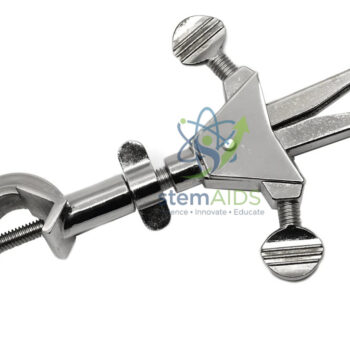
Reinforced Four-Prong Design: Features a wide-span, four-finger jaw system that provides multiple points of contact, ensuring a rock-solid, balanced grip on wide-diameter condensers.
Superior Load Bearing: Constructed from high-tensile die-cast zinc alloy or heavy-duty aluminum, finished with a chemical-resistant chrome or epoxy coating to prevent corrosion from acidic vapors.
$2.82
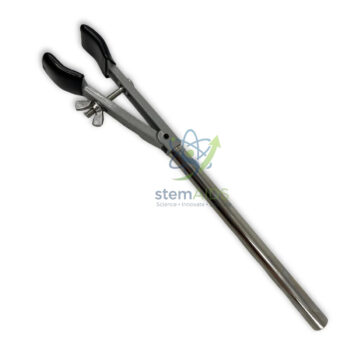
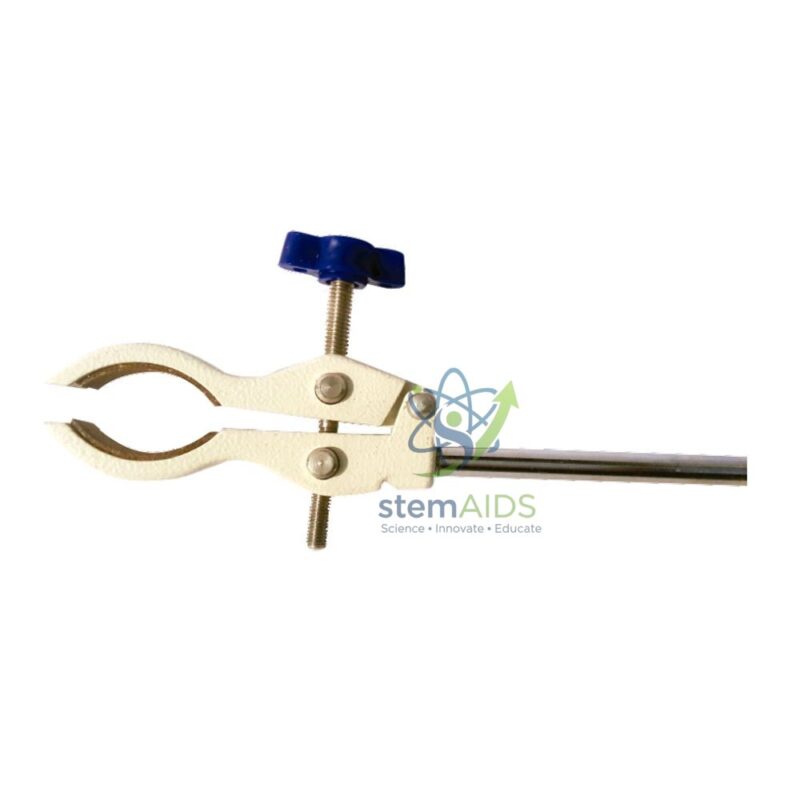
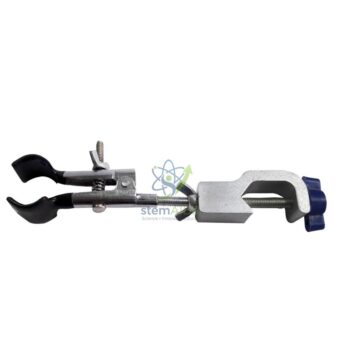
Quick Answer: The Retort Clamp for Condenser is a two-jaw clamp on a rod whose wide, curved jaws open far enough to grip a condenser’s outer jacket. The listing image shows a cream coloured body with the jaws closed by a blue wing screw; it attaches to a retort stand through a boss head.
Built Around the Condenser Jacket
Condensers are the widest straight parts of most distillation and reflux assemblies, and a clamp sized for burettes rarely opens far enough to hold them securely. The retort clamp for condenser has jaws curved to follow the jacket, so it closes around it instead of pinching it at two points. The wing screw sets the grip.
The clamp should hold the condenser at the jacket’s middle, clear of the water side-arms, and it should be tightened last. Set the flask and still head first, bring the condenser up to the joint, and only then close the jaws, so the condenser settles in line with the joint rather than being pulled toward the clamp.
It suits a Liebig condenser sloping down in a distillation or an Allihn condenser standing upright for reflux. For a body that will not rust on damp benches, see the brass condenser clamp with dip-coated jaws.
Care & Handling
- Close the retort clamp for condenser last, after the joints are seated.
- Keep the jaws clear of the water hoses so the tubing is not pinched.
- If the jaws are unlined, cushion them before clamping glass.
Specifications
| Type | Retort clamp for condensers |
| Jaws | Wide, curved (as pictured) |
| Closure | Wing screw |
| Body | Cream coloured in the listing image |
| Mounting | Rod, used with a boss head |
| Jaw opening | Confirm at enquiry |
Applications
- Holding the condenser in simple and fractional distillation
- Supporting a reflux condenser upright above a round-bottom flask
- Holding the condenser on a Soxhlet extractor
- Holding wide glass tubes such as drying columns
Why Choose LabEquip
Every distillation or reflux station needs a condenser clamp as well as a flask clamp, so labs usually buy them in the same numbers as stands. LabEquip lists this design in its General Lab Products range; contact us to check the jaw opening against your condensers.
Frequently Asked Questions
Why not use a burette clamp to hold a condenser?
Burette clamps are sized for narrow tubes and may not open wide enough for a condenser jacket, or may grip it at only two narrow points. A condenser clamp opens wider and follows the curve of the jacket.
In what order should a distillation be clamped?
Clamp the flask at its neck first, fit the still head, then bring the condenser to the joint and close its clamp last. That lets the condenser settle in line with the joint.
Where on the condenser should the clamp go?
Near the middle of the jacket. Keep it away from the inlet and outlet side-arms, which are fragile, and from the joints at each end.
Should the condenser clamp be very tight?
No. It only needs to stop the condenser slipping. A clamp tightened hard onto glass that then warms up can crack the jacket.
Can this clamp be used for reflux?
Yes. For reflux the condenser stands vertically above the flask, and the clamp holds the jacket directly above the flask neck.
Which condenser types does it fit?
Liebig, Allihn and coil condensers all have a cylindrical outer jacket that a condenser clamp can hold, provided the jacket diameter is within the jaw opening.
Last Updated: September 2026
You must be logged in to post a review.
Bestsellers




Reviews
There are no reviews yet.