


In Stock
Retort Clamp, 3 Finger, Dip Coating
3-Finger "Tripod" Grip: Provides three points of contact to securely hold objects of various shapes and sizes, ensuring a balanced and wobble-free setup.
Superior Chemical Dip Coating: The fingers are encased in a thick, durable, and non-slip plastic coating that is highly resistant to acids, bases, and common laboratory solvents.
₹240.00
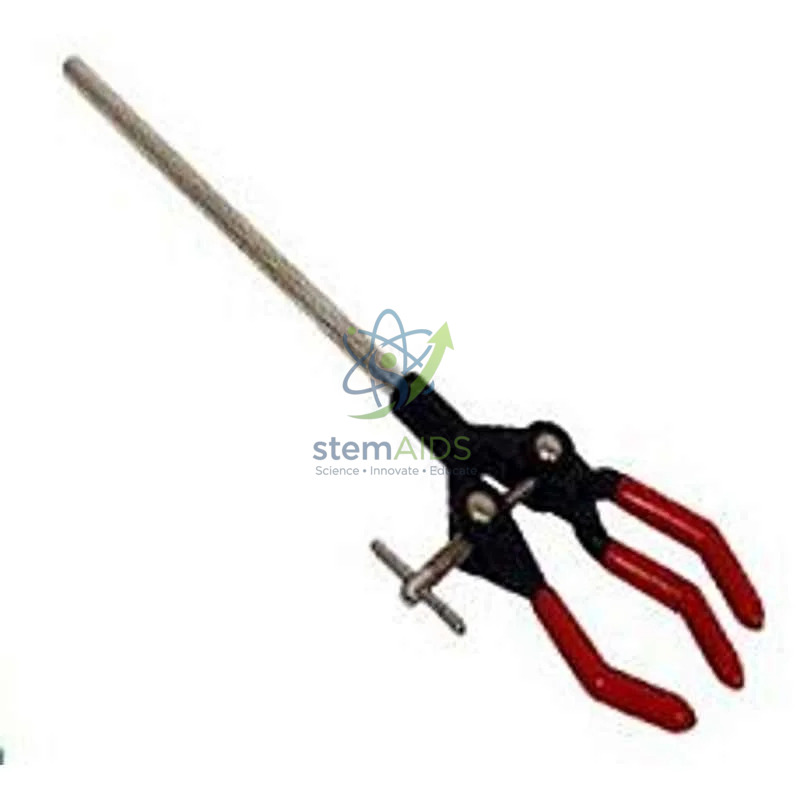
Quick Answer: The Retort Clamp, 3 Finger, Dip Coating is a three finger retort clamp whose fingers are covered in a red plastic dip coating and closed by a T-screw. It grips round flask necks, condensers and columns at three points, and fits a retort stand through a boss head.
Three-Point Grip with Dip-Coated Fingers
The usual three-finger layout has two fingers on one side and one on the other. As the screw closes, the single finger presses the neck into the pair, so the glass is held at three points around its circumference and cannot roll. That is why three-finger clamps are the standard choice for round-bottom flasks, which sit awkwardly in two-prong jaws.
On this clamp the fingers are dip coated, meaning dipped in liquid plastic to form a thick, continuous covering. The coating grips glass, spreads the pressure and cannot slide along the finger as a loose sleeve can. The trade-off is heat: plastic coatings soften, so the clamp should hold the neck above the heat zone, not near the mantle or flame. The photograph shows a black body and a T-screw, which is easy to close firmly with one hand.
Where finger covers need renewing often, the three finger clamp with rubber sleeves uses push-on sleeves instead.
Specifications
| Type | Three finger retort clamp |
| Fingers | Three, red dip coated (as pictured) |
| Closure | T-screw |
| Body | Black in the listing image |
| Mounting | Rod, used with a boss head |
| Opening range | Confirm at enquiry |
Applications
- Holding round-bottom flasks at the neck during reflux and distillation
- Supporting conical flasks and bottles during gas generation
- Holding condensers, chromatography columns and wide tubes
Care & Handling
- Position the clamp on the neck, well above the heating zone.
- Tighten the T-screw until the flask cannot rotate, then stop.
- Inspect the coating for cuts; a split coating can peel and expose metal.
- Clean the coating with water and mild detergent, not solvents.
Why Choose LabEquip
Organic chemistry teaching labs put a three-finger clamp on nearly every stand, and dip-coated fingers need little upkeep. LabEquip lists this clamp in its General Lab Products range; contact us for class quantities.
Frequently Asked Questions
How do three fingers hold a round flask?
Two fingers on one side and one opposite press the neck from three directions. The flask is gripped at three points around its circumference, so it cannot roll or tilt.
What is the advantage of dip coating over rubber sleeves?
A dip coating is a continuous layer bonded to the finger, so it cannot slide off or be lost. Rubber sleeves can be replaced when worn but sometimes slip along the finger.
Can the coating melt?
Plastic coatings soften when hot. Clamp the flask at the neck, above the heat source, and keep the fingers away from flames.
What can the clamp hold besides flasks?
Condensers, columns, wide test tubes, bottles and other round items within its opening range. The three-point grip works on any cylinder.
Why use a T-screw?
A T-shaped handle gives more leverage than a small thumbscrew, so the clamp is easy to close firmly with one hand. The same leverage makes overtightening easy, so stop once the glass is held.
Which solvents damage the coating?
Many plastic coatings are softened by strong organic solvents such as acetone, chloroform and toluene. Wipe off solvent spills promptly and do not soak the clamp.
Last Updated: September 2026
You must be logged in to post a review.
Bestsellers






Reviews
There are no reviews yet.