











In Stock
PTFE SCT1/2 temperature probe
₹2,305.00
Quick Answer: The PTFE SCT1/2 Temperature Probe is a PTFE temperature probe, listed under the code SCT1/2, that plugs into an SCT1-type temperature controller mounted on a hotplate stirrer. Its PTFE sheath lets it sit in acids, alkalis and other corrosive liquids that would attack a bare stainless steel probe.
Why Choose a PTFE Sheath
Temperature probes for hotplate stirrers are usually made with a stainless steel sheath, which is fine for water, oils and most solvents. Hot mineral acids, chloride solutions and strong oxidisers are another matter: they can pit stainless steel and contaminate the sample with metal ions. PTFE (polytetrafluoroethylene) resists almost all laboratory chemicals, which is why a PTFE-sheathed probe is the standard choice for corrosive or trace-metal-sensitive work.
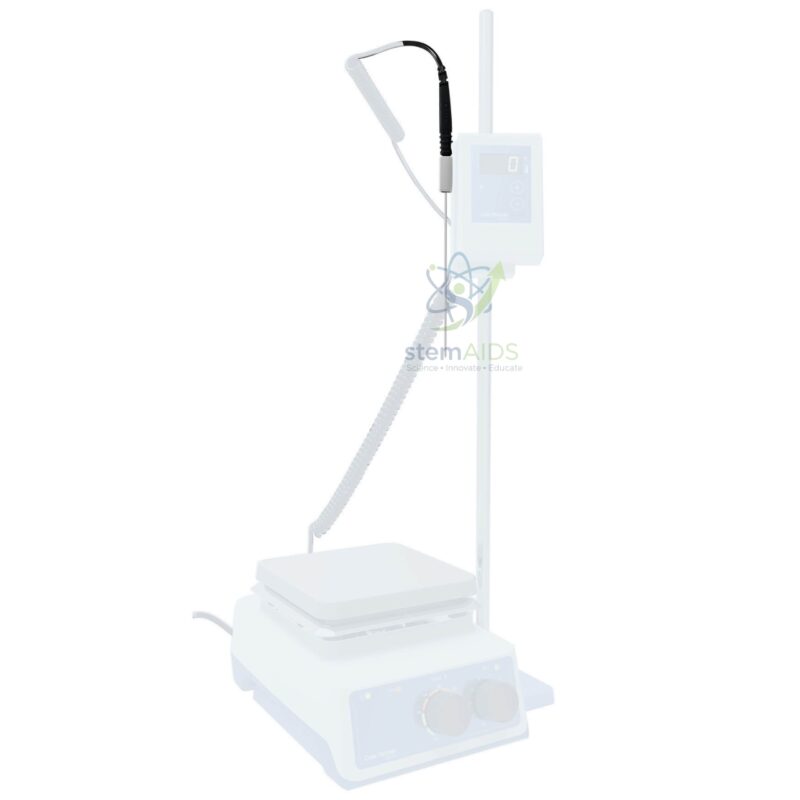
The code SCT1/2 identifies this probe as a companion to an SCT1 temperature controller. In the listing photograph the whole set-up is shown faded in the background: a hotplate stirrer, an upright support rod, a small controller box on the rod, and the probe, highlighted, curving down into the vessel. The controller reads the probe and switches the hotplate’s heating to hold the liquid at the setpoint.
PTFE conducts heat less well than steel, so a PTFE-sheathed probe responds a little more slowly to temperature changes. For most heating tasks this lag is small, but it is worth allowing a little extra time before reading a stable value. Length and connector details are not stated in the listing.
Applications
- Controlling the temperature of acid digestions or etching solutions on a hotplate stirrer
- Heating chloride-rich or saline solutions without corroding the probe
- Temperature control where metal contamination of the sample must be avoided
Specifications
| Product type | PTFE-sheathed temperature probe |
| Listed code | SCT1/2 |
| Used with | SCT1-type temperature controller on a hotplate stirrer |
| Mounting shown in photo | Controller on an upright rod, probe dipping into vessel |
| Length and connector | Confirm at enquiry |
Care & Handling
- Mount the controller and probe on a rod such as the SR1 static stem
- Avoid cutting or scratching the PTFE sheath; a damaged sheath lets liquid reach the sensor
- Keep the cable away from the heated plate
- Rinse the probe with water after use in corrosive liquids and dry it
Why Choose LabEquip
The PTFE probe is ordered by labs that heat acids, saline media or trace-metal samples on hotplate stirrers fitted with an SCT1 controller. LabEquip can confirm compatibility with your controller and supply the probe with a support stem from our general lab products range; contact us with your controller model.
Frequently Asked Questions
Why use a PTFE temperature probe instead of stainless steel?
PTFE resists almost all lab chemicals, including hot acids and chloride solutions that corrode stainless steel. It also avoids metal contamination of the sample.
What controller does the SCT1/2 probe work with?
The code links it to an SCT1-type temperature controller. Check that your controller model is SCT1 or a compatible type before ordering.
Is a PTFE-sheathed probe slower to respond?
Slightly. PTFE conducts heat less well than steel, so allow a little more time for the reading to settle after a temperature change.
Can the probe be used in organic solvents?
Yes. PTFE is resistant to common organic solvents. Keep the cable and controller away from solvent vapour and heat.
How do I stop the probe floating or moving?
Clamp it to an upright rod so the tip stays submerged at a fixed depth, clear of the stir bar and the vessel wall.
What damages a PTFE sheath?
Cuts, sharp bends and scraping against stir bars or glass edges. Molten alkali metals and fluorine gas also attack PTFE, but these are rare in teaching labs.
Last Updated: September 2026
You must be logged in to post a review.
Bestsellers




Reviews
There are no reviews yet.