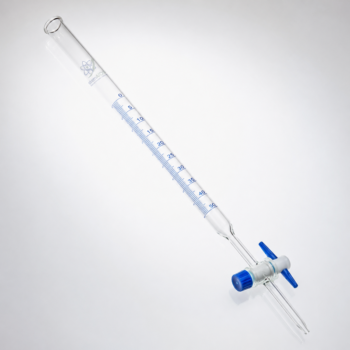
The Scientific Specific Gravity Bottle is a fixed-volume laboratory vessel used for determining the density or relative density of liquids by controlled weighing. It is intended for chemistry, pharmaceutical, research, quality-control, college, and university laboratories where users need a simple gravimetric method for comparing liquid mass at a known volume.
Product Description
The STEMAids Scientific Specific Gravity Bottle is intended for density and specific-gravity measurements using a known bottle volume. In a typical procedure, the clean bottle is weighed empty, filled with a reference liquid or test sample, brought to the required temperature, and weighed again. The resulting mass data are used for density or relative-density calculations.
Specific gravity bottles commonly use a close-fitting stopper, often with a capillary opening that allows excess liquid to escape and helps establish a repeatable filled volume. The exact STEMAids capacity, glass grade, stopper design, calibration temperature, tolerance, capillary bore, and dimensions are . Related products can be sourced through Laboratory Glassware and General Lab Products.
Key Features
- Designed for density measurement: Supports gravimetric determination of liquid density and relative density.
- Fixed-volume principle: Uses a known internal volume for mass-to-volume calculations.
- Suitable for comparative testing: Can compare the mass of a sample with an equal volume of reference liquid.
- Capillary stopper concept: Where fitted, the stopper opening allows excess liquid to escape during filling.
- Manual operation: Requires no electronic sensing system; measurements are performed with a suitable laboratory balance.
- Reusable laboratory format: Can be cleaned and reused when compatible with the sample and confirmed glass specification.
- Critical specifications: Capacity, calibration temperature, tolerance, glass grade, and stopper design are .
Technical Specifications
|
Specification |
Detail |
|
Product Name |
Scientific Specific Gravity Bottle |
|
Brand |
STEMAids |
|
Product Type |
Specific gravity bottle/pycnometer |
|
Primary Application |
Density and relative-density measurement of suitable liquids |
|
Product-Specific Certification |
None verified |
What’s Included in the Kit
- Scientific Specific Gravity Bottle
- Fitted stopper
- Thermometer
- Protective case or storage box
- Instruction or calibration sheet
Applications / Uses
- Determining density of suitable liquid samples.
- Determining relative density or specific gravity.
- Comparing a test liquid with distilled water or another reference liquid.
- Physical chemistry and analytical chemistry practicals.
- Quality-control testing where a pycnometric method is specified.
- Teaching relationships between mass, volume, density, and specific gravity.
How to Use the Scientific Specific Gravity Bottle
- Clean and dry the bottle and stopper thoroughly.
- Weigh the empty bottle according to the laboratory procedure.
- Fill the bottle with the reference liquid or test sample while avoiding trapped air bubbles.
- Insert the stopper carefully so excess liquid can escape through the capillary opening where applicable.
- Bring the filled bottle to the specified measurement temperature.
- Wipe the outside dry without removing liquid from the calibrated internal volume.
- Weigh the filled bottle using a suitable laboratory balance.
- Calculate density or relative density using the recorded masses, known volume, and approved analytical equation.
Safety note: Handle the glass bottle and stopper carefully and use appropriate PPE for the test liquid. Density is temperature dependent, so record and control temperature according to the selected method. Do not heat or autoclave the bottle unless its confirmed glass specification permits it.
Care & Maintenance
- Clean the bottle immediately after use to prevent residues from changing its effective volume or mass.
- Keep the stopper and capillary opening free from deposits and blockage.
- Allow the bottle to reach a stable temperature before precision weighing.
- Store the bottle and stopper together in a protected location to reduce breakage and mismatching.
Why Choose STEMAids
STEMAids supplies laboratory instruments, laboratory glassware, science kits, STEM models, and educational apparatus for institutional users. Its product range supports practical science education as well as general laboratory procurement. Buyers sourcing complementary density and analytical equipment can explore Chemistry Lab Equipment, Lab Experiment Practice Kits, and the complete STEMAids product catalogue.
Frequently Asked Questions
What is a Scientific Specific Gravity Bottle used for?
A Scientific Specific Gravity Bottle is used to determine the density or relative density of a liquid by weighing a known volume of the sample.
Is a specific gravity bottle the same as a pycnometer?
Yes. “Specific gravity bottle,” “density bottle,” and “pycnometer” are commonly used for fixed-volume laboratory vessels designed for density measurements.
How does a specific gravity bottle measure density?
The bottle is weighed empty and then filled with a known volume of liquid and weighed again. The liquid mass and known bottle volume are used to calculate density.
Why is there a capillary hole in the stopper?
In designs that use a capillary stopper, the opening allows excess liquid and some trapped air to escape when the stopper is inserted, helping establish a consistent filled volume.
Why is temperature important when using a density bottle?
Liquid density and the volume of the bottle vary with temperature. Measurements should therefore be made at a controlled and recorded temperature specified by the analytical method.
What capacity is the STEMAids Specific Gravity Bottle?
The nominal capacity is . Specific gravity bottles are manufactured in multiple capacities, so the exact STEMAids value should be verified before publication.