
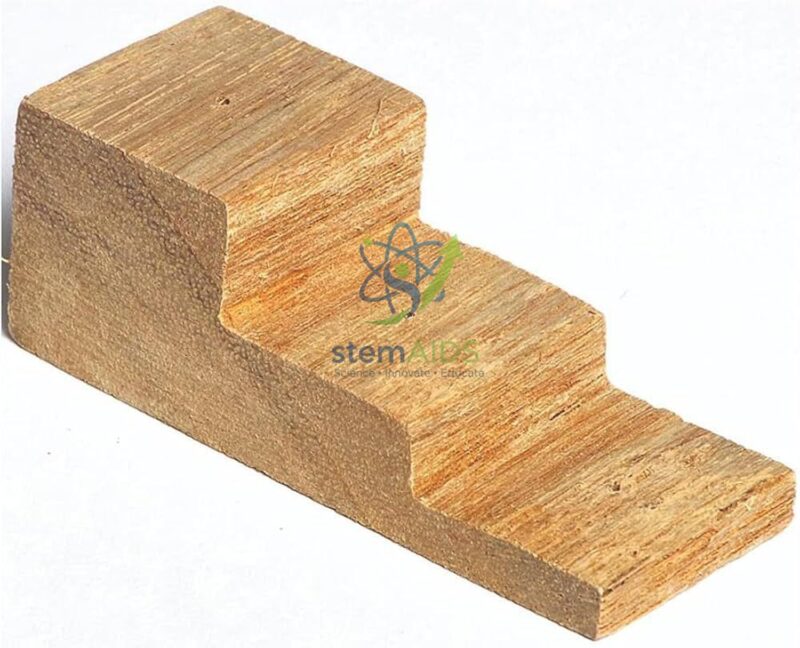
Quick Answer: A pinning block is a small stepped block of wood, as pictured, used in entomology to set the height of an insect and its labels on a pin. Using the steps in turn gives every specimen in a collection the same layout.
How a Stepped Block Standardises a Collection
An insect collection is easiest to study when specimens and labels sit at the same heights on every pin. Labels can then be read without lifting neighbouring specimens, and pins sit evenly in the box base. A stepped block makes this quick. Each step normally has a small hole drilled to a set depth: with the pin point pushed to the bottom of a hole, anything sliding on the pin, the insect or a label, comes to rest on that step’s surface, a fixed distance from the point.
In use, the tallest step sets the specimen height, the middle step the first data label and the lowest step the identification label. Teachers often keep one block per group so students can process their own specimens at the same time.
The block pictured is plain wood with three steps. Wood is easy to drill and does not blunt pin points. Hole arrangements vary between makers, so check the holes and step heights of this block with LabEquip if your collection follows a set layout.
Specifications
| Product | Pinning block (entomology) |
| As pictured | Plain wooden block with three steps |
| Purpose | Sets specimen and label heights on insect pins |
| Used with | Insect pins, data labels and collection boxes |
| Step heights and hole arrangement | Confirm at enquiry |
Applications
- Building school and college insect collections with uniform pin heights
- Field courses where students mount their own specimens
- Re-labelling or curating older collections to a consistent layout
- Mounting labels under specimens fixed on card points
Use & Care
- Push pins straight down into the holes; a bent pin gives uneven heights
- Keep the block dry, since damp wood swells and can grip pin points
- Clear broken pin tips from the holes with a fine wire
- Keep the block with the pins and labels so the kit stays together
Why Choose LabEquip
Biology departments and field-course leaders order pinning blocks with pins so students can mount and label specimens consistently. LabEquip’s general lab products range also covers collecting equipment such as the insect vacuum; request class quantities through the contact page.
Frequently Asked Questions
Why do all specimens need the same height on the pin?
Uniform heights keep labels readable and stop specimens catching on each other in a box. They also make it easier to handle pins with forceps without touching the insect.
How do I set the label heights?
Slide the label onto the pin, push the pin point into the hole on the middle step until it reaches the bottom, and the label is pushed level with that step. Repeat on the lowest step for the second label.
Can the block be used for insects mounted on card points?
Yes. The card point is fixed to the pin, and the block sets its height and the label heights in the same way as for a directly pinned insect.
What is a pinning block usually made of?
Wood is the usual material because it drills cleanly and is gentle on pin points. Plastic and metal versions also exist, with the same stepped design.
Do I need one block per student?
Not necessarily. A block is used for a few seconds per specimen, so one per small group usually works. During intensive collecting sessions, more blocks reduce waiting.
What else is needed to start an insect collection?
Insect pins, a stepped block, a setting board for butterflies and moths, a killing jar, labels and a closed storage box. A relaxing container helps with specimens that have dried out.
Last Updated: October 2026




Reviews
There are no reviews yet.