





In Stock
Magnetic Stir Bars
$4.51
Quick Answer: Magnetic stir bars are small bar magnets sealed in a smooth, chemically resistant coating. Dropped into a beaker or flask standing on a magnetic stirrer, they spin with the drive and mix the liquid, so solutions can be dissolved, stirred during a titration or kept evenly suspended without a glass rod.
How a Stir Bar Follows the Stirrer Drive
Beneath the top plate of a magnetic stirrer, a motor turns a pair of magnets, or in some designs a ring of coils produces a rotating field. A stir bar lying in the liquid above lines up with that field and turns with it, drawing the liquid into a vortex. Nothing passes through the neck of the vessel, so a flask can stay covered with foil or a stopper, and there is no paddle or shaft to wash or to carry contamination between samples.
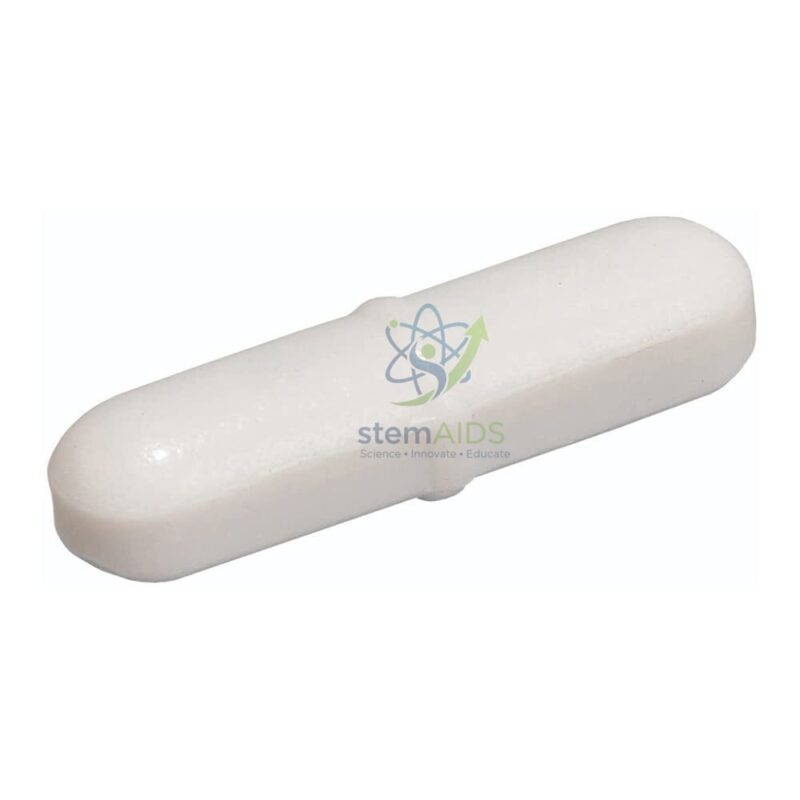
The listing photograph shows a white, capsule-shaped bar with a raised pivot ring around its middle, on which the bar balances as it turns. White bars of this kind are normally coated with PTFE (polytetrafluoroethylene), a plastic that resists most laboratory reagents; the coating and the lengths supplied in the set should be confirmed with the order.
Specifications
| Item | Magnetic stir bars (stirring magnets) |
| Shape shown | Capsule form with a central pivot ring |
| Coating | White chemically resistant coating as pictured; PTFE is the usual material |
| Drive | Any magnetic stirrer or stirring hotplate |
| Suitable vessels | Flat-bottomed beakers, conical flasks and media bottles |
| Lengths and number of bars | Confirm at enquiry |
Applications
- Dissolving weighed salts when making up standard solutions and buffers in chemistry and biology practicals
- Stirring the conical flask during a titration so each drop of titrant mixes at once, especially when a pH or conductivity probe is tracking the end point
- Keeping a suspension, such as a precipitate or a microbial culture, uniform while samples are drawn off
- Mixing while heating on a stirring hotplate, for example when dissolving agar or gelatin powder in water
Care & Handling
- Slide the bar down the wall of a tilted vessel instead of dropping it in, which can crack a glass base.
- Count bars back in after each practical; they are small and easily lost down sinks or into waste containers.
- Wash the bars after every use and look closely at the coating; a cut or cracked coating exposes the magnet, which corrodes and contaminates solutions, so that bar should be retired.
- Store bars in a divided box so they do not snap together and chip, and keep them away from watches and magnetic-stripe cards.
Why Choose LabEquip
Stir bars are usually bought with a stirrer, plus spares, by school chemistry departments and college labs. LabEquip supplies them for stirrers such as the Magnetic stirrer 1 L and the non-heating multi-position magnetic stirrer, which needs a bar for every position. Other bench accessories are listed under General Lab Products, and quantities can be sent through our contact page.
Frequently Asked Questions
What size of magnetic stir bar should I use?
Choose a bar roughly a third to half as long as the diameter of the vessel base. A bar that is too short for a wide beaker wanders and couples weakly with the drive magnets, while one that is too long for a narrow flask strikes the walls and can chip them.
Why does my stir bar jump or rattle instead of spinning?
The stirrer speed was increased faster than the bar could follow, or the liquid is too viscous for that bar. Turn the speed down to zero, let the bar settle over the centre of the drive, then raise it slowly. A longer bar or a stronger stirrer helps with thick mixtures.
Can magnetic stir bars be used on a hotplate?
Yes. On a stirring hotplate the bar mixes the solution as it heats, which evens out hot spots and reduces bumping. PTFE coatings generally cope with routine aqueous heating, but a bar should never be left on a dry, hot plate, and very high plate temperatures can soften the coating.
What is the ring around the middle of the bar for?
It is a pivot ring. The bar rests on the ring instead of lying flat, so less of its surface rubs on the glass and it turns more freely. Pivot-ring bars suit flat-bottomed beakers and bottles, whereas round-bottomed flasks work better with oval or egg-shaped bars.
Which chemicals can damage a PTFE-coated stir bar?
PTFE resists nearly all the acids, alkalis and organic solvents used in teaching labs. Molten alkali metals and fluorine attack it, and the coating can be scratched by abrasive solids or cut by sharp glass fragments, which exposes the magnet inside.
How do I get a stir bar out without touching the solution?
Use a stir bar retriever, a plastic-covered magnetic rod that lifts the bar from the bottom of the vessel. Alternatively, hold a strong magnet against the outside of the beaker and slide the bar up the wall before pouring.
Last Updated: September 2026
You must be logged in to post a review.
Bestsellers




Reviews
There are no reviews yet.