
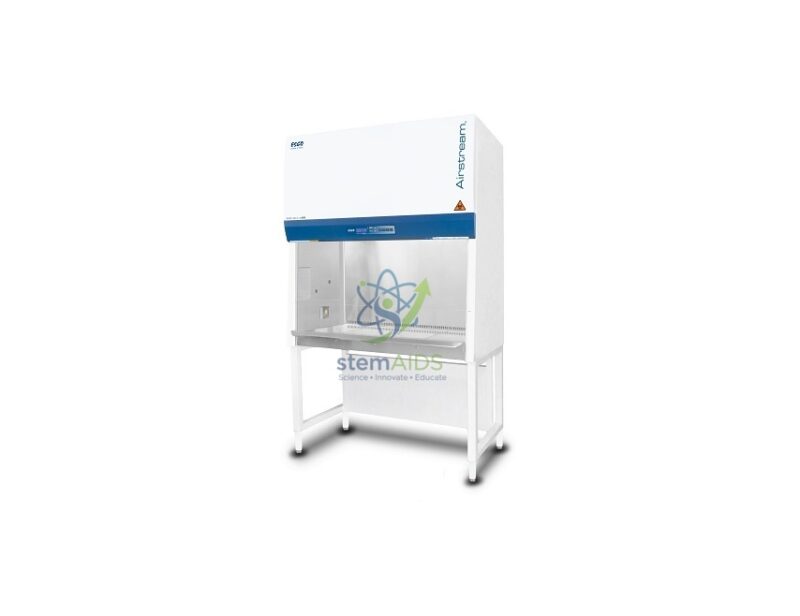
Quick Answer: The PSM microbiological safety cabinet is a ventilated, HEPA-filtered enclosure with a front work opening, pictured on its stand, for handling microorganisms, cultures and biological specimens. PSM is the French abbreviation for ‘poste de sécurité microbiologique’, the French name for this type of cabinet.
How the Cabinet Protects People and Work
Safety cabinets for microbiology control airborne particles, which is what matters when handling microorganisms. Air drawn in at the front opening stops aerosols escaping towards the user, and air leaving the cabinet passes through a HEPA filter, which traps microorganisms before the air is released. In the widely used Class II design, a further stream of HEPA-filtered air flows down over the work surface, so the cultures themselves are protected from contamination as well.
The product title does not state the cabinet’s class. Class I cabinets protect the user and the environment but not the work; Class II cabinets protect all three; Class III cabinets are sealed glove boxes. Ask LabEquip which class this PSM cabinet belongs to, and match it to the biosafety level of your work.
This cabinet is not a fume cupboard. HEPA filters do not capture chemical vapours, and in cabinets that return air to the room, vapours pass straight through. Volatile chemicals belong in a laboratory fume cupboard.
Specifications
| Product | Microbiological safety cabinet (French: poste de sécurité microbiologique, PSM) |
| Filtration | HEPA filtration, as standard for this cabinet type |
| As pictured | Cabinet with front work opening, mounted on a stand |
| Protects against | Aerosols of microorganisms and biological material |
| Cabinet class and dimensions | Confirm at enquiry |
Applications
- Subculturing bacteria and fungi in microbiology teaching and research labs
- Handling clinical specimens in hospital and diagnostic labs
- Cell and tissue culture needing a clean work area (Class II cabinets)
- Pouring media and preparing plates where airborne contamination must be avoided
Safe Working Practice
- Run the cabinet for the warm-up time stated in the manual and keep the front and rear grilles clear
- Wipe the work surface with a suitable disinfectant before and after each session
- Avoid open flames inside; they disturb the airflow and can damage the HEPA filter
- Keep clean items and waste apart, and move hands slowly through the opening
- Have the cabinet tested by a competent engineer at regular intervals and after any move
Why Choose LabEquip
Microbiology departments, hospital and diagnostic labs and biotech facilities choose a microbiological safety cabinet according to the organisms they handle. LabEquip lists the PSM cabinet among its general lab products; send details of your work and the class you need through the contact page.
Frequently Asked Questions
What does PSM stand for?
It is the French abbreviation for ‘poste de sécurité microbiologique’, meaning microbiological safety cabinet. The same equipment is called an MSC or a biological safety cabinet in English.
Can the cabinet be used with chemicals?
Not with volatile or toxic chemicals. HEPA filters trap particles, not vapours. Use a ducted fume cupboard for chemical work.
Why should a Bunsen burner not be used in the cabinet?
The flame creates rising hot air that disrupts the protective airflow pattern, and the heat can damage the HEPA filter. Use sterile disposable loops or an electric loop steriliser instead.
What is the difference between a safety cabinet and a laminar flow cabinet?
A laminar flow cabinet blows filtered air out towards the user to protect the work only. A safety cabinet draws air inwards at the front to protect the user, and Class II models also protect the work.
Where should the cabinet be placed in the room?
Away from doors, windows, air vents and walkways, since draughts and people passing close by disturb the airflow at the front opening. Leave space around it for servicing.
How often does the cabinet need testing?
Follow your local biosafety guidance, which commonly calls for testing after installation, after relocation and at regular intervals, often yearly. Tests check airflow, filter integrity and alarms.
Last Updated: October 2026





Reviews
There are no reviews yet.