
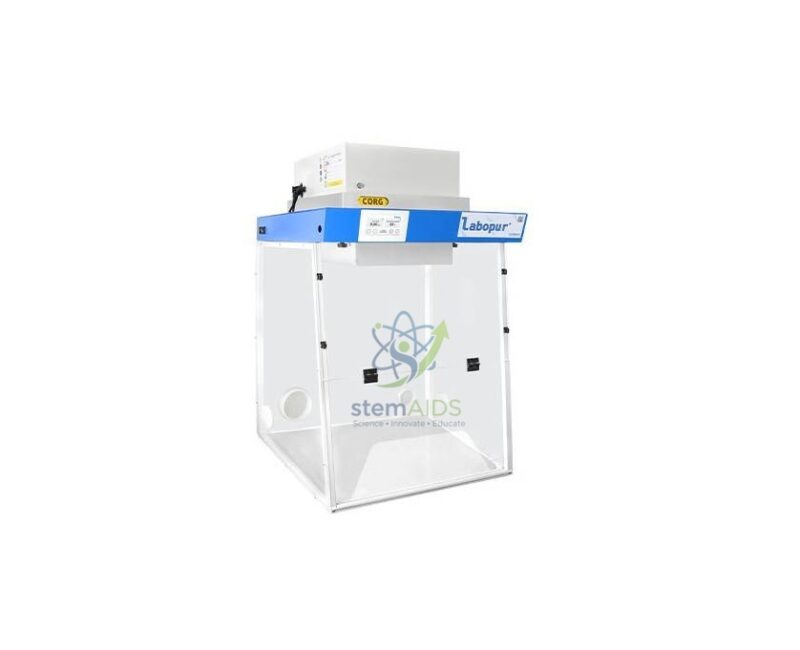
Quick Answer: The Labopur Class 2 filtration hood is a ductless, recirculating bench enclosure: a fan draws air in through the front opening, passes it through filters that hold back vapours or particles, and returns the cleaned air to the room. It is used for handling small quantities of known chemicals where ducting is not available.
How a Recirculating Hood Protects the User
Air enters the front opening of the Labopur hood, sweeps across the work surface away from the operator’s breathing zone, then passes up through the filter stage before being released back into the room. Because nothing is exhausted outside, protection depends entirely on the filter retaining what is released inside the enclosure. Activated carbon adsorbs organic vapours, impregnated carbon grades target acid gases, ammonia or formaldehyde, and particle filters catch powders.
That makes filter selection the key step. Before ordering, list the chemicals and approximate quantities that will be handled, and choose the filter combination for that list. A recirculating hood is not intended for unknown substances, large volumes or reactions that release heat or gas suddenly; those belong in a ducted fume cupboard.
The title calls this hood ‘Class 2’. Some national schemes group filtration hoods into classes according to their use and filtration arrangement, and the meaning differs between schemes, so ask LabEquip which classification is meant and what it covers before relying on it in your risk assessment. The photo shows a compact unit with clear panels and a filter module above, sized for bench work.
Specifications
| Product | Ductless filtration hood (recirculating) |
| Name and class in title | Labopur, Class 2 |
| As pictured | Compact clear-panelled enclosure with filter module on top |
| Filters | Selected to match the chemicals handled |
| Classification meaning and filter options | Confirm at enquiry |
Applications
- Weighing and dispensing small amounts of solvents or odorous reagents in teaching labs
- Preparing staining solutions where vapours need to be contained
- Handling fine powders that should not drift around the bench, with a particle filter fitted
- Labs in rented or historic buildings where new ducting cannot be installed
Filter Management & Care
- Keep a register of the chemicals used in the hood and check it against the filter’s suitability list
- Replace filters on the schedule or saturation indication the supplier gives, and record each change
- Work at least a hand’s width inside the opening and keep large objects from blocking the airflow
- Site the hood away from doors, windows and walkways, where cross draughts disturb the inflow
Why Choose LabEquip
Schools, small QC labs and clinics needing occasional fume control without building work often choose a recirculating hood. LabEquip supplies this model in its general lab products range alongside the smaller Labopur H70 mini hood, and your chemical list can be sent through the contact page for filter matching.
Frequently Asked Questions
Which chemicals can be used in a filtration hood?
Only those the fitted filter is designed to retain, in the quantities the supplier specifies. Organic solvents, acids, ammonia and formaldehyde each need a suitable filter type, so match the filter to a written list of the chemicals you handle.
How do I know when the filter is saturated?
Use the saturation indicator or detection method the supplier provides, together with the replacement interval for your usage. Never rely on smell, since many vapours are harmful below the level at which they can be smelled.
Can a filtration hood replace a ducted fume cupboard?
Only for defined, small-scale tasks with known chemicals. Reactions that produce heat, large volumes, unknown substances or chemicals the filter cannot retain need a ducted fume cupboard that exhausts outside.
Does the hood need to be connected to anything?
Only to a power supply. Because the cleaned air returns to the room, no duct or external fan is needed, which is why a recirculating hood can be moved to another bench if the room layout changes.
Where should the hood be placed in the lab?
On a stable bench away from doors, windows, air-conditioning outlets and walkways. Draughts across the front opening can pull vapour out of the enclosure towards the user.
Can a Bunsen burner be used inside the Labopur hood?
No. An open flame can damage the filters and may ignite solvent vapour drawn through the enclosure. Work that needs heating with a flame belongs in a ducted fume cupboard.
Last Updated: October 2026




Reviews
There are no reviews yet.