







In Stock
Mini air recirculation hood Labopur H70
₹54,580.00
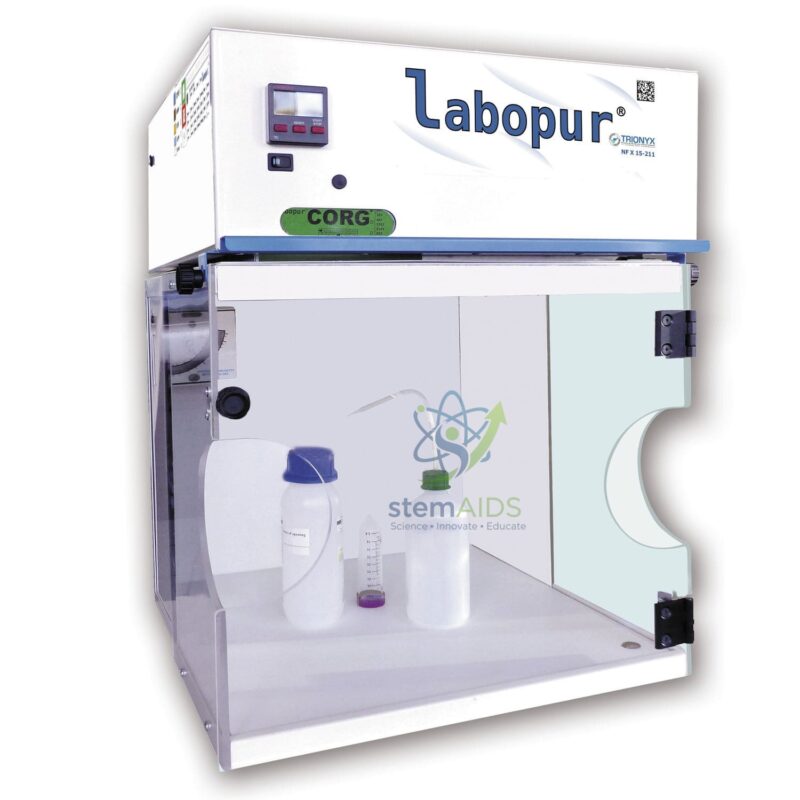
The StemAids Mini Air Recirculation Hood Labopur H70 is a compact ductless laboratory filtration hood designed for safer handling of small quantities of compatible chemicals, vapours, reagents, and laboratory samples. It is suitable for schools, colleges, chemistry laboratories, pharmaceutical labs, research facilities, quality-control laboratories, and compact laboratory workspaces where external ducting is not practical.
Product Description
The StemAids Labopur H70 Mini Air Recirculation Hood is designed to capture chemical vapours inside a compact working enclosure and pass them through a selected activated carbon filter before returning filtered air to the laboratory room. Its small footprint makes it useful for limited bench spaces, teaching laboratories, preparation rooms, and routine chemical handling stations.
The hood is built with a steel structure, epoxy-coated finish, transparent PMMA side walls, ergonomic hand passages, and a swing-opening front panel for full access to the interior. It is suitable for controlled manipulation of compatible products when fitted with the correct filter type.
Important Note: This is a ductless chemical filtration hood, not a biological safety cabinet. It should not be used for infectious biological materials, radioactive substances, explosive vapours, highly toxic unknown chemicals, or applications outside the approved filter compatibility.
Product Specifications
| Parameter | Details |
|---|---|
| Product Name | Mini Air Recirculation Hood Labopur H70 |
| Brand | StemAids |
| Reference Type | Labopur H70 mini ductless fume hood / air recirculation hood type |
| Product Type | Ductless air recirculation filtration hood |
| Internal Dimensions | 455 × 410 × 445 mm, L × H × D |
| External Dimensions | 505 × 605 × 485 mm, L × H × D |
| Width | 505 mm |
| Airflow | Approx. 170 m³/hour |
| Face Velocity | Approx. 0.4 to 0.6 m/s, depending on operating condition and filter configuration |
| Power Supply | 220–240 V, 50 Hz |
| Fan Power | Approx. 10 W |
| Current | Approx. 0.1 A |
| Noise Level | Approx. 57 dB(A), excluding airflow noise |
| Construction | 12/10 steel construction with epoxy paint finish |
| Colour Finish | White epoxy RAL 9010 with blue RAL 5015 detailing |
| Side Walls | Transparent PMMA side walls |
| Access Design | Ergonomic hand passages for safe and easy manipulation inside the enclosure |
| Front Panel | Swinging front panel for full interior access |
| Filter Supply | Filter not supplied as standard; suitable activated carbon filter should be selected separately |
| Compatible Filter Options | Organic vapour filter, common laboratory chemical filter, formaldehyde filter, ammonia filter, or application-specific activated carbon filter depending on handled product |
| Filter Saturation Check | Side control port for reagent-tube based filter saturation checking with manual pump |
| Standard Reference | NF X 15-211 Class 2 ductless filtration hood principle, depending on configuration |
| Application | Chemical vapour handling, small reagent work, sample preparation, educational chemistry, and compact laboratory filtration |
| Suitable For | Schools, colleges, chemistry labs, pharmaceutical labs, research labs, QC labs, and institutional laboratories |
Key Features
- Compact mini ductless air recirculation hood for small laboratory workspaces
- No external duct connection required
- 170 m³/hour airflow supports controlled vapour capture
- Transparent PMMA walls provide clear visibility during operation
- Ergonomic hand passages allow safe and easy manipulation inside the hood
- Swinging front panel gives full access for loading, cleaning, and arrangement
- Steel body with epoxy paint finish supports routine laboratory use
- Activated carbon filter options available according to handled chemicals
- Side control port supports filter saturation checking using reagent tubes
- Suitable for teaching laboratories, preparation rooms, and compact chemical work areas
How to Use
- Place the StemAids Labopur H70 hood on a stable, level, and chemically suitable laboratory bench.
- Review the chemicals, vapours, and quantities to be handled before use.
- Select and install the correct activated carbon filter according to the handled product.
- Connect the hood to a suitable 220–240 V electrical supply.
- Switch on the electric fan before starting any chemical handling.
- Check that airflow is operating correctly before placing materials inside the hood.
- Place only the required chemicals, containers, apparatus, and samples inside the enclosure.
- Use the ergonomic hand passages to perform work slowly and carefully.
- Keep containers closed when not actively in use.
- After completing work, allow the hood to run for a short purge period as per laboratory SOP.
- Clean the work area and remove any residue or accidental spill safely.
- Track filter usage and check filter saturation through the side control port as required.
Applications
- Small-quantity chemical vapour handling
- Reagent preparation and transfer
- School and college chemistry demonstrations
- Pharmaceutical and research sample preparation
- Organic vapour handling with suitable filter
- Formaldehyde vapour handling with suitable filter
- Ammonia vapour handling with suitable filter
- Routine quality-control laboratory handling
- Compact laboratory spaces requiring ductless filtration
- Teaching, training, and institutional laboratory use
Safety and Handling Guidelines
- Always verify chemical compatibility before using the hood.
- Use only the correct filter type for the chemical vapours being handled.
- Do not operate the hood without a suitable installed filter.
- Do not use with explosive, radioactive, infectious, highly toxic, or unknown substances without formal risk assessment.
- Do not exceed the filter capacity or permitted chemical quantity.
- Do not block the air intake, outlet, hand passages, or filter area.
- Check filter saturation regularly using the recommended reagent-tube method.
- Replace saturated, expired, damaged, or incompatible filters immediately.
- Wear suitable PPE such as gloves, safety goggles, and lab coat during operation.
- Keep ignition sources away when handling flammable vapours.
- Follow SDS instructions, institutional safety rules, and local laboratory regulations.
- Allow only trained users to operate, clean, and maintain the hood.
Quality and E-E-A-T Notes
The StemAids Mini Air Recirculation Hood Labopur H70 supports evidence-based laboratory safety by combining controlled airflow, chemical-specific activated carbon filtration, visible work enclosure, and filter saturation checking. For dependable protection, laboratories should maintain chemical compatibility records, filter usage logs, saturation-test records, SDS references, airflow checks, and SOP-based user training.
FAQ
1. What is the StemAids Mini Air Recirculation Hood Labopur H70 used for?
It is used for safer handling of small quantities of compatible chemical vapours, reagents, and samples inside a ductless filtered work enclosure.
2. Does the Labopur H70 require external ducting?
No, it is a ductless air recirculation hood. Air is filtered through a suitable activated carbon filter and returned to the laboratory room.
3. What are the external dimensions?
The external dimensions are approximately 505 × 605 × 485 mm, L × H × D.
4. What are the internal dimensions?
The internal dimensions are approximately 455 × 410 × 445 mm, L × H × D.
5. What is the airflow rate?
The airflow rate is approximately 170 m³/hour.
6. Is the filter included?
The filter is generally not supplied as standard. A suitable activated carbon filter must be selected separately according to the chemical application.
7. Which filters can be used?
Compatible filter options may include organic vapour filters, common laboratory chemical filters, formaldehyde filters, ammonia filters, or other application-specific activated carbon filters.
8. How is filter saturation checked?
The hood includes a side control port that allows the use of specialised reagent tubes and a manual pump to check filter efficiency or saturation.
9. Is this hood suitable for biological work?
No, this is not a biological safety cabinet and should not be used for infectious biological containment.
10. Can it be used for solvent vapours?
Yes, compatible solvent vapours can be handled only when the correct organic vapour filter is installed and the quantity handled is within approved safety limits.
11. What is the noise level?
The fan noise level is approximately 57 dB(A), excluding airflow noise.
12. How should the hood be maintained?
Keep the hood clean, inspect the PMMA panels, verify airflow, monitor filter usage, check filter saturation, replace filters on time, and document maintenance according to laboratory SOP.
Why Choose StemAids?
StemAids laboratory safety equipment is selected for practical workflows, user protection, and institutional laboratory requirements. The StemAids Mini Air Recirculation Hood Labopur H70 supports compact ductless chemical handling, controlled vapour filtration, ergonomic operation, filter monitoring, and safer laboratory workflows for schools, colleges, research laboratories, pharmaceutical units, chemistry labs, and quality-control departments.
SEO Keywords
StemAids Mini Air Recirculation Hood Labopur H70, Labopur H70 Hood, Mini Ductless Fume Hood, Air Recirculation Hood, Laboratory Filtration Hood, Chemical Vapour Filtration Hood, Compact Ductless Hood, Activated Carbon Fume Hood, School Chemistry Fume Hood, Laboratory Safety Hood, StemAids Laboratory Equipment
You must be logged in to post a review.
Bestsellers




Reviews
There are no reviews yet.