










In Stock
Earthquake Shake Table
$13.87
Quick Answer: An earthquake shake table is a platform made to vibrate so that small model buildings standing on it experience simulated ground shaking. Students use it to test and improve earthquake-resistant designs in earth science, physics and engineering lessons.
How the Earthquake Shake Table Is Built
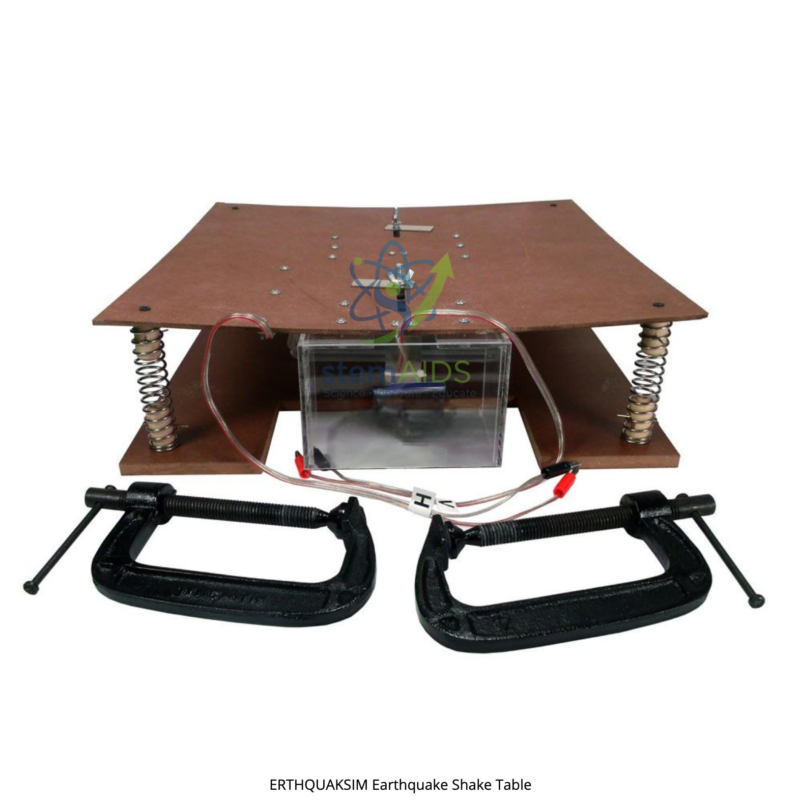
The listing photograph shows a board platform carried on four coil springs above a baseboard, a small drive unit in a clear housing under the platform with leads ending in crocodile clips, and two G-clamps for fixing the base to a bench. In tables of this style a small motor turning an off-centre weight sets the sprung platform vibrating, and the supply voltage decides how strongly it shakes. The title does not give the drive voltage, the power source needed or whether a supply is included, so check those before ordering.
Specifications
| Item | Earthquake shake table (vibrating platform) |
| Platform | Board platform on four coil springs over a baseboard (as pictured) |
| Drive | Small drive unit under the platform with leads and crocodile clips (as pictured) |
| Mounting | Two G-clamps to hold the base on a bench (as pictured) |
| Test models | Light student-built structures of card, straws, sticks or blocks |
| Drive voltage and power supply | Confirm at enquiry |
Engineering Challenges on the Shake Table
The classic task is to build a tower from card, straws, craft sticks or spaghetti and marshmallows, fix it to the platform and record how long it stands, or how much load it carries, while the table shakes. Groups then change one feature at a time: add diagonal cross-bracing, widen the footprint, lower the centre of mass by moving weight downwards, or stand the model on a rubber pad or a tray of marbles to imitate base isolation. Testing every version at the same setting turns a demonstration into a controlled experiment.
Resonance often gives the most memorable result: a tall, slender tower may sway violently at one shaking rate and hardly move at another. That leads straight into why buildings of particular heights suffered most in some real earthquakes, and why engineers add dampers and base isolators.
Applications
- Testing cross-bracing, footprint width and centre of mass on student-built towers
- Showing base isolation by comparing a rigidly fixed model with one on rubber or rollers
- Demonstrating resonance, where a tall model sways far more at one shaking rate than another
- Connecting ground shaking with seismograph traces and seismic waves in geography lessons on natural hazards
Care & Handling
- Clamp the base before switching on, and keep fingers, leads and loose items away from the springs while the platform moves.
- Connect the leads only to the power source specified with the order, observing polarity, and switch off before changing models.
- Keep model loads light; heavy masses overload the springs and drive and can slide off the platform.
- After use, check that the spring fixings and platform screws are tight, and store the table flat in a dry place.
Why Choose LabEquip
The earthquake shake table is chosen by schools running STEM engineering challenges and by geography departments teaching plate tectonics and hazards. LabEquip also supplies the Seismograph Model, which shows how the same shaking is recorded, and the Modeling Seismic Wave Propagation and Shadow Zone set for the wave side of the topic. Related apparatus is listed under General Lab Products.
Frequently Asked Questions
Which materials work well for models tested on a shake table?
Light materials that students can cut and join quickly: card, drinking straws, craft sticks, spaghetti with marshmallows or building blocks. Giving every group the same material means the design, not the material, decides which tower survives longest.
How can students make a fair comparison between two designs?
Keep the table setting, test time, model height and any added load the same, and change only one feature, such as the bracing. Time how long each model stands, and repeat every test at least three times to average out variation.
What is base isolation, and can it be shown on the table?
Base isolation separates a building from the ground with flexible bearings, so less of the shaking reaches the structure above. On the table, stand one model directly on the platform and an identical model on a rubber pad or a tray of marbles, and compare how much each sways.
Why does a tall model sometimes shake much more than a short one?
Every structure has a natural frequency at which it sways most easily. When the table shakes near that frequency, the motion builds up through resonance. Short, stiff models have higher natural frequencies than tall, slender ones, so the two respond differently to the same shaking.
Why must the shake table be clamped to the bench?
An unclamped base drifts and bounces as it vibrates, which changes the shaking from test to test and can walk the table off the bench edge. The two G-clamps shown in the listing photograph hold the base still, so tests are repeatable and safe.
What power source does the shake table need?
The listing photograph shows leads with crocodile clips, which points to a low-voltage supply connection rather than a mains plug. The title does not state the voltage or whether a supply is included, so confirm both when ordering and use only the specified source.
Last Updated: September 2026
You must be logged in to post a review.
Bestsellers




Reviews
There are no reviews yet.