


In Stock
Dissolved Oxygen Kit
Kit Oxygène dissous utilizes high-stability, vacuum-sealed reagents designed to eliminate atmospheric interference, ensuring stoichiometric precision for dissolved oxygen measurements with an accuracy of 0.1 mg/L.
Direct-Reading Micro-Burette System Features a calibrated, high-contrast dispensing interface that provides immediate volumetric analysis in ppm or mg/L, removing the need for complex mathematical conversions in field environments.
₹1,140.00
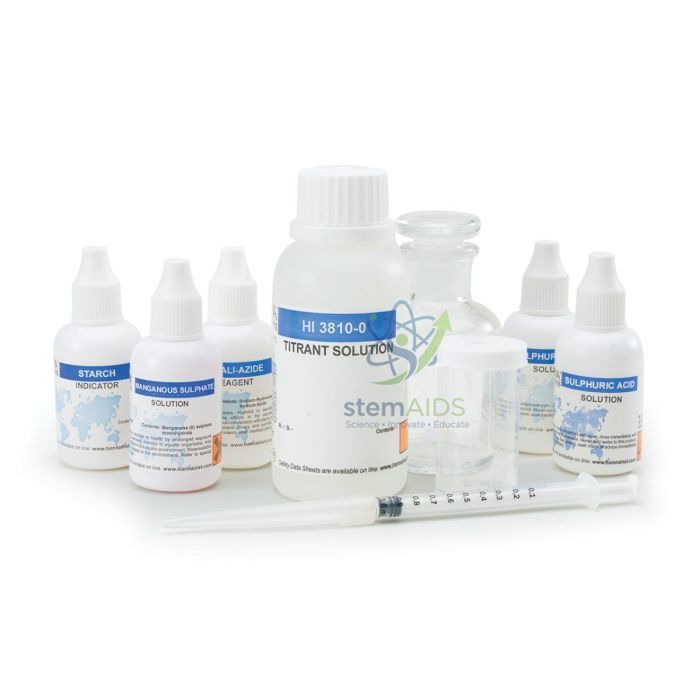
Quick Answer: The Dissolved Oxygen Kit is a chemical test kit for measuring the oxygen dissolved in a water sample, in mg/L, by titration. The reagents shown in the listing photo (manganous sulfate, alkali-azide reagent, sulfuric acid, starch and a titrant solution) are those of the Winkler method, which schools and field teams use to judge the health of ponds, rivers and aquaria.
How the Winkler Titration Measures Oxygen
Oxygen cannot be titrated directly, so the Winkler method converts it into an equivalent amount of iodine. Manganous sulfate and the alkaline iodide-azide reagent are added to a completely filled, stoppered sample bottle; dissolved oxygen oxidises the manganese hydroxide that forms, giving a brownish floc. Adding sulfuric acid dissolves the floc and releases iodine in proportion to the oxygen originally present. The azide is there to suppress interference from nitrite.
The freed iodine is then titrated with the titrant solution. As the yellow-brown colour fades, a few drops of starch are added, turning the liquid blue-black, and the titration continues drop by drop until the blue just disappears. The volume of titrant used gives the dissolved oxygen concentration, following the calculation or scale in the kit instructions. The syringe pictured with the kit dispenses the titrant in small, measured steps.
The step that decides accuracy happens before any reagent is added: the sample bottle must be filled without trapping air bubbles, and the oxygen should be fixed with the first two reagents at the sampling site. Once fixed, the sample can be carried back to the laboratory for the acid and titration steps. For continuous logging rather than spot readings, an electronic sensor such as the wireless optical air and water oximeter sensor is the alternative.
Specifications
| Measurement | Dissolved oxygen in water, reported in mg/L |
| Method | Winkler titration (azide modification), as indicated by the pictured reagents |
| Pictured reagents | Manganous sulfate, alkali-azide reagent, sulfuric acid, starch solution, titrant solution |
| Pictured apparatus | Glass-stoppered sample bottle, plastic vessel, syringe |
| Range, resolution and number of tests | Confirm at enquiry |
Where Dissolved Oxygen Is Measured
- Comparing oxygen levels above and below an outfall, weir or polluted stretch of a stream during a field-study practical
- Showing that cold water holds more dissolved oxygen than warm water by testing samples at different temperatures
- Tracking day and night changes in a pond or aquarium as aquatic plants photosynthesise and respire
- A five-day biochemical oxygen demand (BOD) exercise, testing one bottle at once and a second after incubation in the dark
- Checking aeration in a classroom aquarium or fish-holding tank
Safe Handling of the Reagents
- Read the safety data sheet for each reagent before use; sulfuric acid and the alkaline reagent are corrosive, so wear eye protection and gloves.
- Restopper the sample bottle straight after each reagent addition so that no air is drawn in.
- Rinse the sample bottle, syringe and vessel with clean water after each test, and store the reagents capped, upright and away from heat and direct sun.
- Note the expiry dates, since starch and titrant solutions deteriorate, and dispose of spent solutions as your laboratory’s waste rules require.
Why Choose LabEquip
Environmental science teachers, college ecology departments and water-quality trainees use a Winkler-type kit because it teaches the chemistry behind the number as well as the measurement. LabEquip lists this kit with other field and ecology items in the General Lab Products range; ask through the contact page about refills and the number of tests per set.
Frequently Asked Questions
Why must the sample bottle be filled without air bubbles?
Any trapped air contains far more oxygen than the water itself, and it dissolves into the sample once the reagents are added. Even a small bubble can raise the result noticeably, so the bottle is filled to overflowing, stoppered carefully and checked before fixing.
How soon after sampling must the oxygen be fixed?
As soon as possible, ideally at the water’s edge. Algae, bacteria and temperature changes alter the oxygen content of an unfixed sample within minutes to hours. Once the manganous sulfate and alkali-azide reagent have been added, the result is locked in and the titration can wait until you are back in the laboratory.
What dissolved oxygen level indicates healthy water?
There is no single figure for every habitat, but fish generally struggle when dissolved oxygen falls to a few mg/L, and cool, fast-flowing streams usually hold more than warm, still ponds. Interpret readings alongside water temperature, time of day and local water-quality guidance.
What is the purpose of the starch solution?
Starch forms an intense blue-black complex with iodine. Near the end of the titration the pale yellow colour of iodine is hard to judge, so starch is added to make the final disappearance of iodine sharp and easy to see.
Can the kit measure oxygen in seawater?
The Winkler method is widely used for seawater as well as fresh water, because the chemistry is not upset by salt. Check the kit instructions for any correction or scale specific to saline samples before comparing results.
Is a chemical kit or an electronic meter better for school use?
A chemical kit shows students the reactions behind the reading and needs no calibration or electronics, which suits practicals and field trips. An electronic sensor gives quicker repeated readings and continuous logging. Many departments keep both, using the titration to teach the method and a sensor for long-term monitoring.
Last Updated: September 2026
You must be logged in to post a review.
Bestsellers




Reviews
There are no reviews yet.