



In Stock
Burette Clamp, Rotatable, Double Keys 1
360 Swivel Maneuverability: The clamp head rotates fully on a central axis, allowing for vertical, horizontal, or precise angular orientation to suit complex titrations.
Double-Key Precision: Two independent adjustment screws (keys) allow each jaw to move separately. This ensures a perfectly centered grip and even pressure distribution on the glassware.
$2.93
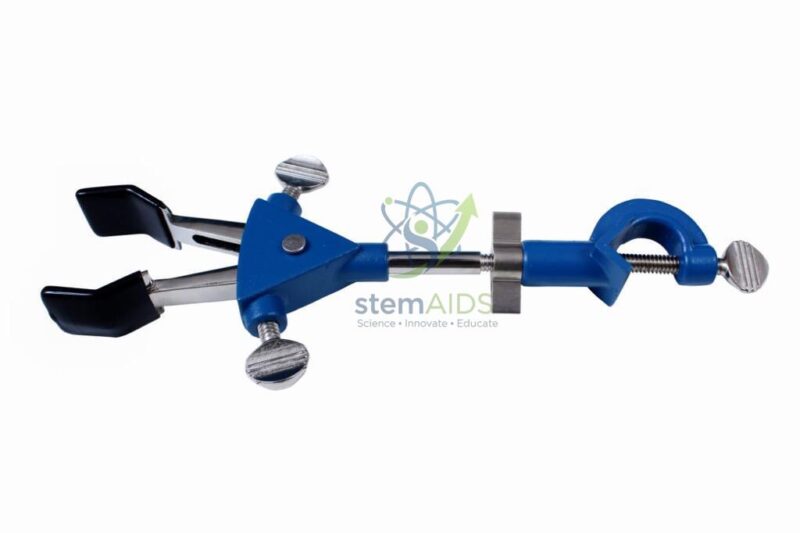
Quick Answer: The Burette Clamp, Rotatable, Double Keys 1 is a rotatable double key clamp that combines two adjustments: a swivel that sets the angle of the jaws, and two thumbscrews that move each prong independently. The listing image shows a blue body, black-tipped prongs and an attached clamp for the stand rod.
Angle and Position, Adjusted Separately
Most clamps offer one adjustment, either the angle or the jaw opening. The Burette Clamp, Rotatable, Double Keys 1 separates three: the attached rod clamp sets the height on the stand, the swivel sets the angle, and the two keys set where between the prongs the glass sits. That suits assemblies in which a tube must enter a flask neck or a ground-glass joint along a precise line.
The double keys are the two thumbscrews visible on either side of the body in the photograph. Turning one moves only its own prong, so a burette or thin tube can be nudged slightly sideways without loosening the whole grip. Black tips on the prongs keep metal away from the glass.
Because a rod clamp is attached, as pictured, no separate boss head is needed. Compare the Rotatable, Double Keys 2, which is photographed with a bright metal body; for work where only the angle changes, the simpler Rotatable 1 is enough.
Specifications
| Type | Rotatable burette clamp with double keys |
| Adjustments | Swivel for angle; two thumbscrews for the prongs |
| Prongs | Two, with black tips (as pictured) |
| Body | Blue coated |
| Stand fixing | Attached rod clamp with thumbscrew (listing image) |
| Jaw range | Confirm at enquiry |
Care & Handling
- Adjust in order: height at the rod clamp, then angle at the swivel, then the two keys.
- Keep all three screws finger-tight rather than overtightening one to make up for another that is loose.
- Refit or replace missing prong tips before holding glass.
Applications
- Aligning an adapter or thermometer pocket with a ground-glass joint while a distillation is assembled
- Holding a burette at a titration station that is shared with other apparatus
- Setting a gas delivery tube at an exact angle into a gas jar or trough
- Positioning a thin probe beside a thicker tube in a small reaction vessel
Why Choose LabEquip
Laboratories that assemble ground-glass apparatus, where joints must meet in line without strain, gain most from the extra adjustments. LabEquip carries this clamp in its General Lab Products range; contact us with the glassware you need to hold.
Frequently Asked Questions
What does a rotatable double keys clamp do that a plain clamp cannot?
It lets you change the angle of the jaws at a swivel and move each prong separately with its own thumbscrew. Together these place glassware on an exact line, which a fixed single-screw clamp cannot do.
Why does ground-glass apparatus need careful clamping?
Ground joints must meet in a straight line. If a clamp pulls one part sideways, the joint is stressed and can crack or leak, especially when heated. Adjustable clamps let each part be set in line before tightening.
In what order should the screws be adjusted?
Set the height first, then the angle at the swivel, then close the two keys onto the glass. Finish by checking that each screw is finger-tight.
Can it hold a burette vertically?
Yes. Set the swivel upright and close both prongs evenly. The two keys also let you move the burette over the centre of the flask without shifting the stand.
Is it suitable for heavy flasks?
It is designed around narrow items such as burettes and tubes. Heavy flasks belong in a three-finger clamp at the neck, held close to the stand.
How is it different from Rotatable, Double Keys 2?
Both have a swivel and two keys. The photographs show number 1 with a blue coated body and number 2 with bright uncoated metal; the titles give no sizes, so compare jaw ranges if that matters for your glassware.
Last Updated: September 2026
You must be logged in to post a review.
Bestsellers




Reviews
There are no reviews yet.