
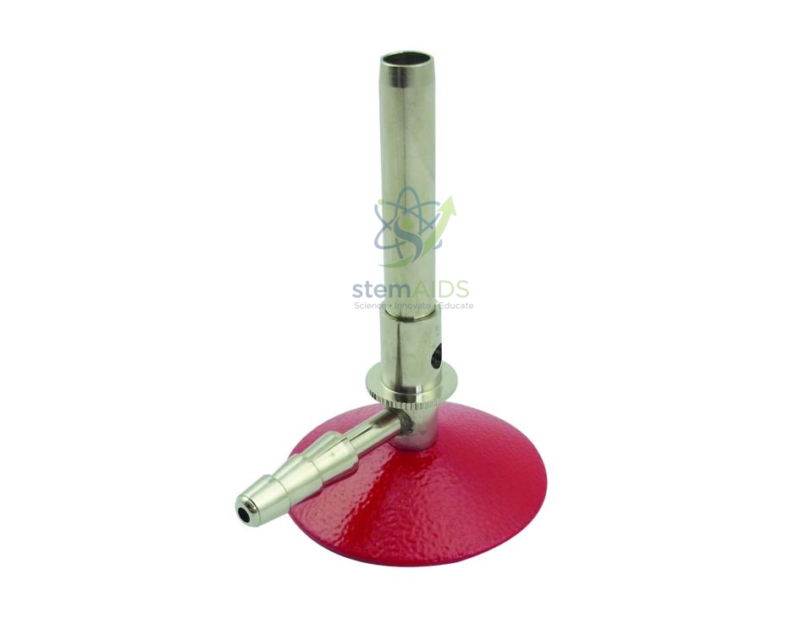
Quick Answer: The Bec Bunsen for butane or propane gas is a plain Bunsen burner for butane or propane, the bottled gases sold as LPG (bec is French for burner): a straight burner tube with an air opening, a side hose inlet and a red cone-shaped base, with the gas flow set at the cylinder regulator or bench valve.
A Plain Bunsen for Cylinder Gas
This is the simplest form of the laboratory burner. The photo shows a straight metal tube with an air opening and collar near its foot, a side nozzle for the hose and a red, hammered cone base that keeps the burner from tipping. There is no tap on the body, so the size of the flame is set at the regulator or valve that feeds it, and the burner itself only mixes and burns the gas.
Air enters through the opening near the foot of the tube. With it closed, the gas burns as the luminous yellow safety flame, which is easy to see but cool and sooty. Opening it lets air mix with the gas before it burns, giving the blue heating flame with a pale inner cone; the hottest region lies just above the tip of that cone. Classes use exactly this change to learn about complete and incomplete combustion.
Butane and propane need a smaller jet than natural gas because they carry more energy in the same volume and arrive through a regulator. That is why burners are sold by gas type. Where the flame has to be adjusted at the burner, the Bunsen burner with tap and pilot light for the same gases adds that control, and for piped natural gas the Bunsen burner for natural gas is the counterpart.
Classroom Uses
- Heating test tubes and boiling tubes over a controlled blue flame
- Heating beakers and evaporating basins on a tripod and gauze
- Flame tests on metal salts using a wire loop or wooden splint
- Teaching the difference between luminous and non-luminous flames
Specifications
| Burner type | Plain Bunsen burner, no tap on the body |
| Gas | Butane or propane (LPG), as titled |
| Base | Red, hammered cone-shaped base, as pictured |
| Gas inlet | Side hose nozzle |
| Air control | Opening with collar near the foot of the tube |
| Flame size control | At the cylinder regulator or bench valve |
Care & Handling
- Check the tubing and the cylinder regulator before each lesson, and replace any hose that is cracked, kinked or loose on the nozzle.
- Hold the lit match or lighter ready first, then open the gas, with the air opening closed so the burner lights with a yellow flame.
- Keep the burner away from the bench edge and from paper, hair and loose sleeves.
- Once cold, clear spilt solids from the air opening and the top of the tube.
Why Choose LabEquip
Schools running practicals from LPG cylinders buy this burner in class sets, as it is simple to use and easy to look after. LabEquip lists it with other burners in General Lab Products; tell us the quantity and your gas supply through the contact page.
Frequently Asked Questions
What does bec Bunsen mean?
Bec is the French word for burner, so a bec Bunsen is simply a Bunsen burner. This one is a standard laboratory Bunsen jetted for butane or propane.
How is the flame controlled without a tap?
Gas flow is set at the regulator on the cylinder or at the bench valve, and the flame type is set with the air opening on the tube. For fine control at the bench, a burner with its own tap is the better choice.
Can it be connected straight to a gas cylinder?
Only through a suitable regulator that reduces cylinder pressure to the low pressure a burner needs, using proper burner tubing. Never connect a burner directly to an unregulated cylinder valve.
Why does the flame sometimes burn inside the tube?
Too much air with too little gas can make the flame travel down and burn at the jet, which makes the tube very hot and gives a roaring sound. Turn off the gas, let the burner cool, then relight with the air opening nearly closed.
Which flame should students use for heating?
The blue, non-luminous flame with the air opening partly or fully open, which is hotter and clean. The yellow flame is for when the burner is lit but idle, because it is easy to see.
Can this burner be used on natural gas?
It is set up for butane or propane. On natural gas its jet would pass too little fuel and the flame would be weak, so a natural-gas burner should be used there.
Last Updated: October 2026




Reviews
There are no reviews yet.