


In Stock
Separatory Funnel, Plastic
Self-Lubricating Fluoropolymer Stopcock: Equipped with a precision-machined PTFE plug that ensures leak-proof closure and smooth rotational torque without the requirement for silicone lubricants, preventing trace-level sample contamination.
Precision-Tapered Squibb Geometry: The optimized internal conical architecture facilitates rapid phase equilibrium and sharp interface visualization, allowing for high-accuracy volumetric separation of varying liquid densities and viscosities.
₹356.00
Quick Answer: A plastic separatory funnel is a pear-shaped funnel moulded from plastic, with a closable neck at the top and a stopcock on the stem, used to shake two immiscible liquids together and then drain them off as separate layers. It is chosen where a glass funnel could break.
A Pear-Shaped Plastic Body and What It Changes
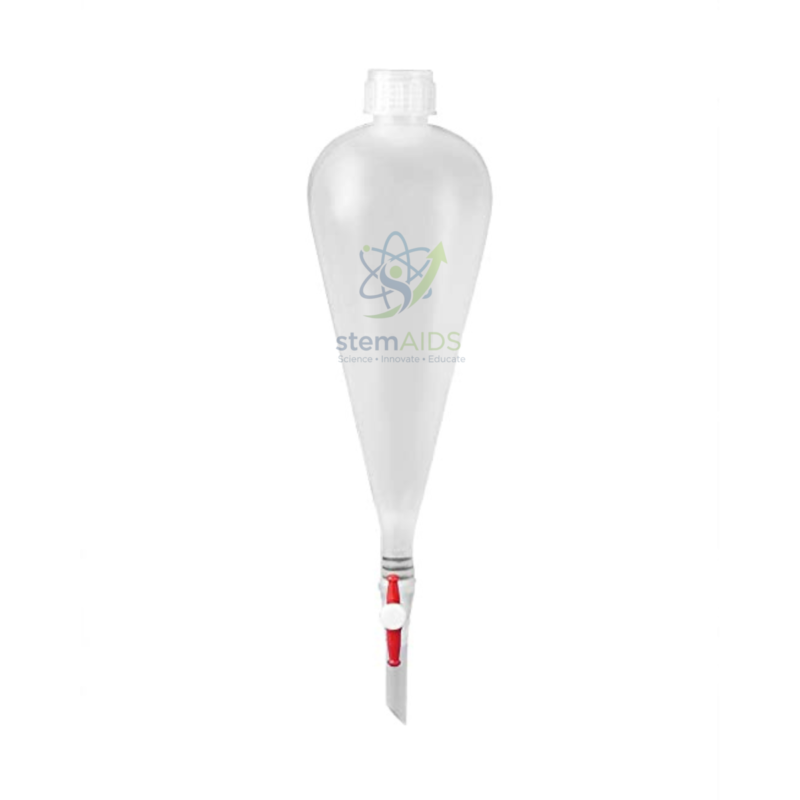
The listing photo shows a translucent, pear-shaped (Squibb-style) body with a threaded neck and a red-handled stopcock on the stem. The tapering cone matters in use: as the lower layer drains, the interface narrows into the stem, so the moment to close the tap is easy to judge by eye.
Plastic changes the chemistry rather than the technique. Polypropylene, a common resin for these funnels, resists aqueous acids, alkalis and salt solutions well and survives knocks that would crack glass. Many organic extraction solvents are a different matter: chlorinated solvents such as dichloromethane and chloroform, and aromatic ones such as toluene, can swell or soften polyolefins. The title does not name the resin, so compare its resistance chart with the solvent before a first extraction.
For chlorinated solvents, or for any work that needs a clear view of a faint interface, the glass separating funnel remains the standard choice. The plastic version suits aqueous work, oil and water demonstrations with younger classes, and outreach or field kits where glass is unwelcome.
Specifications
| Type | Separatory funnel, pear (Squibb) shape, as shown in the listing photo |
| Material | Plastic, as titled; resin not named |
| Outlet | Stopcock on the stem with a coloured key, as shown in the photo |
| Neck | Threaded neck, as seen in the photo |
| Capacity | Confirm at enquiry |
Applications
- Demonstrating immiscibility with vegetable oil and coloured water in middle-school science
- Separating an aqueous layer from a compatible organic layer in simple extraction practicals
- Washing an organic product with water or sodium hydrogen carbonate solution before drying, where the solvent suits the plastic
- Recovering oil from a water sample in environmental or food-science classes
Care & Handling
- Mount the funnel in a ring or a separatory funnel holder and place a beaker beneath before opening the stopcock.
- Vent through the open stopcock after every few shakes, with the stem pointing up and away from people, because vapour pressure builds quickly with volatile solvents.
- Remove the top closure before draining; otherwise a partial vacuum forms and the flow stops.
- Wash with warm water and mild detergent, and dismantle the stopcock now and then to rinse out trapped residue.
- Keep the funnel away from flames and hot plates, since plastics soften with heat.
Why Choose LabEquip
Schools that want students to practise layer separation without breakage, and teams who pack kits for fieldwork, are the usual buyers of a plastic funnel of this kind. LabEquip lists it with other chemistry lab equipment; send the capacities and numbers you need through the contact page.
Frequently Asked Questions
Which solvents can be used in a plastic separatory funnel?
Aqueous solutions, dilute acids and alkalis, and many alcohols are generally fine with polypropylene. Chlorinated solvents such as dichloromethane and chloroform, and aromatic solvents such as toluene, can swell or weaken it. Check the resin against a chemical-resistance chart before using any organic solvent.
How is the funnel vented during shaking?
Hold the closure in place with one hand, invert the funnel so the stem points upward and away from anyone, and open the stopcock briefly to release pressure. Repeat after every few shakes until little gas escapes.
Why does draining stop even though the stopcock is open?
While the cap or stopper sits in the neck, no air can enter to replace the liquid running out, so the pressure above it drops and the flow stalls. Take the closure off before running off the lower layer.
How do I know which layer is aqueous?
The layer with the higher density sits at the bottom, and that is not always the water. A simple test is to run a little water in from the top and see which layer it merges into. Keep both layers until the product has been found.
Is a plastic separatory funnel as clear as glass?
No. Translucent plastics such as polypropylene let you see the layers, but a faint interface is harder to spot than through glass. A lamp or a white card behind the funnel helps.
Can the funnel be autoclaved?
Polypropylene is generally autoclavable, but the stopcock key and the closure may be made of other plastics. Make sure every part tolerates the heat, loosen the closure and take out the key before autoclaving.
Last Updated: September 2026
You must be logged in to post a review.
Bestsellers





Reviews
There are no reviews yet.