

Quick Answer: A pyknometer is a small glass flask of fixed volume, usually closed by a ground stopper with a fine capillary bore, used to measure the density or specific gravity of a liquid by weighing it. Filling it until liquid rises through the capillary gives the same volume every time.
Density by Weighing a Fixed Volume
The name comes from the Greek word for dense, and the principle is simple. The dry, empty pyknometer is weighed; it is then filled with distilled water, the stopper is inserted so excess water overflows through the capillary, the outside is wiped dry, and it is weighed again. Repeating the fill with the sample liquid gives a third mass. Because the volume is the same each time, the specific gravity of the sample is its mass divided by the mass of water, and density follows by multiplying by the density of water at that temperature.
Temperature control matters more than any other factor, because liquids expand when warm. Filling and weighing at a stated temperature, often after standing the bottle in a water bath, and handling it with tissue rather than bare fingers, keeps repeat results close together when an analytical balance is used for the weighings.
The same bottle also measures solids: a powder of known mass is added, the bottle is topped up with a liquid it does not dissolve in, and the displaced volume gives the solid’s density. The terms pyknometer, density bottle and relative density bottle overlap in catalogues; the listing does not state the pattern, nominal volume or whether a thermometer is fitted.
Care & Handling
- Hold the bottle by its neck with tissue or tongs, as body heat from fingers warms the liquid and changes its volume.
- Between samples, rinse with the next liquid or with propanone and dry thoroughly, so no water or previous sample remains.
- Keep each stopper with its own bottle; they are matched as a pair and are not interchangeable.
- Wipe the capillary tip level with the top of the stopper in one stroke, without drawing liquid out of the bore.
Applications
- Specific gravity of oils, syrups and solvents in pharmacy and food laboratories
- Checking the concentration of sugar or alcohol solutions against density tables
- Density of powders and granules by liquid displacement
- Physics and chemistry practicals on density and relative density
Specifications
| Item | Fixed-volume glass bottle for density measurement |
| Stopper | Ground stopper with capillary bore is typical; pattern not stated |
| Method | Weigh empty, with water, and with sample at the same temperature |
| Measures | Density and specific gravity of liquids; density of powders by displacement |
Why Choose LabEquip
Pharmacy, food and petroleum testing laboratories, along with college physics and chemistry practicals, use these bottles wherever a density must be found by weighing. LabEquip supplies the item as part of its chemistry lab equipment; send the volume and quantity you need through the contact page.
Related Products
- Relative Density Bottle (Specific Gravity Bottle): A borosilicate relative density bottle with capillary stopper, the same principle under its other common name.
- Scientific Specific Gravity Bottle: A specific gravity bottle with ground capillary stopper for measuring the density of liquids and solids.
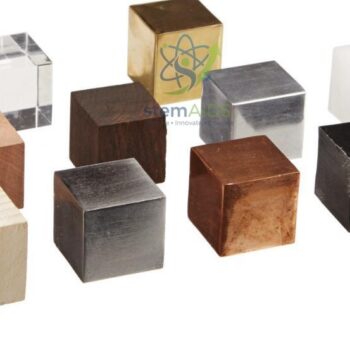
- Density Cube Set of 10: A set of 10 equal-volume density cubes for an introductory density lesson before bottle methods.
- Density Petroleum Kit: A petroleum density kit that measures fuel and oil density with a hydrometer instead of by weighing.
Frequently Asked Questions
What is a pyknometer used for?
A pyknometer is a small glass flask of fixed volume used to measure the density or specific gravity of a liquid by weighing it. It is usually closed by a ground stopper with a fine capillary bore, so filling it until liquid rises through the capillary gives exactly the same volume every time.
How do you find specific gravity with a pyknometer?
Weigh the clean, dry pyknometer empty, then filled with distilled water, then filled with the sample, all at the same temperature. The specific gravity is the mass of the sample divided by the mass of the same volume of water; multiplying by the density of water at that temperature gives the sample’s density.
What is the difference between density and specific gravity?
Density is mass per unit volume, such as grams per cubic centimetre. Specific gravity, or relative density, is the density of a substance divided by the density of water at a stated temperature, so it has no units. A pyknometer measures specific gravity directly by comparing two weighings of the same volume.
Is a pyknometer the same as a specific gravity bottle?
Yes, the names are used for the same kind of vessel: a small bottle of fixed volume with a capillary stopper, sometimes also called a density bottle or relative density bottle. Some patterns include a thermometer in the stopper so the liquid temperature can be read at the moment of filling.
Why does temperature matter when using a pyknometer?
Liquids expand when warm, so the mass that fills the fixed volume changes with temperature. Fill and weigh at a stated temperature, often after standing the filled bottle in a water bath, and handle it with tissue rather than bare fingers so hand warmth does not push liquid out of the capillary.
How do I avoid air bubbles when filling a pyknometer?
Fill slowly down the inside wall or with a fine pipette, and tap the bottle gently to release any bubbles clinging to the glass before inserting the stopper. Push the stopper in steadily so excess liquid rises through the capillary, then wipe the outside dry before weighing.
Last Updated: November 2026




Reviews
There are no reviews yet.