
In Stock
Overflow Can and Bucket Set
₹785.00
Quick Answer: The overflow can and bucket set is a metal displacement can with a side spout plus a small catch bucket with a handle. The overflow can and bucket are used together to collect and weigh the water an object pushes aside, the key measurement in experiments on Archimedes’ principle.
Verifying Archimedes’ Principle Step by Step
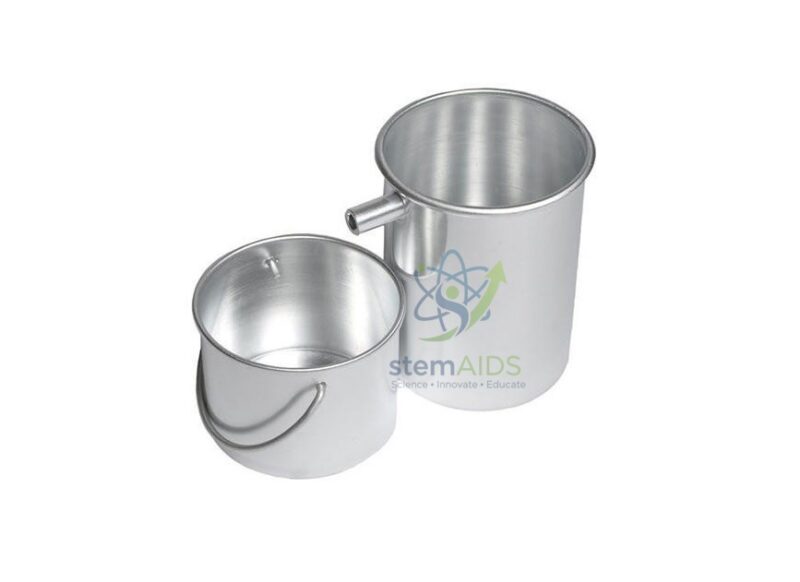
The listing photo shows two bright metal pieces: a cylindrical can with a short spout near the rim, and a smaller open bucket with a wire handle. The can is filled until water just runs from the spout and then left to finish dripping. Anything lowered in afterwards pushes out its own volume of water, and the spout delivers that water straight into the waiting bucket.
The classic procedure uses a spring balance. Weigh the object in air, then lower it, still hanging from the balance, into the full can and read the balance again: the reading drops. Weigh the bucket empty and again with the displaced water. The loss in weight of the object and the weight of water collected come out equal, which is Archimedes’ principle: the upthrust on an immersed body equals the weight of fluid it displaces.
The bucket’s handle lets it hang from a balance hook itself, so the displaced water can be weighed without pouring it into another container and losing drops. The transparent acrylic overflow can lets students watch the water level instead, and the equal volume metal cylinders show that objects of the same volume receive the same upthrust.
Specifications
| Items | Overflow (displacement) can and catch bucket (photo) |
| Can | Cylindrical metal can with side spout near the rim (photo) |
| Bucket | Small open metal bucket with wire handle (photo) |
| Finish | Bright metal, as photographed |
| Capacity and dimensions | Confirm at enquiry |
Applications
- Verifying Archimedes’ principle with a spring balance and a solid hung on a thread
- Finding the volume of irregular objects such as stones from the water they displace
- Comparing the upthrust on one object in tap water and in salt solution
- Showing that a floating object displaces its own weight of water
Care & Handling
- Stand the overflow can on a level surface and wait for the spout to stop dripping before each measurement.
- Lower objects slowly on a thread so that water does not splash over the rim.
- Dry the can and bucket after use to prevent water marks and corrosion at the seams.
- Protect the spout from knocks; a bent spout drips unevenly and spoils readings.
Why Choose LabEquip
Physics and general science teachers covering buoyancy and density buy the overflow can with its bucket so that the displaced water can be weighed directly. It appears in LabEquip’s chemistry lab equipment listings; ask on the contact page about sizes and class quantities.
Frequently Asked Questions
Why does the can have to be filled to the spout first?
The can must already be full, with the last drips finished, so that every drop leaving the spout afterwards is water pushed out by the object. If it is underfilled, some displaced water only raises the level and is never collected.
What is the bucket for?
It catches the displaced water from the spout. Weighing the bucket empty and then full gives the weight of water displaced, which is compared with the loss in weight of the object.
Why does an object seem lighter in water?
The water pushes up on it with a force called upthrust. The spring balance reads the object’s weight minus that upthrust, and Archimedes’ principle says the upthrust equals the weight of water displaced.
Can the set measure the volume of a stone?
Yes. Collect the water the stone displaces and measure it in a measuring cylinder. Since 1 millilitre of water occupies 1 cubic centimetre, that reading is the stone’s volume.
Does the set work with floating objects?
Yes. A floating object displaces water equal to its own weight, so the weight of water in the bucket should match the object’s weight measured in air.
Why are my two weights not quite equal?
Common causes are drops left on the spout or inside the bucket, water splashing over the rim as the object goes in, and reading the balance while the object is still swinging. Repeat slowly and take the mean.
Last Updated: September 2026
You must be logged in to post a review.
Bestsellers




Reviews
There are no reviews yet.