
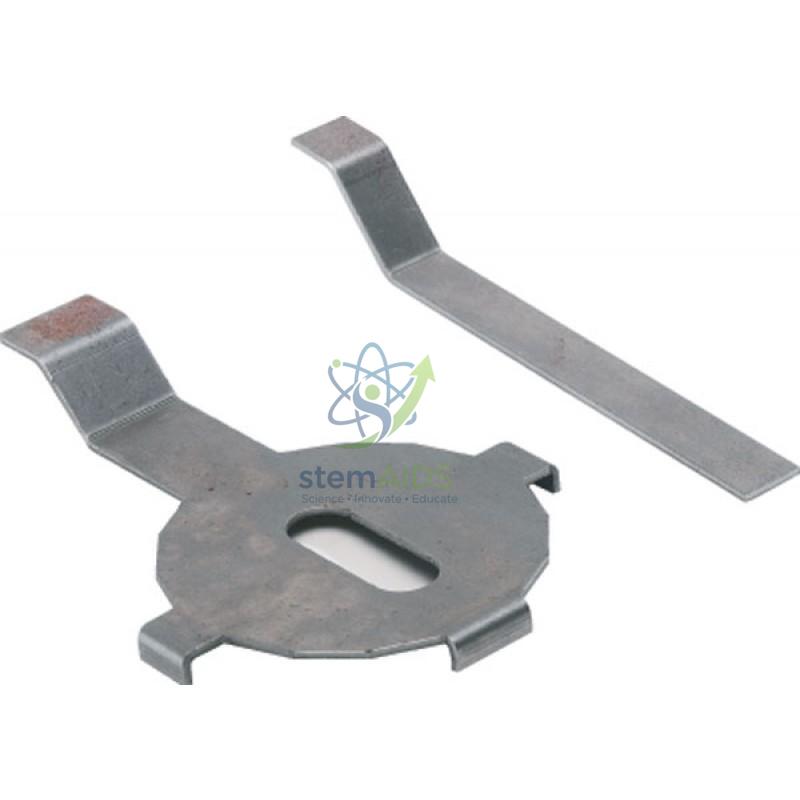
Quick Answer: The metal powder combustion set, listed as ‘Metal Powder Combustion Together’, is a demonstration accessory made of a round metal plate with a central slot and a separate bent metal blade. It is used to show how finely divided metals such as iron burn in the heat above a burner, with the residues caught on the plate.
The Chemistry Being Demonstrated
A lump of iron will not burn in air, yet fine iron powder sprinkled into strong heat gives a shower of sparks. The difference is surface area: a powder exposes far more metal to oxygen, and each tiny particle heats up almost instantly. This metal powder combustion set gives a contained way to show that effect and to compare how different metals behave.
‘Together’ in the listing name is a mistranslation of the French ‘ensemble’, meaning set. In the photo, the set consists of a round plate with bent tabs around its rim and an oblong slot in the middle, plus a long strip bent at one end into a blade. Residues and slag from the burning powder are collected on the plate so they can be examined after the reaction; follow the supplied instructions for positioning the blade and the powder.
Useful comparisons include iron, copper and zinc; aluminium powder burns more vigorously and should be used only in small amounts by the teacher. Magnesium powder is better left out of class work, because it burns with an intensely bright light and is hard to extinguish. Zinc gives a memorable residue: its oxide is yellow while hot and white once cool.
Applications
- Showing the effect of surface area on reaction rate by comparing iron powder with a piece of iron wire
- Comparing how readily metals react with oxygen during a reactivity series lesson
- Collecting and examining oxide residues, such as the colour change of zinc oxide as it cools
- Teacher demonstrations on combustion and oxidation for secondary classes
Specifications
| Item | Metal powder combustion demonstration set |
| Listed as | Metal Powder Combustion Together |
| Parts shown | Round metal plate with central slot and rim tabs; separate bent metal blade (photo) |
| Purpose | Burning small quantities of metal powder and collecting the residue |
| Metal powders | Confirm at enquiry |
Care & Handling
- Use only a small pinch of powder at a time, and keep the stock bottle capped and well away from the heat.
- Wear eye protection, and have students watch from a safe distance, behind a safety screen if one is available.
- Never use water on burning metal; smother small metal fires with dry sand kept close by.
- Let the plate and blade cool fully before scraping residues into a labelled container for disposal under local rules.
Why Choose LabEquip
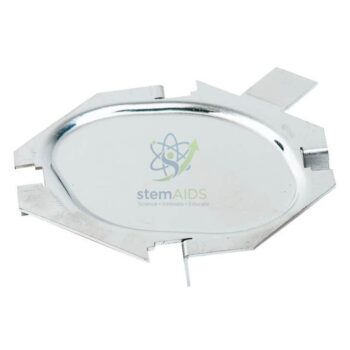
Chemistry teachers who want a repeatable, contained way to demonstrate metal combustion and surface-area effects buy this set to use alongside a bench burner. LabEquip lists it in chemistry lab equipment next to the solid fuel burning plate; ask about pairing it with a burner through the contact page.
Frequently Asked Questions
Why does iron powder burn when an iron nail does not?
Burning needs metal and oxygen to meet. A fine powder exposes a huge surface area, and each particle is so small that it reaches ignition temperature almost at once. A nail has a small surface and its bulk carries heat away, so it only oxidises slowly.
Which metal powders are suitable for classroom demonstrations?
Small amounts of iron, copper and zinc powder are the usual choices. Aluminium powder reacts more vigorously and needs extra care. Magnesium powder burns with blinding intensity and is generally better avoided in class demonstrations.
What does the zinc residue show?
Zinc burns to zinc oxide, which is yellow while hot and turns white as it cools. It is a clear example of a product whose colour can be watched changing on the plate after the reaction.
Why is the item called ‘Together’ in the listing?
It is a translation error. The original French name used ‘ensemble’, which means set, and it was rendered as ‘together’. The product is a metal powder combustion set.
How should a metal powder fire be put out?
Do not use water, which can react with some hot metals and scatter burning particles. Switch off the heat and smother a small fire with dry sand. Keeping the amount of powder small makes a fire unlikely in the first place.
Will the colours be the same over an electric burner as over a gas flame?
Not always. Colours such as the green seen when copper powder enters a gas flame come from the flame itself being coloured, so they will not appear in the same way above an electric burner. Sparks and oxide residues are seen with either heat source.
Last Updated: September 2026





Reviews
There are no reviews yet.