
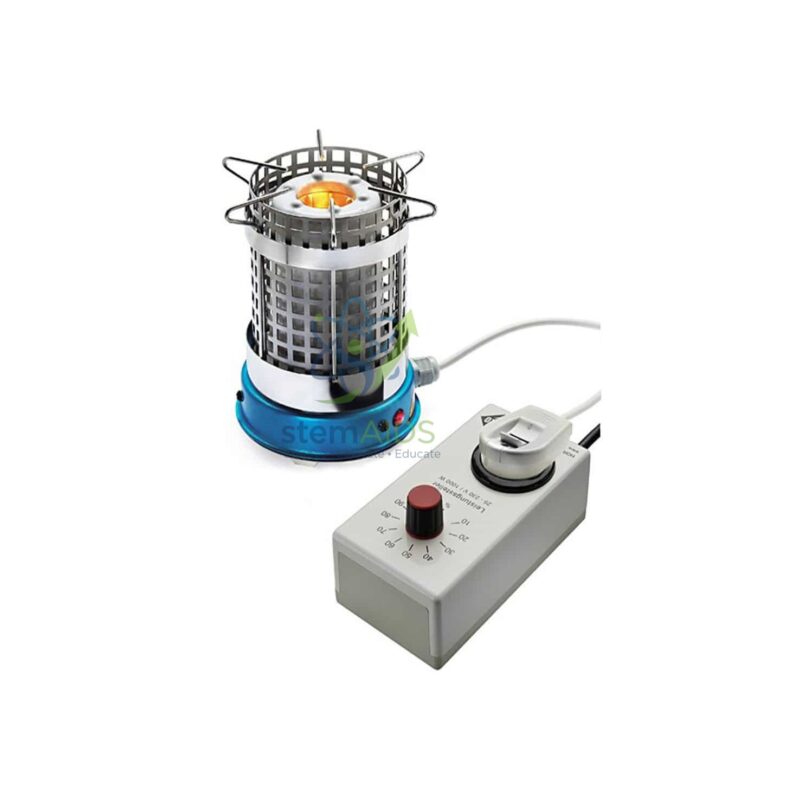
Quick Answer: The Hofmann electric burner is an upright cylindrical laboratory heater that replaces a gas Bunsen burner. The listing photo shows it with a glowing core inside a perforated metal guard, standing on a round blue base and connected to a separate control box with a dial.
How the Hofmann Burner Is Put Together
Most electric burners in this range are box-shaped. The Hofmann burner is different: a narrow upright unit, closer in outline to a gas Bunsen burner, with the heat coming out of the top of a vertical core. In the photo the core glows orange, the unit stands on a round blue base, and a cable runs to a separate box with a dial.
Two items in that photo are listed separately. The Hofmann electric burner guard is the perforated steel cylinder with vessel supports that surrounds the core, and the regulator for the Hofmann burner is a plug-in box that sets heating power.
A tall, narrow heat source suits jobs where a vessel is held over a point of heat: a boiling tube in a holder, or a small flask clamped above the core. With the guard fitted, a small beaker or evaporating dish can rest on the guard’s supports instead of on a tripod.
Specifications
| Item | Hofmann electric laboratory burner |
| Form | Upright cylindrical heater on a round base (photo) |
| Heat source | Electric heating core; no gas |
| Related parts | Guard and power regulator, each listed separately |
Care & Handling
- Stand the Hofmann burner on a level surface; its upright shape tips more easily than a flat box, so keep it clear of cables and elbows.
- Fit the guard before classes use it, and never reach over the open core.
- If a vessel boils over, switch off at the socket, let the burner cool and clean the outside before reuse; never pour water onto a hot core.
- Allow the core and guard to cool completely before lifting the burner or packing it away.
Applications
- Heating test tubes and boiling tubes held in a holder above the core
- Warming small beakers or evaporating dishes resting on the guard’s supports
- Controlled heating demonstrations when paired with the power regulator
- Chemistry benches in schools that have removed or never installed gas taps
Why Choose LabEquip
Schools and colleges that want an electric heat source shaped like a familiar Bunsen burner, with the option of adding power control, are the usual buyers of the Hofmann burner. It is listed with its accessories in LabEquip’s chemistry lab equipment; ask for burner, guard and regulator together via the contact page.
Related Products
- Hofmann Electric Burner Guard: The perforated guard with vessel prongs that fits around this burner’s heating core.
- Regulator for Hofmann Electric Burner: The plug-in regulator that sets the heating power of the Hofmann burner with a dial.
- LAB Microbiology Electric Bunsen Burner: A cage-type electric Bunsen burner designed for loop sterilisation in microbiology.
- Laboratory Bunsen Burner Set of 2: A pair of gas Bunsen burners for labs with a gas supply that want a conventional flame instead.
Frequently Asked Questions
What is a Hofmann electric burner?
It is an upright electric laboratory heater that replaces a gas Bunsen burner. The listing photo shows a narrow unit on a round blue base with a glowing core inside a perforated metal guard, and a cable to a separate control box with a dial. Heat comes from the top of a vertical core rather than a flame.
Is the guard included with the Hofmann electric burner?
The guard and the regulator shown in the photo are each listed separately, as the Hofmann electric burner guard and the regulator for the Hofmann electric burner. Plan a class set with all three items in mind, since the guard is what lets a vessel rest over the core and keeps hands off the element.
Why would a Hofmann electric burner need a regulator?
Without a control, an electric burner runs at full power whenever it is switched on. That suits sterilising a loop, but not warming a solution slowly. The plug-in regulator reduces the power reaching the core, so the heat can be set low for gentle warming or high for strong heating.
How is a Hofmann electric burner different from a hot plate?
A hot plate heats a flat-based vessel through its whole base. The Hofmann burner delivers heat from a narrow upright core, closer to the shape of a gas flame, so it suits a test tube or loop held in the hot zone and small vessels resting on the guard over a point of heat.
What happens if liquid is spilt into an electric burner?
Switch it off and unplug it at once, let it cool, and do not use it again until it has been checked. Liquid on a live heating element can crack it or cause an electrical fault, and spilt solutions can corrode the core. Keep vessels small and avoid overfilling them on the burner.
Is an electric burner safer than a gas burner for students?
It removes the gas supply and open flame, which reduces the fire risk around hair, sleeves and flammable solvents. The core still becomes very hot and gives no visible flame warning once it stops glowing, so students must treat it as hot, use the guard and let it cool before packing away.
Last Updated: November 2026






Reviews
There are no reviews yet.