


In Stock
Hoffman Electrolysis Apparatus
₹2,356.00
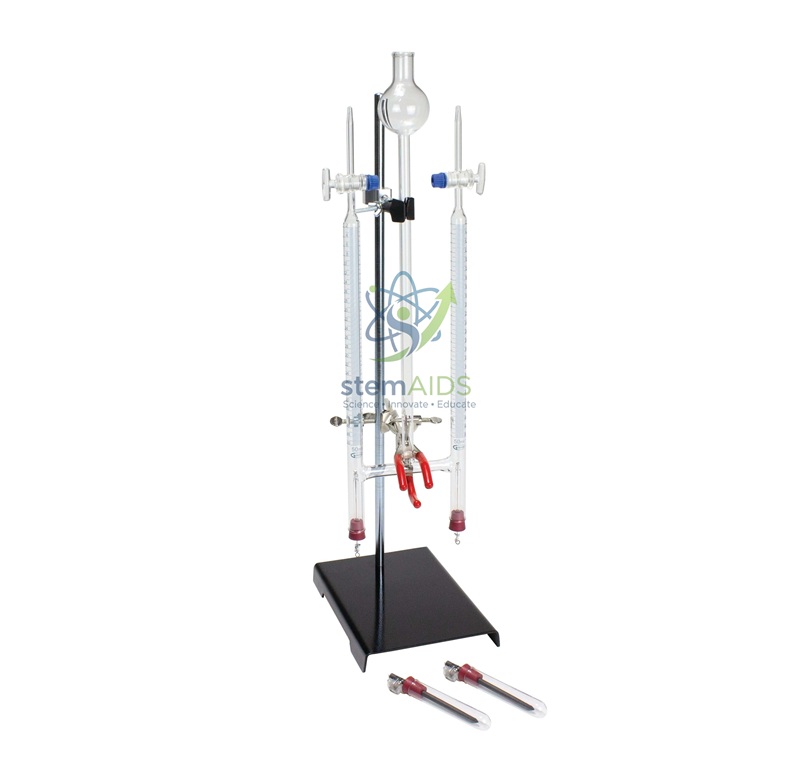
Quick Answer: The Hofmann voltameter, listed here as ‘Hoffman Electrolysis Apparatus’, is a three-limbed glass apparatus for electrolysing water and collecting the hydrogen and oxygen separately. The listing photo shows two graduated side tubes with stopcocks, a central reservoir tube topped by a bulb, and electrodes entering through stoppers at the base, all held on a stand.
How the Three Limbs Work Together
The apparatus takes its name from the chemist August Wilhelm von Hofmann, and ‘Hoffman’ in the listing is a common misspelling. Its two outer limbs are graduated gas-collecting tubes, each closed at the top by a stopcock and fitted at the bottom with an electrode sealed through a stopper. The central limb, open at the top and widening into a bulb, is the reservoir: it joins the outer tubes at the base and keeps them filled with electrolyte.
With the stopcocks open, the electrolyte, usually water made conducting with a little dilute sulfuric acid or sodium sulfate, is poured into the central limb until both outer tubes are full, and the stopcocks are then closed. When direct current flows, hydrogen collects above the cathode and oxygen above the anode. After a few minutes the hydrogen column is visibly about twice as long as the oxygen column, the 2:1 ratio that matches the formula of water.
Because the gases are trapped in graduated tubes, their volumes can be read and each gas tested at its stopcock. The Brownlee electrolysis apparatus collects gases in tubes standing in a jar instead, and the mini electrolysis device is a compact alternative for student benches.
Specifications
| Item | Hofmann-type electrolysis apparatus (voltameter) |
| Listed as | Hoffman Electrolysis Apparatus |
| Glassware | Two graduated side tubes with top stopcocks and a central reservoir limb with bulb (photo) |
| Electrodes | Enter the side tubes through stoppers at the base (photo) |
| Support | Stand with clamps (photo) |
| Electrode material | Confirm at enquiry |
Applications
- Demonstrating the 2:1 volume ratio of hydrogen to oxygen from the electrolysis of water
- Testing the collected gases with lighted and glowing splints
- Relating the charge passed to the volume of gas produced in Faraday’s law investigations
- Comparing the rate of gas production with different electrolyte concentrations
Care & Handling
- Fill the Hofmann voltameter with dilute electrolytes only, and wear eye protection when filling and draining it.
- Use a low-voltage DC supply, and switch it off before touching the electrode connections.
- Never release both gases together near a flame; test one stopcock at a time with the other closed.
- Drain, rinse with distilled water and store with the stopcock keys loosened so that they do not stick.
Why Choose LabEquip
The Hofmann voltameter is bought by teachers who would rather a class measured the composition of water than simply be told it. It is one of LabEquip’s chemistry lab equipment listings; ask on the contact page about electrode type and a suitable power supply.
Frequently Asked Questions
Why is the hydrogen volume twice the oxygen volume?
Each water molecule contains two hydrogen atoms and one oxygen atom, and at the same temperature and pressure equal numbers of gas molecules take up equal volumes. Electrolysis therefore gives two volumes of hydrogen for each volume of oxygen.
Why is the measured ratio often slightly more than 2 to 1?
Oxygen is more soluble in water than hydrogen, and some may react with the anode, so a little less oxygen collects than expected. Running the apparatus for a few minutes before taking readings lets the electrolyte become saturated.
What electrolyte should be used?
Pure water conducts very poorly, so a small amount of dilute sulfuric acid or sodium sulfate is added. These make the water conduct while still giving hydrogen and oxygen at the electrodes.
Is it spelled Hoffman or Hofmann?
The apparatus is named after the chemist August Wilhelm von Hofmann, so Hofmann voltameter is the usual spelling. Hoffman electrolysis apparatus refers to the same item.
What power supply is needed?
A low-voltage direct current supply, such as the DC output of a school laboratory power pack. Alternating current does not separate the gases, because each electrode would keep switching between producing hydrogen and oxygen.
How are the gases tested safely?
Open one stopcock at a time. Hold a lighted splint near the hydrogen jet, which burns with a squeaky pop, or a glowing splint at the oxygen tube, which relights. Never release both gases together near a flame.
Last Updated: September 2026
You must be logged in to post a review.
Bestsellers




Reviews
There are no reviews yet.