













In Stock
Funnel, Separating
High-Stability Borosilicate 3.3 Construction: Fabricated with uniform heavy-wall thickness to provide exceptional resistance to thermal shock and aggressive organic solvents, ensuring structural integrity during vigorous manual agitation.
Precision-Ground Stopcock Assembly: Features a micro-adjustable PTFE or glass stopcock with a 1:10 taper, engineered for a leak-proof seal and smooth rotational control to prevent reagent loss during volumetric separation.
$6.77
Quick Answer: A separating funnel, also called a separatory funnel, is a glass vessel with a stopper at the top and a stopcock above an outlet stem at the bottom. It is used to separate two immiscible liquids, such as an organic solvent and water, and for liquid-liquid extraction, draining the lower layer out through the tap.
Extraction Between Two Liquids That Do Not Mix
Liquid-liquid extraction relies on a compound dissolving better in one liquid than in another. When an aqueous solution and an immiscible organic solvent are shaken together in the funnel, the compound distributes itself between them, and after the layers settle the denser one lies at the bottom. Opening the stopcock drains the lower layer; the upper layer is then poured out through the top so it is not contaminated by drops left in the stem.
Which layer is which depends on density, not on which liquid is organic. Diethyl ether, ethyl acetate and hexane float on water, while dichloromethane and chloroform sink below it. A few drops of water added to the funnel show which layer is aqueous by joining it.
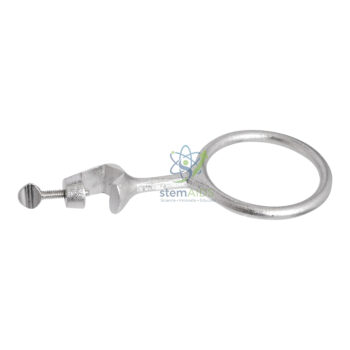
The title does not state the body shape (pear, globe or cylindrical), capacity or whether the stopcock is glass or PTFE. Glass keys need a thin film of grease; PTFE keys run without grease but must not be overtightened. Support the funnel in a ring on a retort stand, with a conical flask beneath to collect each layer.
Applications
- Extracting iodine from aqueous solution into a non-polar solvent such as cyclohexane in class demonstrations
- Washing an organic product with sodium hydrogencarbonate solution and water during a synthesis work-up
- Separating an oil and water mixture in lessons on separation techniques
- Adding a reagent slowly to a reaction, with the tap used to control the flow
Care & Handling
- Close the stopcock and test it for leaks with water before adding the mixture.
- Vent often: invert the funnel, hold the stopper in, and open the tap with the stem pointing away from people, especially with volatile solvents or carbonate washes.
- Take the stopper out before draining, or the lower layer will stop flowing as a partial vacuum forms.
- After use, dismantle the stopcock for cleaning and store a glass key apart from its barrel so it cannot seize.
Specifications
| Item | Separatory funnel with top stopper, stopcock and outlet stem |
| Principle | Separation of immiscible liquids by density; solvent extraction |
| Support | Iron ring or funnel holder on a retort stand |
| Stopcock | Glass or PTFE, not stated in the listing |
| Shape and capacity | Confirm at enquiry |
Why Choose LabEquip
Organic chemistry courses, pharmacy colleges and research groups use a separatory funnel in almost every synthesis work-up. It forms part of LabEquip’s chemistry lab equipment; say what capacity and stopcock type you need on the contact page.
Frequently Asked Questions
Is a separating funnel the same as a separatory funnel?
Yes. Separating funnel is the usual term in British and Indian laboratories and separatory funnel is common in American usage; both describe the same stoppered vessel with a tap at the bottom.
How do I know which layer is organic?
Compare densities, or add a few drops of water and watch which layer they join. Solvents less dense than water, such as ether and hexane, form the top layer; denser solvents, such as dichloromethane, form the bottom layer.
Why must the funnel be vented while shaking?
Volatile solvents build vapour pressure when shaken, and carbonate washes release carbon dioxide. Without venting, the pressure can force out the stopper and spray the contents. Vent through the tap with the stem pointed away from people.
Why does the liquid stop draining from the tap?
The stopper is probably still in place. As liquid leaves, a partial vacuum forms above it and holds the rest in. Remove the stopper, or turn it so its vent groove lines up with the hole in the neck, if it has one.
What causes an emulsion and how do I break it?
Vigorous shaking, fine solids and soap-like substances can leave the layers mixed as a cloudy emulsion. Swirling gently instead of shaking, waiting, adding saturated sodium chloride solution, or filtering through glass wool usually helps the layers separate.
Should the stopcock be greased?
A glass stopcock needs a very thin film of grease, applied in two bands away from the bore, so it turns smoothly and does not leak. A PTFE stopcock needs no grease; keep it clean and loosen its retaining nut for storage.
Last Updated: September 2026
You must be logged in to post a review.
Bestsellers





Reviews
There are no reviews yet.