







In Stock
Density Blocks
$7.33
Quick Answer: Density blocks are solid blocks of different materials that students measure with a ruler, weigh on a balance and use to calculate density. They show that density is a property of the material rather than of the object’s size, and they can be tested for floating or sinking in water.
Working Out Density from a Block
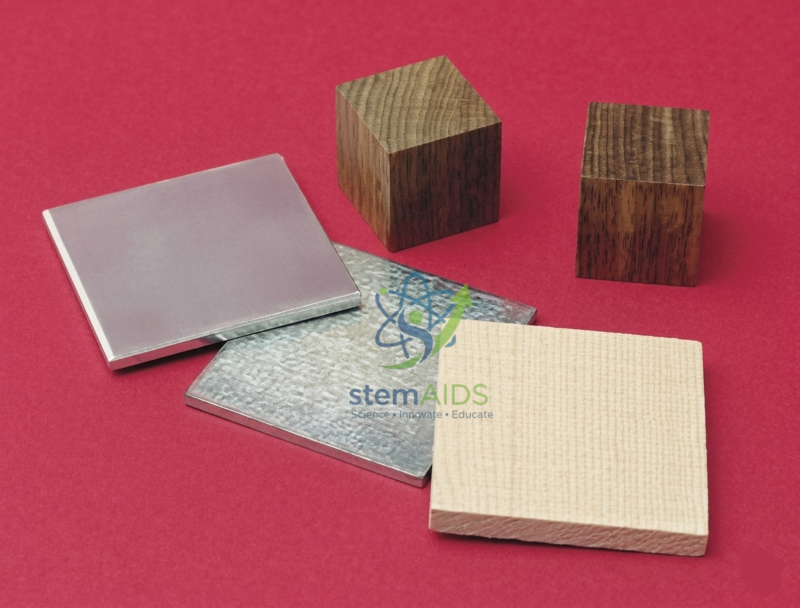
The listing does not give the shapes, sizes or materials of the blocks, and its image is an illustration showing wooden cubes and flat square plates of wood and metal. Whatever the final mix, the method is the same. Students measure the length, width and height of a block, multiply them for the volume, weigh the block and divide mass by volume.
Real blocks are rarely perfect, so each dimension should be measured in two or three places and averaged, and the effect of a one-millimetre error on a small block discussed. A block that is too irregular for a ruler can have its volume found by displacement instead, using a clear overflow can and a measuring cylinder.
Blocks of the same material in different sizes or thicknesses give the same density even though their masses differ greatly, which tackles the common belief that heavier means denser. The density cube set of 10 takes the opposite approach, keeping the size fixed and changing the material.
Applications
- Calculating density from three measured dimensions and the mass
- Comparing a calculated volume with one found by water displacement
- Showing that density does not depend on size, using two pieces of one material
- Predicting floating and sinking in water, then checking by experiment
Specifications
| Item | Density blocks for measuring and calculating density |
| Used for | Mass, dimensions and float-or-sink comparisons |
| Measuring tools needed | Ruler or vernier calipers, balance, container of water |
| Listing image | Illustrative; shows wood and metal cubes and plates |
| Materials, sizes and number of blocks | Confirm at enquiry |
Care & Handling
- Measure each dimension of the density blocks at two or three points and average the results, especially on wood.
- Dry blocks after water tests, because wet wood gains mass and may swell.
- Zero the balance before each weighing and keep blocks off the pan between measurements.
- Store the blocks in a labelled box so each material can be identified in later lessons.
Why Choose LabEquip
Teachers who build density lessons around measurement skills, rather than simply comparing weights, buy density blocks for their classes. LabEquip lists them in its chemistry lab equipment; send the materials and sizes you want through the contact page.
Frequently Asked Questions
How do students find the density of a block?
Measure the length, width and height, multiply them to get the volume, then weigh the block. Dividing the mass by the volume gives the density, usually in grams per cubic centimetre.
Does a bigger block of the same material have a higher density?
No. A bigger block has more mass but also more volume, in the same proportion, so its density stays the same. Comparing two sizes of one material demonstrates this clearly.
What if a block is too irregular to measure with a ruler?
Find its volume by displacement instead. Lower it into a full overflow can and collect the water that runs out, or note the rise in level in a measuring cylinder.
Why do wooden blocks give variable results?
Wood is not uniform. Grain, knots, species and moisture content all change its density, and damp wood weighs more, so results for wood vary more than results for metals or plastics.
What materials are the blocks made of?
The listing does not specify them, and its image is illustrative, showing wood and metal pieces. Ask for the materials and block sizes when you enquire.
Which blocks float?
Blocks with a density lower than water, about 1 gram per cubic centimetre, float. Most dry woods float while metals sink; a block’s density, not its size or weight, decides the result.
Last Updated: September 2026
You must be logged in to post a review.
Bestsellers





Reviews
There are no reviews yet.