














In Stock
Brownlee Electrolysis Apparatus
₹1,045.00
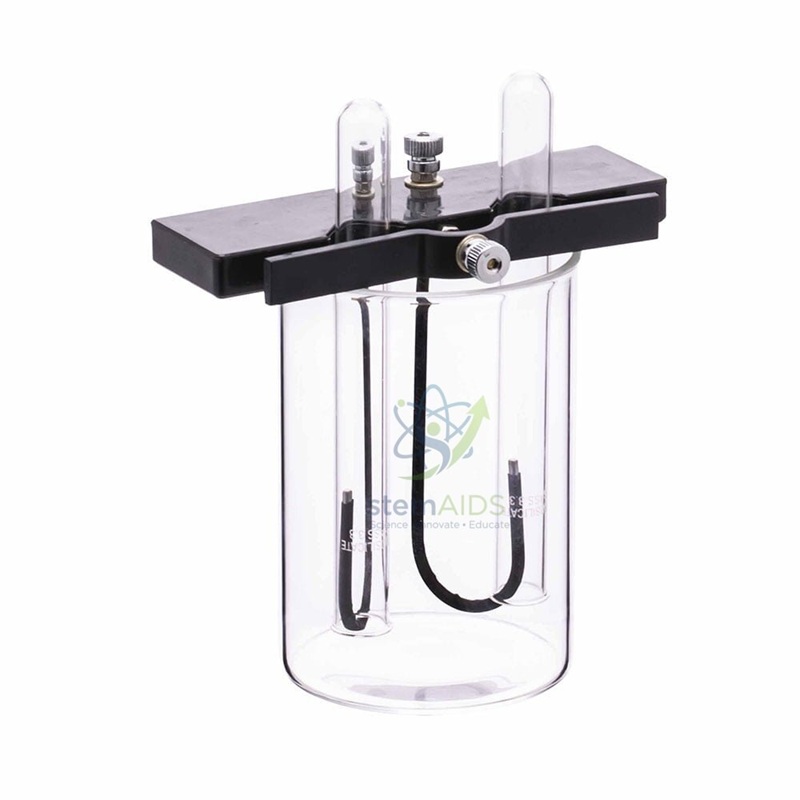
Quick Answer: The Brownlee electrolysis apparatus is a jar-type electrolysis cell in which two electrodes rise into inverted collecting tubes held by a bar across the top. The listing photo shows a clear jar, a black cross-bar with two terminal posts, and curved insulated electrodes whose tips sit inside two glass tubes.
A Jar Cell with Removable Collecting Tubes
The Brownlee design is a simpler, sturdier alternative to the three-limbed Hofmann voltameter. There are no stopcocks and no long reservoir limb: the jar holds the electrolyte, the cross-bar carries the terminals, and each electrode is bent so that its bare tip points upward into a collecting tube standing in the jar. Gas released at the tip rises into the tube and pushes the liquid down.
The tubes are held in the cross-bar, so a tube full of gas can be lifted out, kept mouth downwards, and tested straight away: hydrogen with a lighted splint and oxygen with a glowing one. Because the whole cell stands on the bench without clamps, it is quick to set up at the front of the class and easy to fill and empty.
Compared with the Hofmann voltameter, the Brownlee cell has fewer parts and nothing to seize, while the voltameter gives more precise gas volumes. For groups working at their own benches, the mini electrolysis device is smaller again.
Applications
- Electrolysis of dilute sodium sulfate solution, collecting hydrogen and oxygen separately
- Testing the collected gases with lighted and glowing splints
- Showing that gas forms at the cathode about twice as fast as at the anode
- Copper plating onto the cathode from copper(II) sulfate solution
Care & Handling
- Run the Brownlee apparatus from a low-voltage DC supply, and switch off before adding or removing tubes.
- Wear eye protection when filling the jar and handling acidified electrolytes.
- Rinse the jar, tubes and electrodes with water after use, and dry the terminals to prevent corrosion.
- Inspect the electrode insulation before each use; damaged insulation lets gas form away from the tubes.
Specifications
| Item | Brownlee-type electrolysis apparatus |
| Cell | Clear jar with a black cross-bar across the top (photo) |
| Terminals | Two terminal posts on the cross-bar (photo) |
| Electrodes | Insulated, bent upward, with bare tips inside the collecting tubes (photo) |
| Gas collection | Two tubes held in the cross-bar over the electrode tips (photo) |
| Electrode material | Confirm at enquiry |
Why Choose LabEquip
Teachers who want a robust bench-top electrolysis cell for demonstrations, without the stopcocks and clamps of a voltameter, choose the Brownlee apparatus. It is listed with LabEquip’s chemistry lab equipment; ask about electrode type on the contact page.
Frequently Asked Questions
How does the Brownlee apparatus collect the gases?
Each electrode is bent so its bare tip points upward inside a collecting tube filled with electrolyte. Gas released at the tip rises into the tube and displaces the liquid, so the two gases are kept apart.
How is it different from a Hofmann voltameter?
It has no stopcocks, reservoir limb or stand. The gases collect in tubes standing in a jar, which makes it quicker to set up and sturdier, while the Hofmann voltameter gives more precise gas volumes.
Why are the electrodes insulated along their length?
Only the bare tips should be exposed to the electrolyte, directly under the tubes. Insulation stops gas forming along the rest of the electrode, where it would escape into the jar instead of being collected.
Which electrolyte gives hydrogen and oxygen?
Dilute sodium sulfate solution or very dilute sulfuric acid. Both make water conduct while leaving hydrogen at the cathode and oxygen at the anode as the products.
How are the collected gases tested?
Lift a full tube out, keeping its mouth downward. A lighted splint at the mouth gives a squeaky pop with hydrogen, and a glowing splint placed in the oxygen tube relights.
Can it be used for copper plating?
With copper(II) sulfate solution, copper deposits on the cathode as a pink-brown coating. Oxygen still forms at an inert anode, so the tube over the anode continues to collect gas.
Last Updated: September 2026
You must be logged in to post a review.
Bestsellers






Reviews
There are no reviews yet.