















In Stock
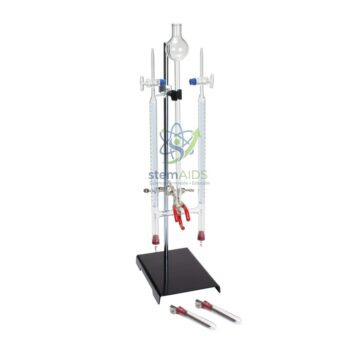
Arsenic Apparatus
Precision-Ground Interchangeable Joints: Engineered with standardized, CNC-ground joints to ensure an airtight hermetic seal, preventing the leakage of hazardous arsine gas during the chemical reduction process.
Integrated Scrubber Geometry: Features a specialized glass scrubber tube designed for lead acetate-soaked media, effectively filtering out hydrogen sulfide interferences to ensure high-purity reaction outcomes and analytical accuracy.
₹540.00
Quick Answer: An arsenic apparatus is a glass assembly used for the limit test for arsenic by the Gutzeit method. Arsenic in the sample is converted to arsine gas, which passes up a tube and stains a test paper impregnated with a mercuric salt; the stain is compared with one produced from a standard arsenic solution.
How the Gutzeit Test Works
The sample is dissolved in acid in the generator bottle or flask of the apparatus, and potassium iodide and stannous chloride are added to reduce any arsenic to the trivalent state. Zinc granules then generate hydrogen, which converts the arsenic to arsine gas. The gas rises through a glass tube packed with cotton wool moistened with lead acetate solution, which removes hydrogen sulfide that would otherwise darken the paper, and then meets mercuric chloride or mercuric bromide paper held across the top, depending on the pharmacopoeia followed. A yellow to brown stain forms in proportion to the arsenic present.
The result is a limit test, not a measurement. The stain from the sample is compared with that from a standard containing the permitted amount of arsenic, run at the same time in an identical apparatus. If the sample stain is no more intense than the standard, the sample passes. That is why arsenic apparatus is normally used in matched pairs.
Pharmacopoeias describe the apparatus in detail, including the bore of the tube and the way the paper is clamped, and the monograph being followed takes precedence. The listing title does not state which pattern this apparatus follows or which parts are included.
Care & Handling
- Carry out the test in a fume cupboard: arsine is highly toxic, and the hydrogen generated by the zinc is flammable.
- Handle mercuric salt papers with gloves, and dispose of used papers and lead acetate cotton as hazardous waste.
- Use arsenic-free zinc and reagents, and run a blank if contamination is suspected; a stained blank shows the reagents are unsuitable.
- Clean the apparatus with dilute acid and then distilled water after every test.
Applications
- Limit test for arsenic in pharmaceutical raw materials in pharmacy college practicals
- Quality control of chemicals and excipients against pharmacopoeial limits
- Teaching qualitative trace analysis in analytical chemistry
- Screening laboratory reagents for arsenic contamination
Specifications
| Method | Gutzeit limit test for arsenic |
| Typical parts | Generator bottle, tube for lead acetate cotton, paper holder at the top |
| Detection | Mercuric chloride or mercuric bromide test paper |
| Material | Glass |
| Pattern and parts included | Confirm at enquiry |
Why Choose LabEquip
Pharmacy colleges and pharmaceutical quality-control labs buy arsenic apparatus for limit tests, usually as a matched pair for sample and standard. LabEquip lists it with its chemistry lab equipment and within its wider range of pharmacy lab equipment; state the pattern you follow on the contact page.
Frequently Asked Questions
What is the Gutzeit test?
A limit test for arsenic in which arsenic in the sample is converted to arsine gas, which stains a mercuric salt test paper. The stain is compared with one from a standard arsenic solution.
Why is lead acetate cotton wool used in the tube?
It absorbs hydrogen sulfide, which can come from sulfur-containing samples or from the zinc and would also darken the test paper. Removing it prevents a false result.
Why are two apparatus needed?
The sample and the standard are run side by side under identical conditions. Matched apparatus means any difference in the stain comes from the arsenic content, not from the equipment.
Is the arsenic test dangerous?
Yes, if handled carelessly. Arsine is a highly toxic gas and the test papers contain mercury salts, so work in a fume cupboard, wear gloves and eye protection, and dispose of papers and residues as hazardous waste.
What does the stain colour mean?
A yellow to brown stain shows arsenic is present, and a deeper or longer stain means more of it. The sample passes the limit test if its stain is not more intense than the standard’s.
Why are stannous chloride and potassium iodide added?
They reduce arsenic in the higher oxidation state to the lower one, which the zinc and acid then convert to arsine quickly and completely, so sample and standard react in the same way.
Last Updated: September 2026
You must be logged in to post a review.
Bestsellers





Reviews
There are no reviews yet.