








In Stock
Aneroid Barometer
₹1,560.00
Quick Answer: An aneroid barometer measures atmospheric pressure with a sealed, partly evacuated metal capsule that flexes as pressure changes, moving a pointer over a dial. Schools use it in geography, physics and environmental science to track air pressure and relate it to the weather.
Inside the Aneroid Barometer
Aneroid means without liquid. Instead of a column of mercury, the instrument uses a thin, corrugated metal capsule from which most of the air has been removed, held open by a spring. When air pressure rises, the capsule is squeezed slightly; when it falls, the capsule expands. A train of levers magnifies this tiny movement and turns a pointer across a scale, usually marked in hectopascals or millibars and sometimes in millimetres or inches of mercury.
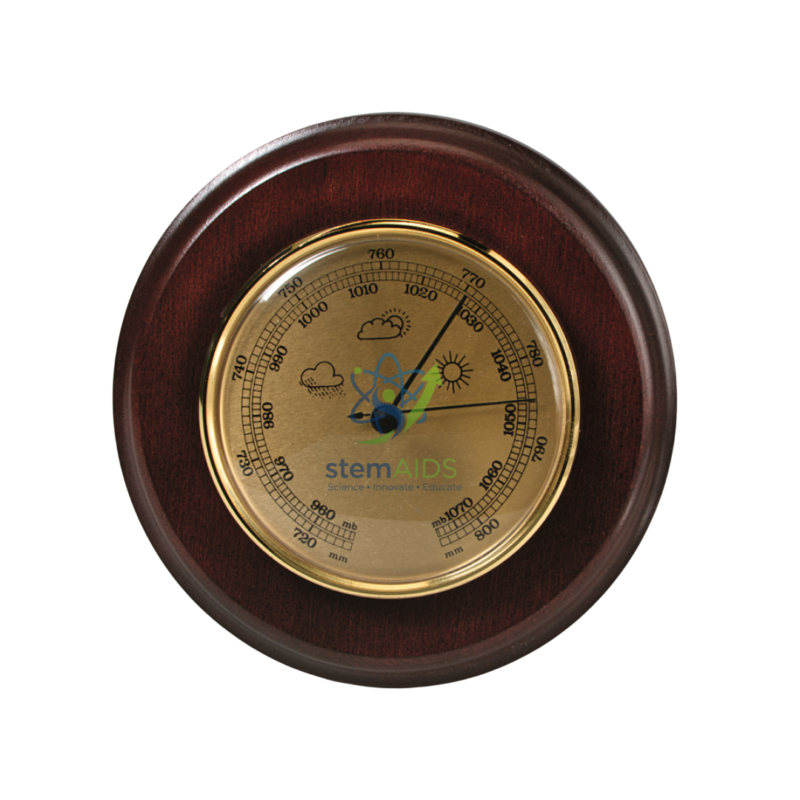
The design was patented by the French engineer Lucien Vidie in the 1840s and quickly replaced mercury barometers wherever portability mattered. The product photo shows a round dial barometer set in a wooden mount for wall or desk display. Many dials also carry a second, hand-set pointer, so the reading can be marked and compared later to see whether pressure is rising or falling.
Because the capsule responds only to pressure, the instrument has to be adjusted for the local height above sea level before its readings can be compared with weather reports. Most aneroid instruments have a small adjusting screw on the back for this.
Specifications
| Instrument | Aneroid (non-liquid) barometer |
| Sensing element | Sealed, partly evacuated metal capsule with spring and lever linkage |
| Readout | Pointer on a circular dial |
| Mounting (from product photo) | Round dial set in a wooden mount |
| Scale units and dial markings | Confirm at enquiry |
Weather Lessons
- Daily weather records in geography, logging pressure alongside rainfall from a rain measure cylinder
- Relating falling pressure to approaching low-pressure systems and rising pressure to settled weather
- Physics lessons on atmospheric pressure and how it changes with altitude
- School weather station projects, together with a simple anemometer for wind
Reading and Care
- Mount the aneroid barometer indoors on an inside wall, away from heaters, windows and direct sun, since temperature changes affect the reading.
- Tap the glass lightly before reading to free the pointer from friction in the linkage.
- Do not open the case or force the adjusting screw; the mechanism is delicate.
- Dust the case and glass with a dry cloth only.
Why Choose LabEquip
Geography departments, science labs and school weather clubs buy this dial barometer as the pressure instrument for a classroom weather station. LabEquip carries it in the biology lab products range; for class or department quantities, write to us via the contact page.
Frequently Asked Questions
How does an aneroid barometer work?
A sealed metal capsule with most of its air removed is squeezed by rising air pressure and expands when pressure falls. Levers and a fine chain magnify that small movement and turn the pointer across the dial, so the reading follows the pressure outside.
Why should I tap the barometer before reading it?
Friction in the linkage can hold the pointer slightly behind the true value. A gentle tap on the glass frees it to settle. If the pointer jumps, note the direction: a jump downward suggests pressure has been falling.
How do I set the barometer to local pressure?
Find the current sea-level pressure for your area from a weather service such as the India Meteorological Department, then turn the adjusting screw on the back until the pointer matches it. After that, the barometer reads pressure corrected to sea level for your altitude.
Do the words on the dial, such as rain and fair, predict the weather?
Only roughly. The direction and speed of change tell you more than the pointer’s position. Steadily falling pressure often means unsettled weather is coming, and rising pressure usually signals improvement, but local conditions vary.
What is the difference between an aneroid and a mercury barometer?
A mercury barometer balances air pressure against a column of mercury and needs no calibration, but it is long, fragile and contains toxic mercury. The aneroid type is compact, portable and mercury-free, which suits schools, though it must be set against a reference.
Can the barometer be used to show changes in altitude?
Air pressure falls with height, so the same principle is used in altimeters, which are aneroid instruments with a scale marked in metres. A classroom barometer shows pressure dropping if carried up a tall building or hill, a simple demonstration of the effect.
Last Updated: September 2026
You must be logged in to post a review.
Bestsellers




Reviews
There are no reviews yet.