
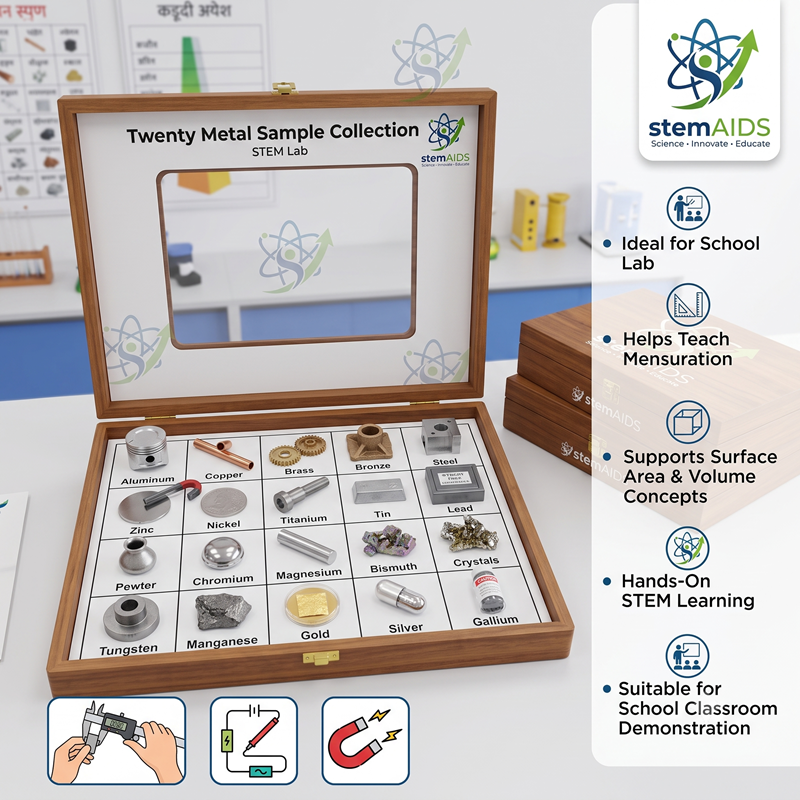
Quick answer: The Twenty Metal Sample Collection is a set of 20 real metal specimens for hands-on classroom study, letting students compare colour, lustre, surface texture and physical properties across different metallic materials.
Product Description
The LabEquip Twenty Metal Sample Collection brings 20 separate specimens together for comparative classroom study. Learners can place the samples side by side and record observable attributes such as colour, lustre, surface texture, specimen form and response to approved non-destructive tests.
The collection supports chemistry, physics and introductory materials-science lessons on metal properties and classification.
Specifications
| Specification | Detail |
|---|---|
| Product name | Twenty Metal Sample Collection |
| Brand | LabEquip |
| Product category | Chemistry / physics laboratory specimen collection |
| Number of specimens | 20 metal samples |
Suggested Use
- Distribute or display specimens for students to examine under supervision.
- Ask students to record observations on colour, lustre, texture and form for each specimen.
- Use only approved, non-destructive tests when comparing physical properties.
- Relate observed properties to common practical applications of each metal.
Care & Maintenance
- Handle specimens carefully to avoid dropping or scratching surfaces.
- Return each specimen to its labelled position in the collection after use.
- Store the collection in a dry location to reduce the risk of corrosion or tarnishing.
- Wash hands after handling specimens, particularly before eating.
Why Choose LabEquip
For related specimen collections, see our Twenty Rock Specimen Collection, Twenty Mineral Specimen Collection, or visit the LabEquip homepage to browse our full catalogue.
Related Products
- Ten Metal Collection: A smaller ten-metal set focused on magnetism, density and conductivity tests.
- Metals & Alloys Set, Collection of 24 Metals & Alloys: A set of 24 metals and alloys for a wider comparison between pure metals and mixtures.
- Twenty Mineral Specimen Collection: A mineral collection for comparing natural minerals with the refined metal samples in this set.
- Bar Magnet, Pair, Alnico: A pair of Alnico bar magnets for testing which of the twenty samples are magnetic.
Frequently Asked Questions
How can a 20-sample metal collection be used to classify metals?
Students sort the twenty samples into groups by observable properties, such as ferrous and non-ferrous, magnetic and non-magnetic, or light and heavy for their size. Comparing sorting results across groups leads into how metals are classified in chemistry and engineering.
What is the difference between a pure metal and an alloy?
A pure metal contains only one element, such as copper or aluminium. An alloy is a mixture of a metal with other elements, such as brass (copper and zinc) or steel (iron and carbon). Alloys are often harder or more resistant to corrosion than the pure metals they are made from.
Why are copper and gold coloured when most metals are silver-grey?
Most metals reflect nearly all colours of visible light equally, so they look silvery. Copper and gold absorb some blue light because of the arrangement of their electrons, so the light they reflect looks reddish or yellow. Alloys containing copper, such as brass, share this warm colour.
How can students compare the hardness of metal samples?
A scratch test is the simplest method: try scratching one sample with another, and the harder one leaves a mark on the softer. Students can rank the set from softest to hardest. Use light pressure and the same corner of each sample so the test stays fair.
How do metal properties decide what each metal is used for?
Copper conducts electricity well and bends easily, so it is used for wires. Aluminium is light and resists corrosion, so it suits aircraft and drink cans. Iron and steel are strong and cheap, so they are used for buildings and machines. Students can link each sample in the set to a real use.
How should a metal sample collection be stored to prevent tarnishing?
Keep the collection in a closed case in a dry place, away from damp, acids and cleaning chemicals. Handle samples with clean, dry hands, since moisture and salt from skin speed up corrosion. A small sachet of silica gel in the box helps keep the air dry.
Last Updated: November 2026









Reviews
There are no reviews yet.