

Sale
In Stock
Solar and Lunar Eclipse Educational Model
Original price was: ₹600.00.₹290.00Current price is: ₹290.00.
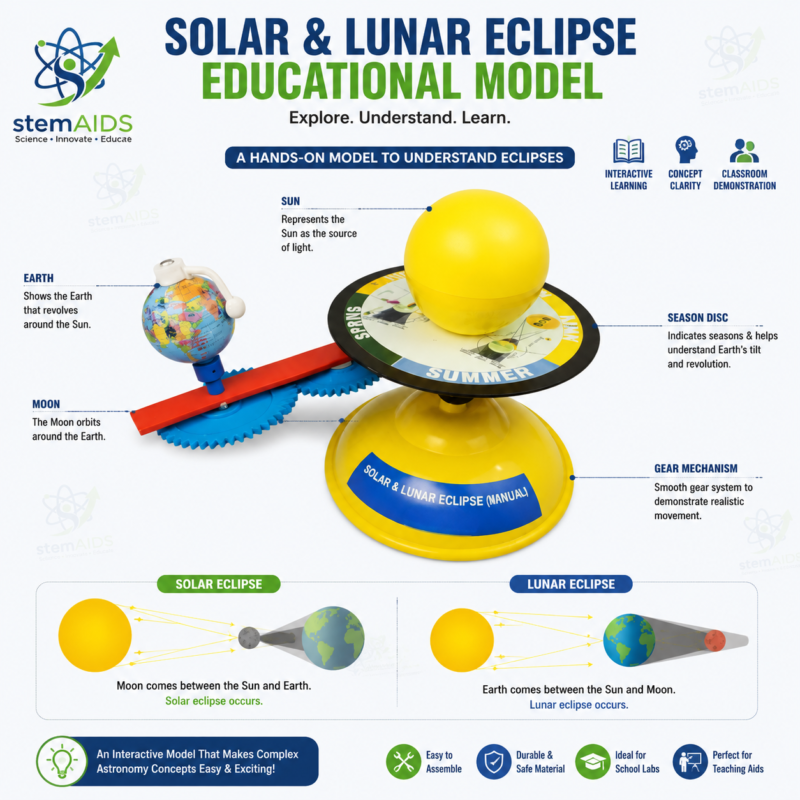
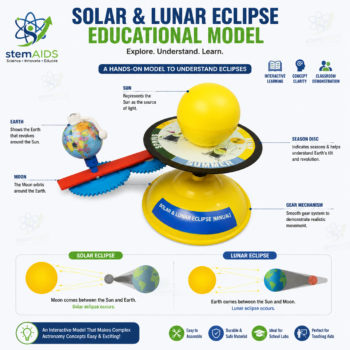
Quick answer: The Solar and Lunar Eclipse Educational Model demonstrates both types of eclipse in one teaching aid: a solar eclipse (Moon between Sun and Earth) and a lunar eclipse (Earth between Sun and Moon). Students can physically position the Sun, Earth and Moon representations to see how shadow and alignment create each eclipse type, and why eclipses do not happen every month.
Description
The Solar and Lunar Eclipse Educational Model from LabEquip gives students a physical reference for comparing two distinct astronomical alignments. A solar eclipse occurs when the Moon passes between the Sun and Earth, casting a shadow on Earth’s surface. A lunar eclipse occurs when Earth passes between the Sun and Moon, casting Earth’s shadow onto the Moon.
By repositioning the Sun, Earth and Moon representations, learners can examine how shadows form and understand why eclipses require a specific alignment rather than occurring during every lunar orbit. The model is intended as a conceptual teaching aid for classroom demonstration, not a precision orbital simulator.
What’s Included
- Sun, Earth and Moon representations
- Adjustable arm or mount for repositioning the bodies
- Base or demonstration stand
- Teacher instructions or student activity sheet
Exact included accessories can vary by batch. Please confirm the current configuration with our sales team before ordering if a specific accessory is required.
Specifications
| Product Type | Solar and lunar eclipse educational / demonstration model |
| Bodies Represented | Sun, Earth, Moon |
| Key Concepts | Eclipse geometry, shadow formation, orbital alignment |
| Subject Area | Astronomy, space science, STEM |
| Recommended For | School and college astronomy labs, science exhibitions |
| Dimensions / Materials | Confirm with our sales team for the current batch specification |
Applications / Uses
- Comparing solar eclipse and lunar eclipse alignments side by side
- Teaching shadow formation (umbra/penumbra concepts)
- Explaining why eclipses do not occur every month
- Supporting astronomy lessons, school projects and science exhibitions
Care & Maintenance
- Store the model in a dry, dust-free location when not in use.
- Handle the Sun, Earth and Moon representations gently to avoid damaging paint or printed detail.
- Clean with a soft, dry cloth; avoid solvents on painted or printed surfaces.
- Check the adjustable arm or mount periodically and tighten any loose fittings before classroom use.
Why Choose LabEquip
LabEquip supplies astronomy teaching models to schools and colleges, backed by responsive support from our team at [email protected]. Pair this model with other Sun-Earth-Moon teaching aids:
- Eclipse Demonstration Working Model
- Day and Night Cycle Teaching Model
- Four Seasons Educational Apparatus
- LabEquip Home
FAQs
What is the difference between a solar and a lunar eclipse?
A solar eclipse happens when the Moon passes between the Sun and Earth. A lunar eclipse happens when Earth passes between the Sun and Moon.
Why doesn’t an eclipse happen every month?
The Moon’s orbit is tilted relative to Earth’s orbit around the Sun, so the Sun, Earth and Moon are rarely in perfect alignment; the model helps demonstrate this concept.
Can the model show both eclipse types with the same set?
Yes, the Sun, Earth and Moon representations can be repositioned to demonstrate either a solar or a lunar eclipse alignment.
Is this suitable for younger students?
Yes, it is designed as a classroom teaching aid suitable for introductory astronomy lessons at school level.
How do I get exact dimensions or material details?
Please contact our sales team at [email protected] for the current batch specification sheet.
Last Updated: September 2026
You must be logged in to post a review.
Bestsellers
Sale
Sale
Sale
Sale
Sale
Sale
Sale


Reviews
There are no reviews yet.