
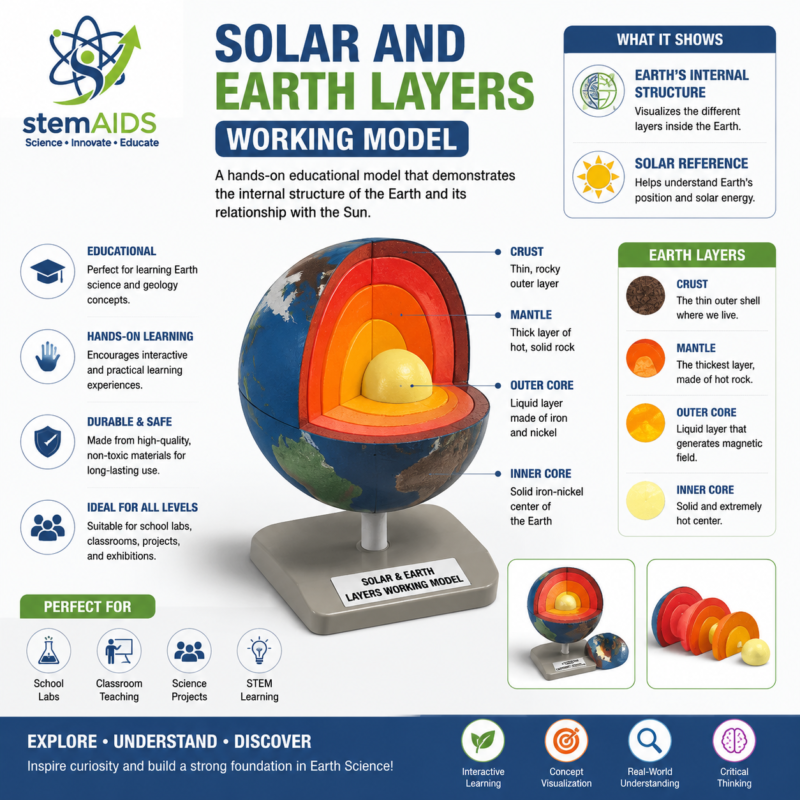
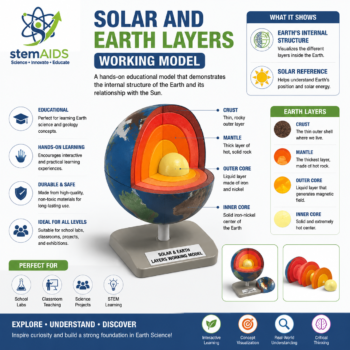
Quick answer: The Earth Layers Working Model demonstrates Earth’s internal structure through a visual cross-section showing the crust, mantle, outer core and inner core, making otherwise inaccessible geological regions easy to identify and compare.
Product Description
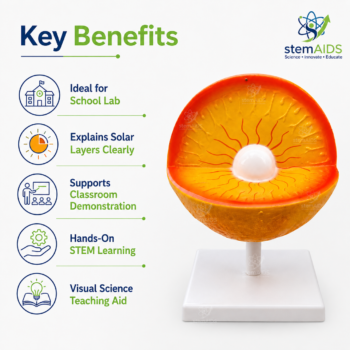
The LabEquip Earth Layers Working Model presents the principal compositional layers beneath Earth’s surface. The model supports instruction on the thin outer crust, the much thicker mantle, the liquid outer core and the solid inner core.
A physical cross-section gives learners clearer spatial context than a flat diagram alone, helping students compare the relative thickness and physical state of each layer.
Specifications
| Specification | Detail |
|---|---|
| Product name | Earth Layers Working Model |
| Brand | LabEquip |
| Product category | Astronomy / Earth science laboratory apparatus; Earth structure model |
| Layers represented | Crust, mantle, outer core, inner core |
Suggested Use
- Use the cross-section to point out each layer from the outer crust to the inner core.
- Compare the relative thickness of the crust, mantle and core layers.
- Discuss the physical state (solid or liquid) of each layer.
- Relate Earth’s internal structure to related topics such as plate tectonics or the geomagnetic field.
Care & Maintenance
- Handle the model carefully to avoid damaging the cross-section detail.
- Keep the model clean and free of dust for clear classroom visibility.
- Store the model in a stable location when not in use.
- Avoid dropping or applying excess pressure to layered components.
Why Choose LabEquip
For related Earth-science teaching resources, see our Geological Seismograph Apparatus, Day and Night Cycle Teaching Model, or visit the LabEquip homepage to browse our full catalogue.
Related Products
- EARTH’S LAYERS MODEL: Another Earth’s layers model offered as an alternative cross-section for comparing displays.
- Earth Globe Internal Structure: An Earth globe with an internal-structure cut-away, showing the layers in relation to the surface map.
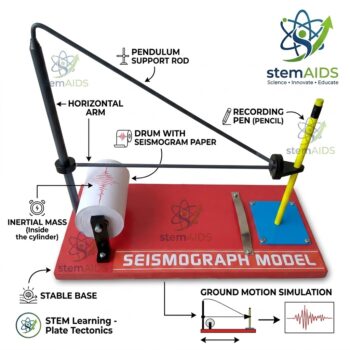
- Geological Seismograph Apparatus: A seismograph apparatus for explaining how earthquake waves are detected, the main evidence for Earth’s layers.
- Twenty Rock Specimen Collection: Twenty rock specimens that show students the materials that make up the crust.
Frequently Asked Questions
What are the four main layers of the Earth shown on a layers model?
This model shows the crust, mantle, outer core and inner core. The crust is the thin rocky skin we live on; the mantle is hot rock that flows very slowly; the outer core is liquid iron and nickel; and the inner core is a solid ball of iron and nickel at the centre.
How thick is each layer of the Earth?
Textbook figures are: crust about 5 to 10 km under oceans and 30 to 70 km under continents, mantle about 2,900 km thick, outer core about 2,200 km thick, and an inner core with a radius of about 1,200 km. Comparing these with the model shows students how thin the crust really is.
Why is the Earth’s inner core solid when it is hotter than the outer core?
Pressure. The weight of all the layers above squeezes the inner core so hard that iron and nickel stay solid even at temperatures above their normal melting point. Higher up, in the outer core, the pressure is lower and the metal is molten. This liquid outer core is linked to Earth’s magnetic field.
How do scientists know what is inside the Earth if nobody has drilled to the core?
Mainly from earthquake waves. Seismic waves change speed and bend as they pass through layers of different density, and S-waves cannot travel through liquid, leaving a shadow zone on the far side of Earth. Records from seismographs around the world revealed the liquid outer core and the solid inner core.
What is the difference between the crust and the lithosphere?
The crust is the outermost chemical layer. The lithosphere is a mechanical layer made of the crust plus the rigid top of the mantle, and it is broken into tectonic plates. Below it lies the asthenosphere, a weaker zone of the mantle on which the plates move.
How can an Earth layers model be used in a classroom lesson?
Students label each layer, put them in order of depth, state whether each is solid or liquid and compare relative thickness. The model then leads into plate tectonics, volcanoes and earthquakes. A boiled egg or a peach cut in half is a familiar comparison for the crust, mantle and core.
Last Updated: November 2026


Reviews
There are no reviews yet.