
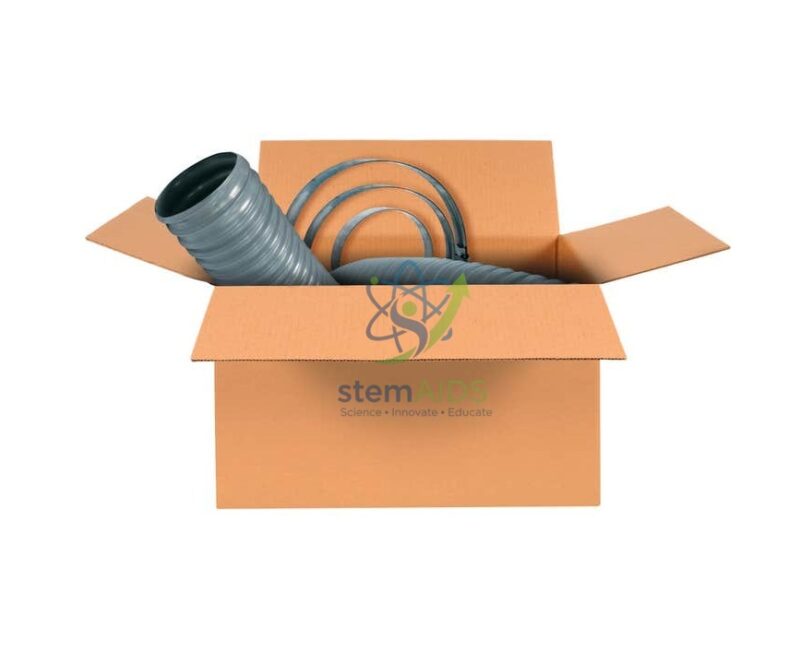
Quick Answer: The complete fan support for ø125 with 7.5m hose is a ventilation accessory set for hoods and workstations with a ø125 outlet, pictured as a boxed kit with grey flexible hose. It provides the mounting for an extraction fan and 7.5 m of hose to carry the exhaust to an outside discharge.
Planning an Exhaust Run with the ø125 Set
A ducted enclosure is only as good as its exhaust path. This set covers the part between the hood outlet and the outside: support for the extraction fan and 7.5 m of flexible hose sized for a ø125 connection, normally read as a 125 mm diameter in ventilation fittings. Flexible hose is quick to fit and can be routed around obstacles, which suits small enclosures such as the external ducted hood with 2 hand passages or workstation units.
Every metre of hose and every bend adds resistance, so the fan has to work harder to keep the same airflow at the hood. Route the hose as straight and short as the building allows, avoid sagging loops where condensate can collect, and never squash it through tight gaps.
Where the fan sits also matters. Placing it towards the discharge end keeps most of the hose under suction, so any small leak draws room air in rather than pushing fumes out into occupied space. The discharge itself should point away from windows, doors and air intakes.
Installation Checks
- Secure every joint with clamps so the hose cannot slip off the outlet or fan spigots
- Support the hose at intervals to prevent sagging, especially across horizontal runs
- Inspect the hose for splits, crushing and loose joints at regular intervals
- Measure airflow at the hood opening after installation and after any change to the routing
Specifications
| Product | Fan support set with flexible exhaust hose |
| Connection size (title) | ø125 |
| Hose length (title) | 7.5 m |
| As pictured | Boxed kit with grey flexible ducting hose |
| Fan inclusion, mounting hardware and fan rating | Confirm at enquiry |
Applications
- Connecting a small ducted hood or enclosure to an outside discharge
- Ventilating a hazardous-material workstation where fixed ductwork is not available
- Temporary exhaust during lab refurbishment
- Replacing a worn or damaged flexible exhaust run
Why Choose LabEquip
Labs connecting a small enclosure or workstation to extraction without a full ductwork contract use a set like this. LabEquip supplies it with other ventilation items in its general lab products range, such as the Asecos APA 900mm frame; describe your hood outlet and the distance to the outside through the contact page.
Frequently Asked Questions
What does ø125 mean?
It is the nominal diameter of the duct connection, normally read as 125 mm in ventilation fittings. The hood outlet, hose and fan spigots must all match this size for an airtight connection.
Is 7.5 m the maximum exhaust run?
It is the length of hose in the set. Whether the fan keeps enough airflow over that length depends on the fan, the number of bends and the hood, so measure the airflow at the hood once the run is installed.
Why place the fan near the outside end?
With the fan near the discharge, most of the hose inside the building is under suction. A small leak then draws room air in, instead of pushing contaminated air out into the room.
Can the hose run out through a window?
A window panel adapter or wall sleeve can be used, but the discharge should point away from openable windows, doors and air intakes so fumes are not drawn back inside.
How do I know the airflow is adequate after installation?
Measure the inflow at the hood opening with an anemometer and compare it with the hood’s stated requirement. Repeat the check after any change in routing or when the hose is replaced.
Is the complete fan support suitable for all fumes?
Flexible hose suits many uses, but corrosive or solvent-laden exhaust can attack some hose materials. Make sure the hose material is compatible with the substances you will extract.
Last Updated: October 2026






Reviews
There are no reviews yet.