
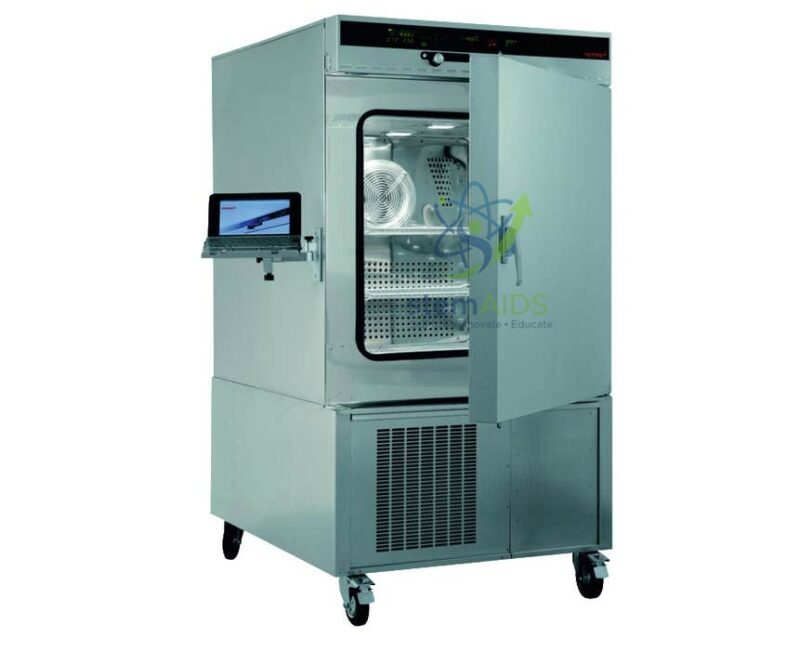
Quick Answer: The CTC environmental test chamber is a floor-standing laboratory cabinet, pictured in stainless steel on castors with a touchscreen and an inner glass door, that exposes products and materials to programmed temperature and climate conditions. Its live title reads ‘Pregnant with Environmental Testing CTC’, where ‘pregnant’ is a mistranslation of the French ‘enceinte’, meaning chamber or enclosure.
A Climate Test Chamber, Not a Storage Cabinet
Storage cabinets hold one steady condition. A test chamber is built to change conditions on purpose: ramping temperature up and down, holding at extremes and repeating cycles so that a product experiences in days what it might meet over months of use or transport. Engineers use the results to find weak joints, seals and materials before a design goes into production.
The photograph shows a larger unit than the compact cabinets in this range, with a machine compartment below the test space, castors for positioning and a touchscreen controller at the side. An inner glass door lets the operator look at test pieces without opening the chamber fully. The letters CTC are part of the model name; the title gives no temperature range, humidity capability or volume, and those must be confirmed with LabEquip before a test plan is built around the unit.
Chambers of this kind need a level floor, clearance for heat rejected by the cooling system and, if humidity is used, a water supply and drain. Plan these with your site team before delivery.
Applications
- Temperature cycling of electronic assemblies and solder joints
- Ageing tests on plastics, rubber seals and adhesives
- Checking how packaging and labels survive hot and cold transport conditions
- Research and teaching projects in materials science and engineering departments
Specifications
| Product | Environmental (climatic) test chamber |
| Model name in title | CTC |
| As pictured | Floor-standing stainless cabinet on castors, touchscreen, inner glass door |
| Typical tests | Temperature cycling, ageing and climate exposure of products and materials |
| Temperature range, humidity and volume | Confirm at enquiry |
Running Tests Safely
- Spread test pieces across shelves and never block the internal air circulation
- Bring the chamber back to room temperature before opening after a cold step, to limit frost and condensation
- Keep the door seals clean and check them for damage, since a poor seal lets moist air in
- Have the controller and sensors checked on a regular service schedule
Why Choose LabEquip
Electronics makers, materials-testing labs and engineering colleges choose a floor-standing chamber when product testing needs programmed cycles rather than one fixed condition. Where a steady storage climate is enough, the compact SP climate chamber in LabEquip’s general lab products range is the alternative; send your test conditions through the contact page.
Frequently Asked Questions
Why does the product title say ‘Pregnant’?
It is a translation error. The original French name used ‘enceinte’, which means chamber or enclosure, and the same word also means pregnant. The product is an environmental test chamber.
What is the difference between a test chamber and a climate storage cabinet?
A storage cabinet holds one set condition for long periods. A test chamber runs programmes that change temperature, and often humidity, in steps or cycles, to stress samples and reveal failures.
What is temperature cycling used for?
Repeated heating and cooling makes materials expand and contract. Joints between different materials, such as solder on circuit boards or seals in housings, can crack under this strain, and cycling shows how many cycles they survive.
Can powered devices be tested inside the chamber?
Many test chambers let devices run during a test, with cables led in through a sealed port. Ask LabEquip whether this unit has such a port and what heat load it can handle before planning powered tests.
Why does frost form inside after a cold step?
Moisture in the chamber air freezes on cold surfaces. Opening the door while the chamber is cold lets in more moist room air, so warm it to room temperature first, or use a drying step if the controller offers one.
How should test pieces be arranged in the environmental test chamber?
Space them on shelves so air passes around each one, and keep them away from walls and air outlets. Packed loads warm and cool unevenly, so pieces in the middle lag behind the set temperature.
Last Updated: October 2026





Reviews
There are no reviews yet.