
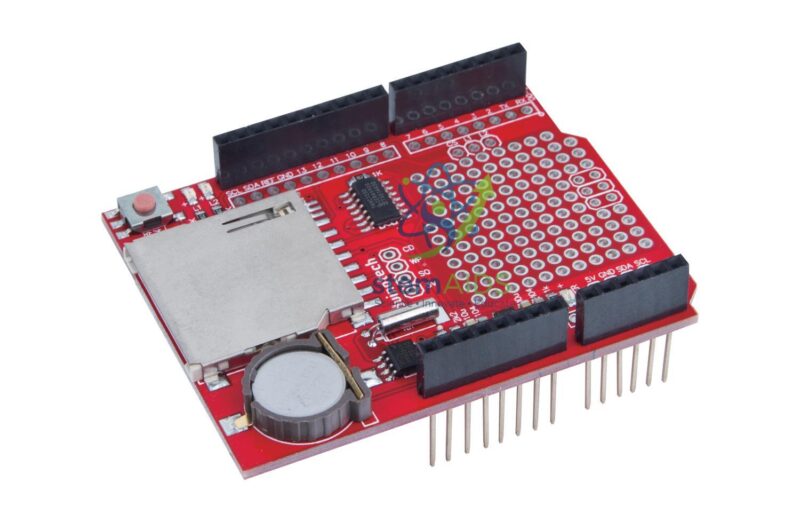
Quick Answer: The LabEquip Real-Time Clock (RTC) Module keeps accurate time and calendar data for microcontroller projects, using an I2C interface so an Arduino-style board can read seconds, minutes, hours, day, date, month and year even after it is powered off.
Description
The LabEquip Real-Time Clock Module is a small RTC timekeeping board built around an RTC integrated circuit (such as a DS1307/DS3231-class chip, depending on the specific model supplied) that communicates with a host microcontroller over the I2C interface. It supplies accurate time and calendar data — seconds, minutes, hours, day, date, month and year — independently of the main program, which is essential for projects like data loggers, digital clocks, timers and automation systems.
Many RTC modules include support for a small backup battery so the module can keep track of time even when the main board is powered down, though whether a backup battery is fitted/included can vary by model configuration. This makes the module a common choice in embedded systems, IoT and automation coursework where students need to timestamp events or trigger actions on a schedule.
Specifications
| Attribute | Detail |
| Brand | LabEquip |
| Product Type | RTC (Real-Time Clock) timekeeping module |
| Function | Provides real-time clock and calendar data to microcontroller-based projects |
| Typical RTC IC | DS1307, DS3231, or equivalent RTC IC, depending on the supplied model |
| Communication Interface | I2C interface for data communication |
| Supported Data | Seconds, minutes, hours, day, date, month and year |
| Operating Voltage | Commonly 3.3V or 5V compatible, depending on module configuration — confirm for your exact board with our sales team |
| Backup Battery Support | May be available on some variants for maintaining time when main power is off |
| Recommended Users | Students, teachers, makers, hobbyists and electronics trainers |
Compatibility & Safety Note
- Communicates over I2C (SDA/SCL), which is supported by most Arduino-style and similar microcontroller boards.
- Connect VCC/GND correctly before powering on; reversed connections can damage the RTC IC.
- If your module carries a backup coin-cell battery, replace it with the same battery type and observe correct polarity.
- Avoid exposing the board to moisture or static discharge during handling.
Why Choose LabEquip
LabEquip stocks Arduino-compatible sensors and modules used across school and college embedded-systems, robotics and IoT coursework. Browse related boards in our TLM Kits (Teaching Learning Material Kits) category, learn more on our homepage, or read About Us. For bulk/institutional orders or technical questions, contact us via Contact Us.
Frequently Asked Questions
Q1: What is the Real-Time Clock Module used for?
A: It provides accurate time and calendar data (seconds, minutes, hours, day, date, month, year) to microcontroller projects such as data loggers, timers and digital clocks.
Q2: How does it communicate with a microcontroller?
A: It communicates over the I2C interface, which is widely supported by Arduino-style and similar development boards.
Q3: Does it keep time when the board is powered off?
A: Some variants support a backup battery for this purpose; battery support can vary by model, so please confirm for your exact unit.
Q4: Which RTC chip does this module use?
A: Common RTC modules of this type use a DS1307, DS3231 or equivalent RTC IC, depending on the specific model supplied.
Q5: Is this suitable for school STEM and robotics projects?
A: Yes, RTC modules are a standard component in embedded systems, automation and IoT coursework.
Last Updated: September 2026





Reviews
There are no reviews yet.