
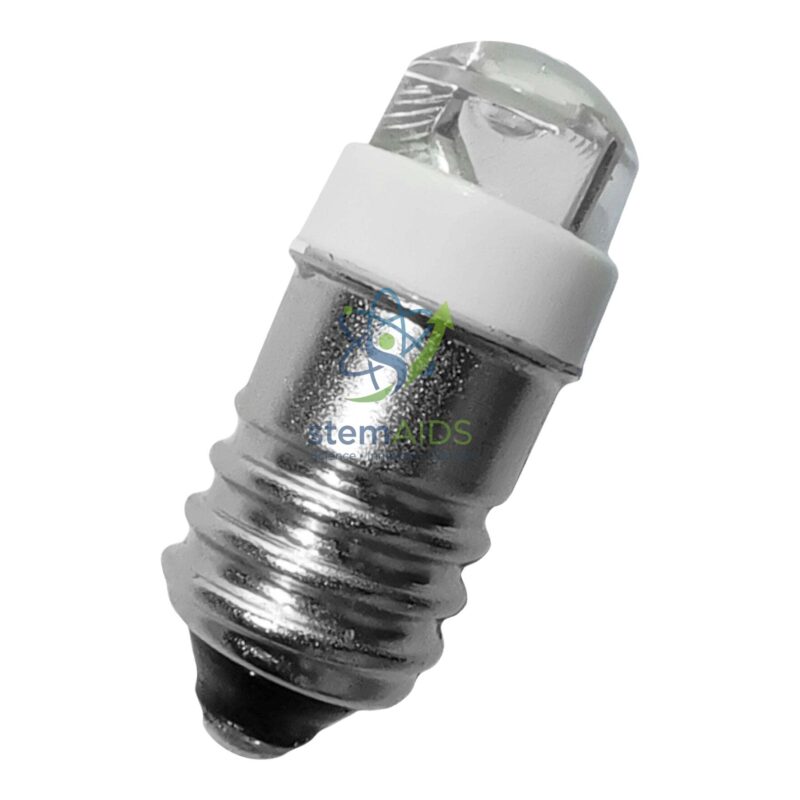
Quick Answer: The LED bulb E10 is a miniature lamp with the small E10 screw base used on torch bulbs and school circuit sockets, but with a light-emitting diode in place of a filament. It fits the same lamp holders and gives light while staying much cooler than a filament bulb.
What Changes When the Filament Becomes an LED
An E10 screw base is the miniature Edison screw found on torch bulbs and on the bulbs pushed into school circuit boards. Swapping the filament for an LED changes how the lamp behaves electrically. A filament is a resistor that glows because it is hot, and its resistance rises sharply as it warms up. An LED is a semiconductor diode: it conducts only once the voltage across it reaches a threshold, it conducts in one direction only, and it turns most of its input into light rather than heat.
Because a bare LED would draw too much current, an LED bulb E10 carries a small current-limiting circuit in its base, matched to a particular supply voltage. That is why the voltage has to be chosen to suit the circuit. Many LED replacements of this size are also polarity-sensitive, so a bulb that stays dark may simply be fitted in a holder wired the other way round; reversing the supply leads is the first thing to try.
A Lesson in Comparing Lamps
Putting the LED version and a filament bulb of similar voltage side by side in two E10 bulb sockets gives a quick practical on efficiency. With an ammeter in series with each, students find that the LED draws a fraction of the current for similar brightness, and a thermometer held against each glass after a few minutes shows where the filament’s extra energy went. Reversing the supply to each lamp in turn then separates the diode from the resistor: the filament lights either way, while a polarity-sensitive LED lamp does not.
Specifications
| Product | LED bulb with E10 screw base |
| Base | E10 miniature Edison screw |
| Light source | LED with built-in current limiting in the base |
| Fits | E10 lamp holders on circuit boards, modules and torches |
| Polarity | May be polarity-sensitive on DC; reverse the supply if it does not light |
| Operating voltage | Confirm at enquiry |
Applications
- Replacing filament torch bulbs on school circuit boards and lamp modules
- Comparing LED and filament lamps for current, brightness and heat
- Showing one-way conduction by reversing the supply to an LED lamp
- Indicator lamps on demonstration panels that stay on for long periods
Care & Handling
- Screw the LED bulb E10 in by hand until it just seats; overtightening damages the small base
- Match the bulb’s voltage to the supply before switching on
- Do not connect it to a supply above its rating, even briefly, as the built-in limiter can fail
- Store spare bulbs in a small box where the lens cannot be crushed
Why Choose LabEquip
Schools refitting circuit boards and lamp modules with LEDs are the main buyers of this bulb, often in class quantities. LabEquip can supply it with E10 holders; mention your supply voltage through our contact page so the right version is sent, and see the physics lab equipment range.
Frequently Asked Questions
Will an LED E10 bulb fit my existing circuit board sockets?
If the sockets take E10 torch bulbs, the base will screw in. Check that the bulb’s voltage matches the supply used with those boards, since an LED lamp is made for a particular voltage.
Why does the LED bulb not light in some holders?
Many LED lamps of this size conduct in one direction only. If the holder is wired with the opposite polarity, the lamp stays dark. Swap the supply leads; if it then lights, polarity was the cause.
Can an LED E10 bulb be used on AC?
Some LED miniature lamps include a rectifier and work on low-voltage AC, while others are made for DC only. Match the type to your supply and state it when ordering.
How does the LED compare with a filament torch bulb?
For similar brightness it draws much less current and runs far cooler, because a filament produces most of its output as heat. A filament lamp’s resistance also changes strongly with temperature, while an LED behaves as a diode with a threshold voltage.
Is it suitable for I-V characteristic experiments?
It is not a good choice for measuring a plain LED’s characteristic, because the built-in current-limiting circuit changes the curve. For that experiment use a bare LED with a series resistor; use the LED bulb where a ready-made lamp is wanted.
Does the LED bulb get hot?
It runs much cooler than a filament bulb, though the base and the electronics inside can become warm in an enclosed holder. Let it settle for a moment before unscrewing it after long use.
Last Updated: October 2026









Reviews
There are no reviews yet.