
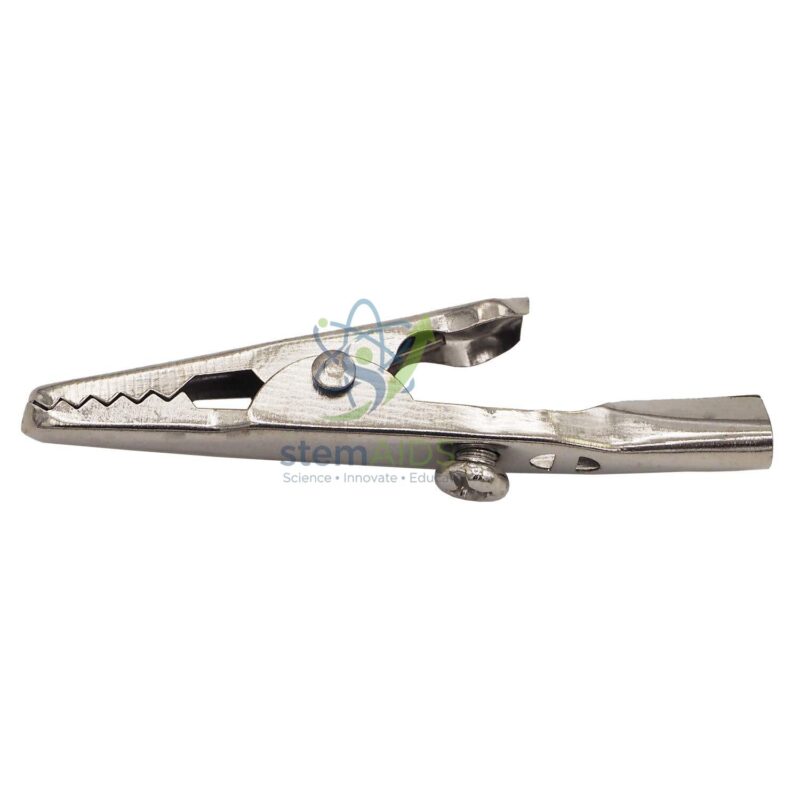
Quick Answer: Non-insulated screw crocodile clips are bare spring-loaded metal clips with toothed jaws and a screw terminal at the rear, so a wire can be clamped on without soldering. They make quick temporary connections to terminals, component leads and battery strips in low-voltage circuits.
How the Screw Terminal Works
Strip a short length of insulation from a wire, wrap the bare end clockwise round the screw at the back of the clip and tighten it. The screw clamps the wire against the clip body, giving a firm connection that can be undone and remade as often as needed. This suits schools that make up their own leads to length or replace damaged leads without a soldering iron.
Wrapping the wire clockwise matters: as the screw tightens it draws the loop in rather than pushing it out. A stray strand left outside the screw can touch a neighbouring clip, so trim strands neatly.
Specifications
| Type | Spring-loaded crocodile clip with toothed jaws |
| Connection | Screw terminal for clamping wire, as titled |
| Insulation | None, bare metal |
| Use | Temporary low-voltage connections |
| Pack quantity and jaw size | Confirm at enquiry |
When Bare Clips Are the Right Choice
With no plastic sleeve, the whole clip is exposed metal. That is acceptable for low-voltage battery and power-supply circuits, where touching the clip does no harm, and it keeps the clip slim enough to fit between closely spaced terminals. The trade-off is that two bare clips side by side can short together; where clips sit close to each other or students work quickly, insulated crocodile clips are the safer choice.
Uses
- Making up custom connecting leads without soldering
- Connecting to battery strips, component leads and terminal posts
- Holding small components and wires during circuit assembly
- Temporary test connections in electronics practicals
Care & Handling
- Use only on low-voltage circuits
- Keep clips apart so their bare bodies do not short together
- Tighten the screw again if the wire works loose
- Store dry so the spring and jaws do not corrode
Why Choose LabEquip
Bare screw clips are bought by technicians who build and repair their own leads for electricity practicals. LabEquip supplies them with ready-made alligator clip test leads and other physics lab equipment.
Frequently Asked Questions
Why choose a screw terminal clip?
It lets a wire be attached and removed without soldering, so leads can be made to any length and repaired quickly.
Are non-insulated clips safe for students?
Yes, on low-voltage circuits such as battery and bench power-supply work, where the exposed metal carries no shock risk. They should not be used on mains equipment.
How should the wire be attached?
Strip a short length of insulation, wrap the bare end clockwise round the screw and tighten it so the loop is drawn in.
What is the main drawback of bare clips?
Two clips touching each other or a metal surface can cause a short circuit. Insulated clips reduce this risk where connections are close together.
Can the clips grip thick terminals?
They grip wires, component leads, battery strips and small terminal posts. Very large terminals need a larger clip.
Why do the jaws have teeth?
The teeth bite through light oxide and hold the conductor firmly, giving a reliable electrical contact that does not slip off.
Last Updated: October 2026



Reviews
There are no reviews yet.