
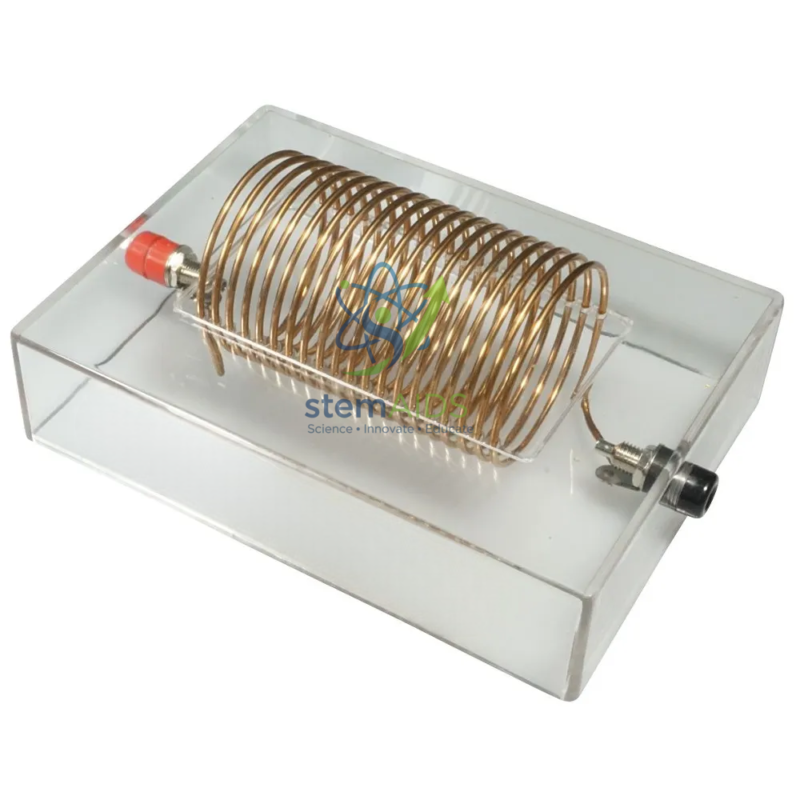
Quick Answer: This solenoid field pattern apparatus is a helical coil of copper wire threaded through a horizontal transparent plate and mounted on a clear base with terminal sockets. Sprinkling iron filings on the plate while a current flows reveals the magnetic field inside and around a solenoid.
The Pattern Students See
When direct current flows and the plate is tapped gently, the filings line up with the field. Inside the coil they form nearly parallel lines running along its axis, showing a strong, almost uniform field. Outside, the lines spread out and curve round from one end to the other, so the overall pattern closely resembles the field of a bar magnet.
Small plotting compasses placed on the plate show the direction of the field. One end of the coil behaves as a north pole and the other as a south pole, and the right-hand grip rule predicts which is which: fingers curled in the direction of the current, thumb pointing to the north end. Reversing the current swaps the poles.
Why the Coil Passes Through the Plate
Because the turns pass up and down through the plate, the horizontal surface cuts the coil along its axis. Filings on the plate therefore show a section through the field that includes the inside of the coil, which an enclosed solenoid hides from view. The open spacing of the turns seen in the product photograph lets filings settle between them.
Teaching Uses
- Comparing the solenoid field with the field of a bar magnet
- Applying the right-hand grip rule to identify the north and south ends
- Showing that the field reverses when the current reverses
- Introducing the electromagnet, relay and electric bell
Care & Handling
- Pass current only while observing; filings respond most clearly to a fairly large current and the wire warms if it is left on
- Use a current-limited DC supply or a series rheostat, since the coil alone has a low resistance
- Tip used filings onto paper and back into their container, and keep them out of the terminal sockets
- Clean the plate with a soft damp cloth; abrasive cleaners scratch clear plastic
Specifications
| Apparatus | Helical solenoid through a transparent plate |
| Base | Clear base with terminal sockets, as pictured |
| Field shown | Uniform inside, bar-magnet pattern outside |
| Used with | Iron filings or plotting compasses and a DC supply |
| Number of turns and current rating | Confirm at enquiry |
Why Choose LabEquip
This plate is chosen by teachers who need the whole class to see the inside of a solenoid field rather than only its ends. LabEquip supplies it with fine iron filings and the matching straight wire field apparatus among its physics lab equipment.
Frequently Asked Questions
Why is the field inside a solenoid nearly uniform?
The fields of the individual turns add together inside the coil and largely cancel outside, so the lines run close together and parallel along the axis. The longer and more closely wound the coil, the more uniform the inside field.
Does the solenoid behave like a bar magnet?
Outside the coil, yes. Its field pattern matches that of a bar magnet, and a compass finds a north end and a south end. Unlike a permanent magnet, it can be switched off and its poles reversed.
Why are compasses sometimes used instead of filings?
Compasses show the direction of the field as well as its shape and work with smaller currents. Filings give a quicker picture of the whole pattern but do not show which way the field points.
What happens if an iron rod is put inside the coil?
The iron becomes magnetised and greatly strengthens the field, turning the solenoid into an electromagnet. Filings near the ends then gather much more strongly.
Can AC be used?
Not for field patterns. An alternating current reverses the field many times a second, so compasses cannot settle and filings only vibrate. Use direct current.
How is it different from an enclosed solenoid used for field measurements?
An enclosed or protected solenoid is designed for probing the field along its axis. This open coil through a plate is designed for seeing the field pattern on a flat surface.
Last Updated: October 2026








Reviews
There are no reviews yet.