
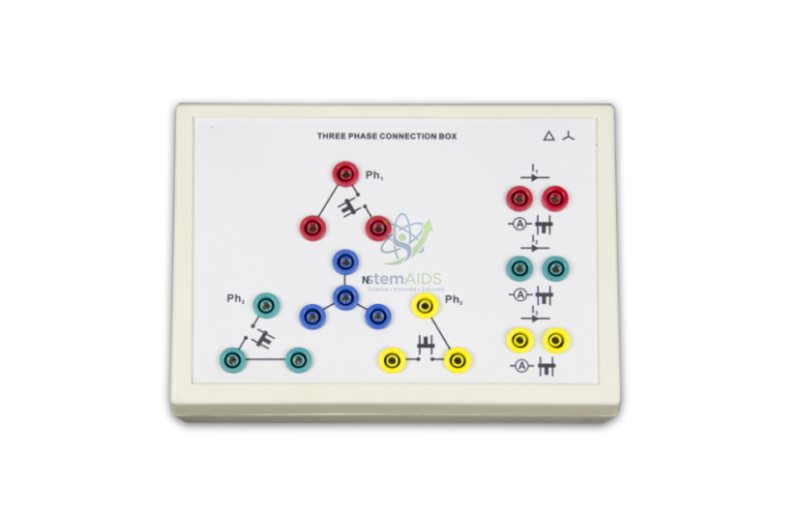
Quick Answer: The three-phase connection board is a panel of colour-coded terminal sockets laid out around a printed star and delta diagram, used to wire three loads or windings in either arrangement from a three-phase supply. Students use the three-phase connection board to compare line and phase quantities and to confirm the √3 relationship between them.
Star and Delta on One Panel
The product photograph shows a cream panel printed as a three-phase connection box, with red, blue and yellow socket groups for the three phases, green sockets for the neutral side, and small star and delta symbols in one corner. Leads plugged between the sockets build either connection without loose wires twisting together.
In star, one end of each load goes to a common point, which can be joined to neutral; each load then sees the phase voltage, and the voltage between any two lines is √3 times larger. In delta, the loads are joined end to end in a triangle across the lines, so each sees the full line voltage, and each line current is √3 times the current in one load when the loads are equal.
What the Neutral Carries
With three equal loads in star, the three currents are equal in size and a third of a cycle apart, and their sum is zero, so the neutral wire carries no current. Make one load different and a current appears in the neutral, equal to the imbalance. Measuring this on the board shows why distribution networks try to spread single-phase consumers evenly across the phases.
Specifications
| Product | Three-phase connection board (connection box) for teaching |
| Layout | Printed star and delta diagram with colour-coded phase sockets |
| Connections | Terminal sockets for laboratory leads |
| Configurations | Star (with or without neutral) and delta |
| Supply | Low-voltage three-phase teaching supply |
Experiments on the Board
- Measuring line and phase voltages in star and finding their ratio
- Measuring line and phase currents in delta with equal loads
- Showing zero neutral current with balanced loads and a neutral current with unbalanced ones
- Connecting the windings of a low voltage three-phase motor in star or delta
Care & Handling
- Feed the board only from a low-voltage three-phase teaching supply, never directly from the mains
- Wire and check every connection with the supply switched off
- Use leads with shrouded plugs and keep the colour code consistent with the phases
- Keep the panel surface clean so the printed diagram stays readable
Why Choose LabEquip
Electrical courses in technical schools and colleges use a connection board like this to make three-phase theory measurable at safe voltages. LabEquip supplies it alongside the low voltage three phase motor in its physics equipment; questions about leads and loads can be sent via the contact page.
Frequently Asked Questions
What is the difference between star and delta connection?
In star, one end of each load meets at a common point and each load gets the phase voltage. In delta, the loads form a closed triangle between the lines and each gets the full line voltage.
Why is the line voltage about 1.73 times the phase voltage in star?
The line voltage is the difference between two phase voltages that are a third of a cycle apart. Adding them as rotating arrows gives a result the square root of three times larger, about 1.73.
What happens to the neutral current when the loads are balanced?
It falls to zero. Three equal currents a third of a cycle apart cancel exactly at the star point, so nothing needs to return along the neutral.
What loads can be connected to the board?
Three matched lamps or resistors suited to the supply voltage are usual, or the winding terminals of a low-voltage three-phase motor. Use identical loads first, then change one to study imbalance.
What supply should feed the board?
A low-voltage three-phase teaching supply with protective devices. Students should never connect the board to the mains, and the teacher should check the wiring before switching on.
How is the phase current measured in delta?
Place an ammeter in series with one load inside the triangle for phase current, and in one supply lead for line current. With equal loads the line current is about 1.73 times the phase current.
Last Updated: October 2026




Reviews
There are no reviews yet.