
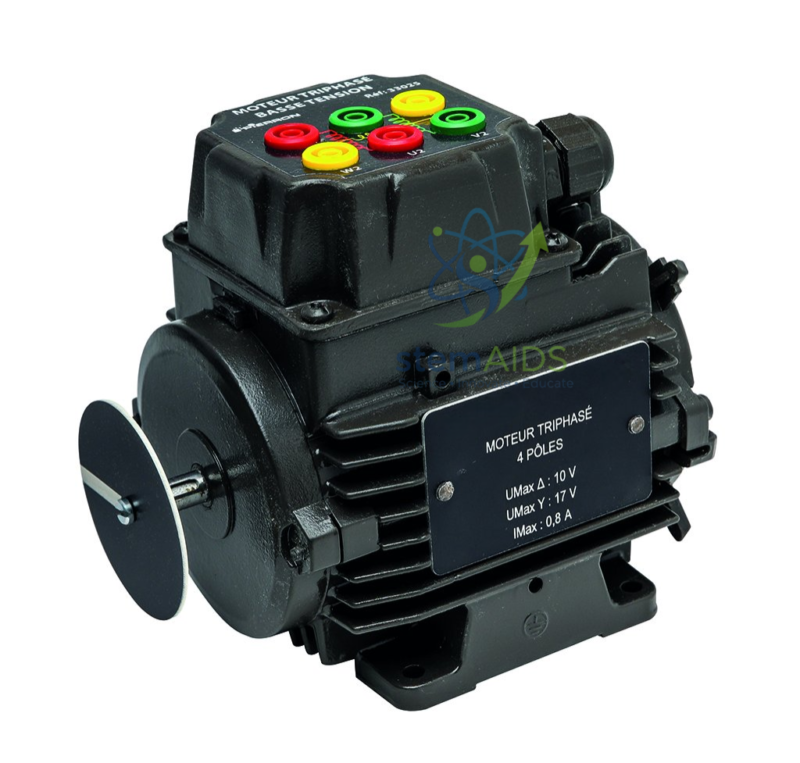
Quick Answer: The Low Voltage Three Phase Motor is a teaching-scale three-phase AC motor built to run from a low-voltage three-phase supply rather than the mains, so students can wire, start and measure a motor of industrial type at the bench. Coloured terminal sockets on top of the housing bring out the winding ends for star or delta connection.
How a Three-Phase Supply Turns the Rotor
Inside the low voltage three phase motor, three sets of stator windings are spaced around the frame, and each is fed by one phase of the supply. Because the three currents peak one after another, a third of a cycle apart, their combined magnetic field rotates around the stator at a steady speed called the synchronous speed. Nothing in the stator moves, yet the field turns.
In an induction motor the rotating field sweeps past the rotor conductors and induces currents in them; those currents feel a force that drags the rotor round. The rotor always turns a little slower than the field, a difference called slip, because if it caught up there would be no relative motion and no induced current. Swapping any two supply lines reverses the direction in which the field rotates, and the motor reverses too.
Bench Investigations
- Reversing the direction of rotation by swapping two supply lines
- Measuring shaft speed with an optical tachometer and calculating slip
- Comparing line currents with the windings in star and in delta
- Measuring the starting current and how it falls as the motor runs up to speed
Star and Delta Connection
With six winding ends available, the windings can be joined in star, where one end of each winding meets at a common point, or in delta, where the windings form a closed triangle across the lines. In star each winding receives the line voltage divided by about 1.73; in delta it receives the full line voltage. The connection must match the rating plate and the supply, and in industry the same choice is used to start large motors gently in star before switching them to delta.
Specifications
| Machine | Three-phase AC motor for teaching |
| Supply | Low-voltage three-phase, as the product name states |
| Terminals | Coloured sockets on the housing for the winding ends |
| Connections possible | Star or delta |
| Rotor type and rated values | Confirm at enquiry |
Care & Handling
- Run the motor only from the low-voltage three-phase supply its rating plate specifies, never from the mains
- Make and change all connections with the supply switched off
- Clamp or stand the motor firmly and keep fingers, hair and leads clear of the shaft
- Allow the housing to cool after long runs before handling it
Why Choose LabEquip
Technical schools, polytechnics and teacher-training colleges buy a low voltage three phase motor so students can handle a real three-phase machine without mains-voltage risks. LabEquip offers it with matching items such as the three-phase connection board among its physics equipment, and supply questions can be raised through the contact page.
Frequently Asked Questions
Can this motor be run from the mains supply?
No. It is a low voltage machine and should only be connected to a low-voltage three-phase teaching supply that matches the values on its rating plate. Connecting it to the mains would overload the windings and create a serious shock risk.
How is the direction of rotation reversed?
Switch off, then swap any two of the three supply leads. This reverses the order in which the phases peak, so the magnetic field rotates the other way and the rotor follows it.
What is slip in a three-phase motor?
Slip is the difference between the speed of the rotating field and the speed of the rotor, divided by the field speed. An induction motor needs some slip, because the rotor current that produces torque only exists while the field moves past the rotor.
When should the windings be connected in star rather than delta?
Use star when the line voltage of the supply is higher than the rating of each winding by about 1.73 times, and delta when the line voltage matches the winding rating. The rating plate states which connection suits which supply.
What other equipment is needed with the motor?
A low-voltage three-phase supply, laboratory leads, ammeters in the supply lines, a voltmeter and an optical or contact tachometer. A three-phase connection board makes star and delta wiring easier to follow.
Why does the motor draw a large current when it starts?
At standstill the rotating field cuts the rotor conductors at the greatest rate, so the induced rotor currents and the matching stator currents are large. As the rotor speeds up, the slip falls and so does the current.
Last Updated: October 2026




Reviews
There are no reviews yet.