
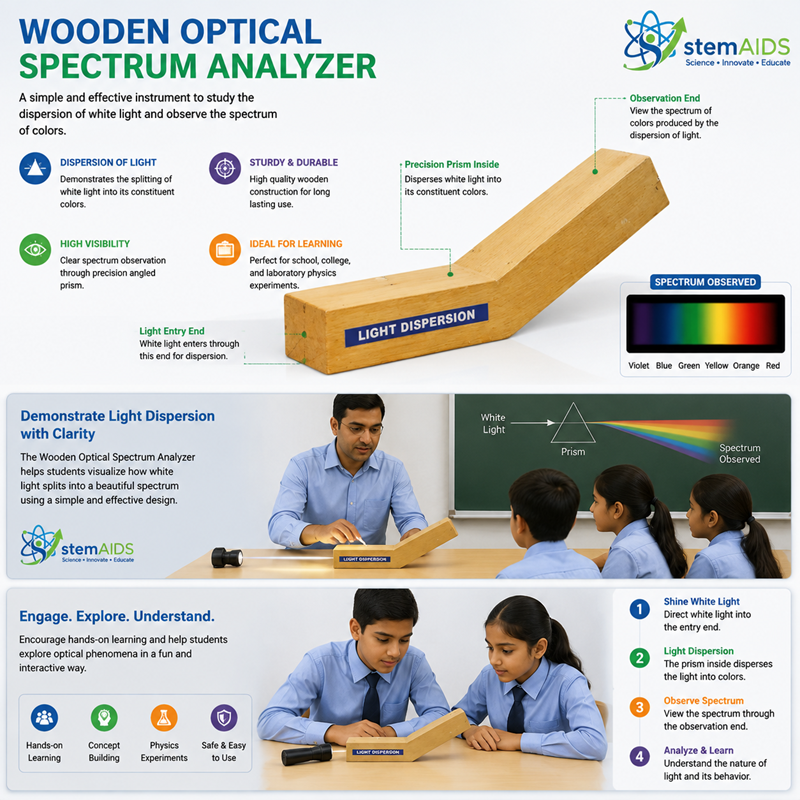
Quick Answer: The Wooden Optical Spectrum Analyzer is a bent wooden viewing box with a prism at the bend. White light from a torch or lamp enters one arm, is split by the prism, and travels down the second arm, so a student looking in at the viewing end sees the light spread into a spectrum of colours from red to violet.
Why the Box Is Bent
The listing image of the wooden optical spectrum analyzer shows two rectangular wooden arms joined at an angle, like a shallow letter V lying on its side. The lower end is marked as the light entry, the upper end as the observation end, and a prism is labelled inside, at the bend. In the classroom scenes a torch is held at the entry end.
A prism does two things to light. It bends the light towards its base, and it bends violet more than red, because the refractive index of glass is slightly higher for shorter wavelengths. The bend in the wooden box follows that deviation, so the spread-out colours run along the second arm straight to the eye. The enclosed arms also shut out stray room light, which makes the colours richer than those from a bare prism on a bench.
Isaac Newton’s prism experiments showed that white light is a mixture of colours rather than a pure colour that the glass somehow stains. With this box, students can repeat the essential observation, then try coloured filters at the entry end to see which parts of the spectrum each one passes. A comparable hand-held instrument for looking at the line spectra of gases is the Optical Spectrum Analyzer. The size of the entry opening and of the prism should be confirmed at enquiry.
Applications
- Showing the dispersion of white light into a spectrum
- Explaining why a prism bends violet light more than red
- Comparing torches, filament lamps and LEDs, and testing coloured filters
- Linking dispersion to rainbows and Newton’s prism experiments
Care & Handling
- Keep the box in a dry cupboard, since damp can swell or warp the wood.
- Clean the outside with a dry cloth only, and keep dust out of the openings.
- Handle gently and do not shake the box, which can loosen the prism mounting.
- Never aim the entry end at the Sun.
Specifications
| Instrument type | Prism spectroscope in a bent wooden box |
| Body | Two wooden arms joined at an angle, as pictured |
| Dispersing element | Prism at the bend, as labelled in the listing image |
| Ends | Light entry end and observation end |
| Light source | External, such as a torch or lamp |
| Entry opening and prism size | Confirm at enquiry |
Why Choose LabEquip
Teachers of younger classes pick this wooden viewer for the light and colour unit, because pupils can use it safely in pairs and see a spectrum without setting up a darkened optics bench. LabEquip supplies it through the STEM kits range, and you can ask about class quantities through our contact page.
Frequently Asked Questions
Why is the wooden box bent in the middle?
A prism changes the direction of light as well as splitting it. The bend follows the prism’s deviation, so the separated colours travel along the second arm straight to the viewer, while the enclosed wood keeps out stray room light.
Why does violet light bend more than red?
Glass has a slightly higher refractive index for shorter wavelengths. Violet light therefore slows down and bends more at each face of the prism than red light does, and the colours separate into a spectrum.
What light source should be used?
A bright white torch, filament lamp or white LED held at the entry end works well in a dimmed room. Sources can be compared: a filament lamp gives a smooth spectrum, while some LEDs and fluorescent lamps show uneven bands.
Is it safe to point the box at the Sun?
No. No optical instrument should be aimed at the Sun, because concentrated sunlight can harm the eyes. For daylight, point the entry end at a bright white cloud or a sunlit white wall instead.
Why are seven colours usually named when the spectrum is continuous?
The spectrum changes smoothly from red to violet with no sharp boundaries. Naming seven bands, remembered as VIBGYOR, is a tradition going back to Newton, though the eye can tell apart many more shades than seven.
How does it differ from a pocket spectroscope?
This wooden model is a simple bench viewer for first lessons on dispersion. A metal pocket spectroscope has a fine slit and a compact prism system, which makes it suitable for examining the bright lines given out by individual gases.
Last Updated: September 2026






Reviews
There are no reviews yet.