







In Stock
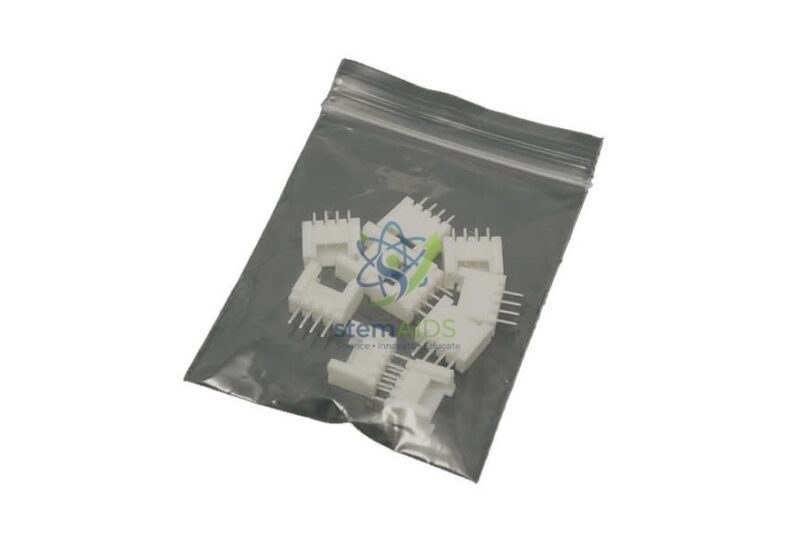
Universal Connector for Grove Printed Circuit Board
₹135.00
Quick Answer: The Universal Connector for Grove Printed Circuit Board is the four-pin Grove socket supplied as a separate part for soldering onto a printed circuit board. It lets students and technicians add standard Grove ports to their own circuits, so home-made boards accept the same plug-in cables as ready-made Grove modules.
Where This Connector Fits in a Grove System
Every Grove module and base shield uses the same four-way connector: two signal lines, power and ground. Grove cables are normally colour-coded, with yellow and white for the two signals, red for power and black for ground. Bought as a separate universal connector, the socket becomes the bridge between that plug-in system and a circuit someone has built themselves, such as a sensor soldered on a small project board.
For a school or college, the connector opens a design-and-make stage beyond buying ready modules. Students can lay out a small PCB in a free design program, leave a footprint for the Grove socket and then connect their board to a microcontroller with an ordinary Grove cable. Technicians also keep spare sockets to repair modules whose connector has been damaged by rough handling.
Grove sockets come in latched (buckled) and unlatched versions, in vertical or right-angle forms, and singly or in packs. The title does not say which version or quantity this listing covers, so confirm it before drawing a footprint.
Typical Uses
- Adding a Grove port to a student-designed sensor or output board
- Repairing a Grove module with a cracked or loose socket
- Making an adaptor board that links breadboard circuits to a Grove shield
- Teaching PCB footprints and soldering in a design and technology course
Soldering and Handling
- Solder with a temperature-controlled iron and keep contact time short, since overheating can soften the plastic housing.
- Check the pin order against the Grove pinout before soldering, because a reversed socket swaps power and ground.
- Supervise soldering, use fume extraction and wear eye protection.
Specifications
| Item | Grove-type 4-pin connector socket for PCB mounting |
| Pins | Four: two signal lines, power and ground |
| Mounting | Soldered onto a printed circuit board |
| Mates with | Standard Grove 4-pin cables |
| Typical users | Design-and-make students, technicians and electronics clubs |
| Latch type, orientation and pack quantity | Confirm at enquiry |
Why Choose LabEquip
Colleges and schools with design and technology courses buy loose Grove sockets so students can make their own boards compatible with class kits. LabEquip stocks the connector within its STEM kits range alongside finished parts such as the Shield Grove micro:bit. For pack quantities, write via the contact page.
Frequently Asked Questions
What are the four pins on a Grove connector?
Two pins carry signals, one carries the supply voltage and one is ground. On digital and analog ports the signal pins are two input or output lines, on I2C ports they are the clock and data lines, and on UART ports they are receive and transmit.
Will this connector fit standard stripboard?
Grove connectors use a finer pin spacing than the 0.1 inch pitch of common stripboard, so fitting one usually needs bent pins, a small adaptor board or a PCB designed for it. Check the connector’s dimensions in its documentation before planning the layout.
What is the difference between buckled and unbuckled Grove connectors?
A buckled connector has a latch that clips the cable plug in place, which stops it working loose on robots or moving models. An unbuckled one has no latch, so plugs slide in and out more easily. Both carry the same four signals.
Why would I use this instead of jumper wires?
A soldered Grove socket takes a polarised plug that only fits one way, so students cannot swap power and ground by mistake. It also lets a home-made board plug into the same shields and cables as the rest of the class kit.
Is soldering safe for students?
With supervision, a temperature-controlled iron, a stand, fume extraction and eye protection, soldering is a normal part of secondary design and technology courses. Younger pupils can use ready-made modules instead.
Can I repair a broken Grove module with this socket?
Often yes. Remove the damaged socket with a desoldering pump or braid, clean the pads and fit the new one in the same orientation. Test the module afterwards with a known-good cable and program.
Last Updated: September 2026
You must be logged in to post a review.
Bestsellers


Sale

Sale

Sale


Reviews
There are no reviews yet.