



Sale
In Stock
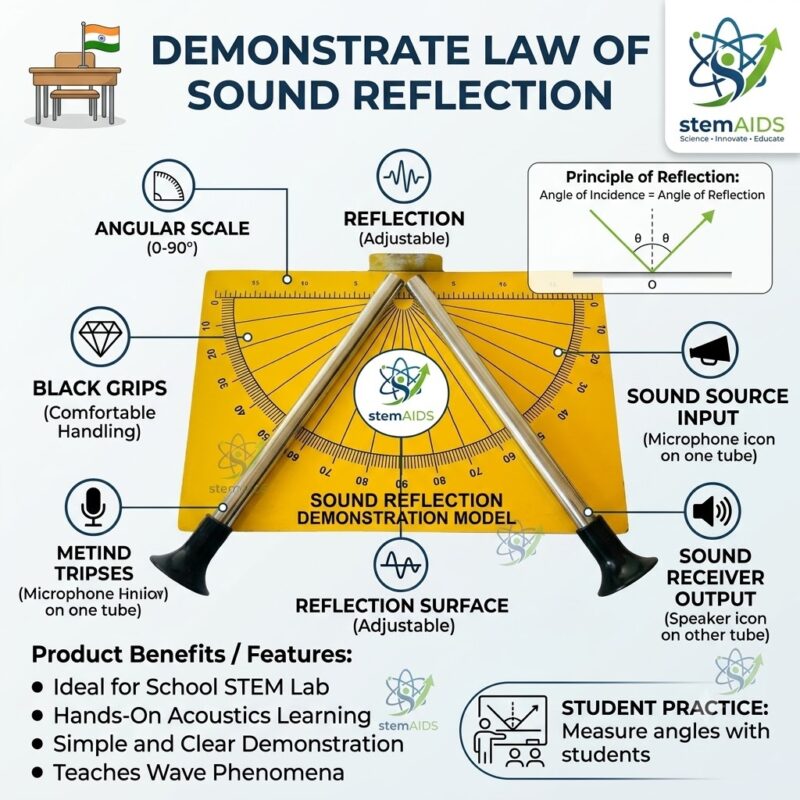
Sound Reflection Demonstration Model
Original price was: ₹700.00.₹340.00Current price is: ₹340.00.
Quick Answer: The Sound Reflection Demonstration Model is a physics teaching apparatus for showing that sound reflects from a hard surface in the same way light reflects from a mirror, with the angle of incidence equal to the angle of reflection. It is used in school lessons on the laws of reflection of sound.
The Classic Two-Tube Experiment
The standard school experiment points two tubes at a smooth, hard reflecting surface. A steady, quiet sound source, such as a ticking clock or a small buzzer, is placed at the open end of one tube, and a student listens at the end of the second tube while it is swung to different angles. The tick is loudest when the second tube makes the same angle with the normal as the first. A screen between the tubes stops sound travelling directly from source to ear. Apparatus of this kind is usually built around that arrangement, often with an angle scale; confirm the construction of this model.
The experiment establishes three points: the angle of incidence equals the angle of reflection; the incident sound, the reflected sound and the normal lie in one plane; and hard, smooth surfaces reflect sound far better than soft ones. Replacing the reflector with a cushion or a sheet of foam and repeating the test demonstrates absorption, which leads naturally into acoustic design.
Reflection of sound explains echoes, the curved ceilings of concert halls, sound boards behind stages and the use of megaphones and ear trumpets, and it is the principle behind sonar and echo-location. Older pupils can calculate distances from echo times using the speed of sound in air, about 340 metres per second at room temperature.
Specifications
| Item | Demonstration apparatus for the laws of reflection of sound |
| Principle | Angle of incidence equals angle of reflection |
| Usual arrangement | Two tubes aimed at a hard reflector, with a screen between them |
| Sound source | A steady, quiet source such as a ticking clock or small buzzer |
| Level | Middle and secondary school physics |
| Construction and angle scale | Confirm at enquiry |
Where It Fits in the Syllabus
- Verifying the laws of reflection of sound in a class practical
- Comparing reflection from hard and soft surfaces to introduce absorption
- Explaining echoes, concert-hall design and sonar
- Linking the reflection of sound and of light in one lesson
Care & Handling
- Run the experiment in a quiet room and keep the class silent while readings are taken.
- Keep the tubes clean and dry inside, since debris muffles the sound.
- Wipe the reflecting surface gently and avoid scratching or denting it.
- Store the tubes supported along their length so they do not bend or dent.
Why Choose LabEquip
Physics teachers buy this model because the two-tube experiment is awkward to improvise with card tubes and textbooks. LabEquip lists it in the STEM kits range, and the Curved Mirror Fun Model makes a matching reflection demonstration for light. Contact us through the contact page for class sets.
Frequently Asked Questions
What are the laws of reflection of sound?
The angle of incidence equals the angle of reflection, and the incident sound, the reflected sound and the normal all lie in the same plane. These are the same laws that apply to light.
Why is a screen placed between the two tubes?
Without it the listener hears sound travelling straight from the source as well as the reflected sound. The screen blocks the direct path, so the result depends on reflection alone.
What sound source works well?
A steady, quiet sound such as a ticking clock or a small buzzer. Loud sources spread in every direction and make the loudest angle harder to find.
Why should the reflecting surface be hard and smooth?
Hard, smooth surfaces reflect most of the sound energy. Soft or rough materials absorb or scatter it, which is why curtains and carpets reduce echoes in a room.
How is an echo related to this experiment?
An echo is reflected sound that reaches the listener at least about a tenth of a second after the original. The experiment shows the reflection; an echo adds the time delay caused by distance.
How can students measure distance using echoes?
Time the echo from a distant wall, multiply by the speed of sound in air, about 340 metres per second, and halve the result because the sound travels there and back.
Last Updated: September 2026
You must be logged in to post a review.
Bestsellers

Sale

Sale

Sale


Reviews
There are no reviews yet.