





Sale
In Stock
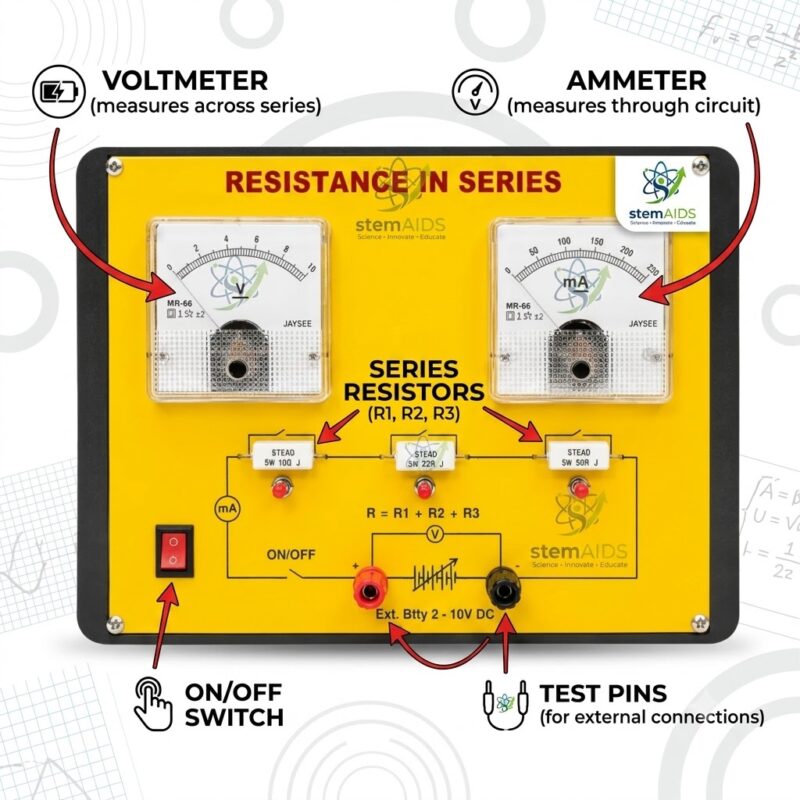
Series Resistor Network Apparatus
Original price was: ₹1,500.00.₹740.00Current price is: ₹740.00.
Quick Answer: The Series Resistor Network Apparatus is a physics teaching aid carrying resistors joined end to end in a single path, used to show that the same current flows through each resistor, that the total resistance is their sum and that the supply voltage divides between them.
One Path, One Current
A series network has only one route for charge, so the current is identical at every point. Students test this by placing an ammeter before the first resistor, between resistors and after the last, and the readings match. Potential difference behaves differently: a voltmeter across each resistor shows that the larger resistor takes the larger share of the supply voltage, and the individual readings add up to the voltage across the whole chain.
The series rule, R = R1 + R2 + and so on, follows directly from these measurements. Students calculate the total from V/I and compare it with the sum of the marked values, then discuss why the two differ slightly because of resistor tolerance, meter accuracy and lead resistance. The same arrangement demonstrates the potential divider, the circuit behind volume controls, sensor circuits and the analog inputs of microcontrollers.
As physics lab equipment, a ready-made series network saves lesson time and avoids the loose connections that spoil student-built circuits. Typical designs mount each resistor between terminals so voltmeter leads can be placed across it; confirm the values and connection style of this unit. Paired with the Parallel Resistor Network Apparatus, it gives a complete series-versus-parallel practical.
Specifications
| Item | Series resistor network teaching apparatus |
| Arrangement | Resistors joined end to end in one path |
| Rule shown | R = R1 + R2 + … for the total resistance |
| Measurements | Common current, voltage across each resistor, total voltage |
| Used with | Low-voltage DC supply, ammeter, voltmeter and leads |
| Resistor values and terminals | Confirm at enquiry |
Class Practicals
- Showing that the current is the same everywhere in a series circuit
- Measuring how the supply voltage divides in proportion to resistance
- Building a potential divider and relating it to sensor circuits
- Comparing series and parallel networks side by side
Care & Handling
- Keep to a low-voltage DC supply and switch off between sets of readings.
- Place voltmeters across a resistor and ammeters in the circuit path, never the other way round.
- Wipe terminals occasionally with a dry cloth so contacts stay reliable.
- Store in a dry cupboard where heavy equipment cannot crush the components.
Why Choose LabEquip
Schools usually order this apparatus with its parallel partner so every group can run the same practical without tangled leads. LabEquip lists it in the STEM kits range, and quantities can be discussed on the contact page.
Frequently Asked Questions
Why is the current the same through every resistor in series?
There is only one path, so all the charge that passes through the first resistor must pass through the others. Charge is not used up, so the current is equal everywhere in the loop.
How does the voltage divide in a series network?
In proportion to the resistances. A resistor with twice the resistance of another has twice the potential difference across it, and all the voltages add up to the supply voltage.
What happens if one resistor in a series circuit is disconnected?
The only path is broken, so the current stops everywhere. This is why older strings of decorative lights went dark when a single bulb failed.
Why does my measured total resistance differ from the sum?
Resistors have a tolerance, meters have limited accuracy, and leads and terminals add a little resistance. Differences of a few percent are normal and worth discussing in the write-up.
What is a potential divider?
Two resistors in series across a supply. The voltage at the junction between them is a fixed fraction of the supply, set by the ratio of the resistances. Sensor circuits and volume controls use this idea.
Can the series and parallel apparatus be combined?
If both units have accessible terminals, leads can join them into a mixed series-parallel network. That makes a good extension for students who already handle each type confidently.
Last Updated: September 2026
You must be logged in to post a review.
Bestsellers


Sale

Sale

Sale


Reviews
There are no reviews yet.