


Sale
In Stock
Magnetic Effect of Current
Original price was: $15.23.$7.50Current price is: $7.50.
Quick Answer: The Magnetic Effect of Current apparatus is a physics demonstration in which a compass needle, placed at the centre of current-carrying coils, is deflected when the current flows. It reproduces Oersted’s discovery that electric currents produce magnetic fields and shows how the effect depends on the size and direction of the current.
Recreating Oersted’s Discovery
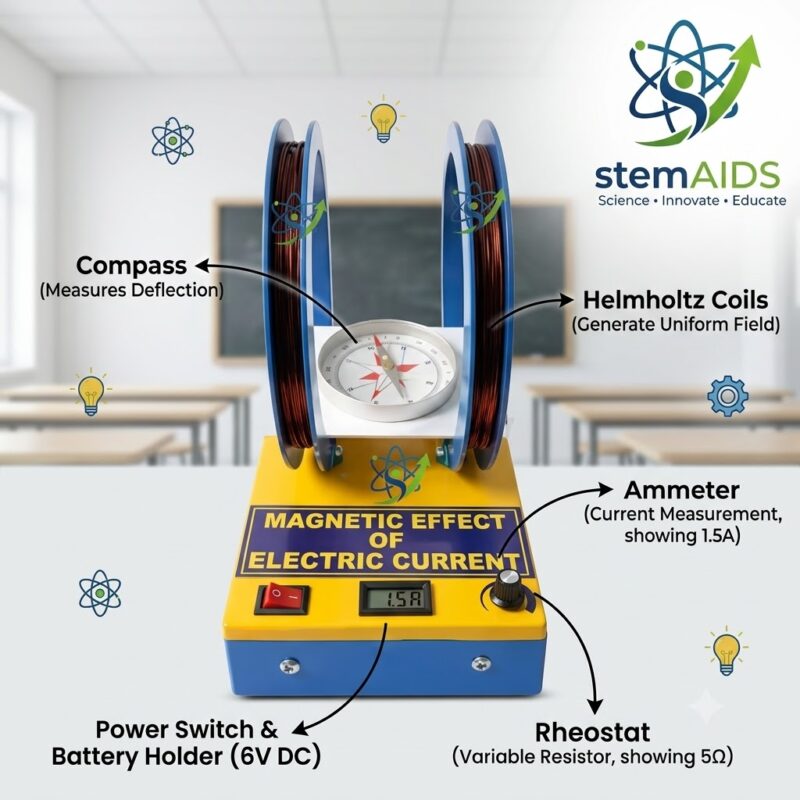
The listing image of the magnetic effect of current apparatus shows two upright circular coils facing each other on a boxed base, with a compass mounted on a platform between them. The base carries a power switch, a small current display and a control knob for setting the current. With no current flowing the compass needle simply points north; switch on, and the needle swings as the coils’ magnetic field acts on it.
In 1820 Hans Christian Oersted noticed a compass needle move when a current flowed in a nearby wire, the first sign that electricity and magnetism are connected. This apparatus makes the same observation larger and easier to see. A coil concentrates the field: many turns of wire, each producing its own field at the centre, add together, and a matched pair of coils spaced apart gives a field that is fairly uniform in the region where the compass sits.
Students can reverse the current and watch the needle swing the other way, then increase the current and see the deflection grow. If the coils are turned so that their plane lies north-south, the needle settles at an angle where the coil field and Earth’s horizontal field combine, and the tangent of that angle is proportional to the current, which is the principle of the tangent galvanometer.
Demonstrations and Measurements
- Showing that a current produces a magnetic field by switching the coils on and off
- Reversing the current to show that the field direction reverses
- Recording compass deflection for several currents and plotting its tangent against current
- Introducing electromagnets, motors and moving-needle current meters
Specifications
| Item | Demonstration of the magnetic effect of an electric current |
| Coils | Two circular coils on either side of a central compass (listing image) |
| Indicator | Magnetic compass at the coil centre |
| Controls | Power switch, current display and control knob, as shown in the listing image |
| Concepts | Oersted’s experiment, field of a coil, tangent galvanometer principle |
| Power supply and current range | Confirm at enquiry |
Care & Handling
- Clear magnets, steel objects and mobile phones from the bench during readings, since their fields swamp that of the coils.
- Switch off between readings so the coils do not warm up.
- Set the apparatus on a non-magnetic bench, away from steel frames and cables.
- Tap the compass lightly before each reading so the needle is not held by friction.
Why Choose LabEquip
The magnetic effect of current is often the first electromagnetism lesson, and teachers want an apparatus where the deflection is large enough for the whole class to see. LabEquip lists this unit in its STEM kits range, and the Solenoid Working Model takes students on to the field of a long coil. Contact us through the contact page with your requirements.
Frequently Asked Questions
Why does the compass needle move when the current is switched on?
A current in a wire produces a magnetic field around it. At the centre of the coils these fields add together, and the compass needle, which is a small magnet, turns to line up with the combined field of the coils and the Earth.
What happens if the current is reversed?
The magnetic field of the coils reverses, so the needle is deflected the opposite way. The field’s direction is therefore set by which way the current flows, and students can predict the swing with the right-hand grip rule.
Why are two coils used instead of one?
A pair of equal coils carrying the same current, spaced apart, gives a more uniform field in the space between them than a single coil does. That means the compass needle responds to a steady field even if it is not exactly at the centre.
How should the apparatus be aligned before use?
Turn the base until the plane of the coils lies north-south, along the compass needle at rest. The coil field then acts at right angles to Earth’s horizontal field, and the deflection angle can be related directly to the current.
Can the apparatus measure current?
In principle, yes. When aligned correctly, the tangent of the deflection angle is proportional to the current, the idea behind the tangent galvanometer. In a school lesson it is mainly used to show the trend, with the current read from a meter.
Is the apparatus safe for students?
It runs from a low-voltage supply and is safe to use under normal classroom supervision. Switch off between readings, keep the current within the range the apparatus is designed for, and keep liquids off the base.
Last Updated: September 2026
You must be logged in to post a review.
Bestsellers

Sale

Sale
Sale


Reviews
There are no reviews yet.