





Sale
In Stock
Invisible Pipe Water Tap Model
Original price was: $15.23.$7.50Current price is: $7.50.
Quick Answer: The Invisible Pipe Water Tap Model is a floating-tap illusion: a tap appears to hang in mid-air pouring water with no supply pipe. In fact a small pump in the base sends water up a transparent tube that runs inside the falling stream, so the water flowing back down hides the pipe that feeds it.
The Trick Behind the Floating Tap
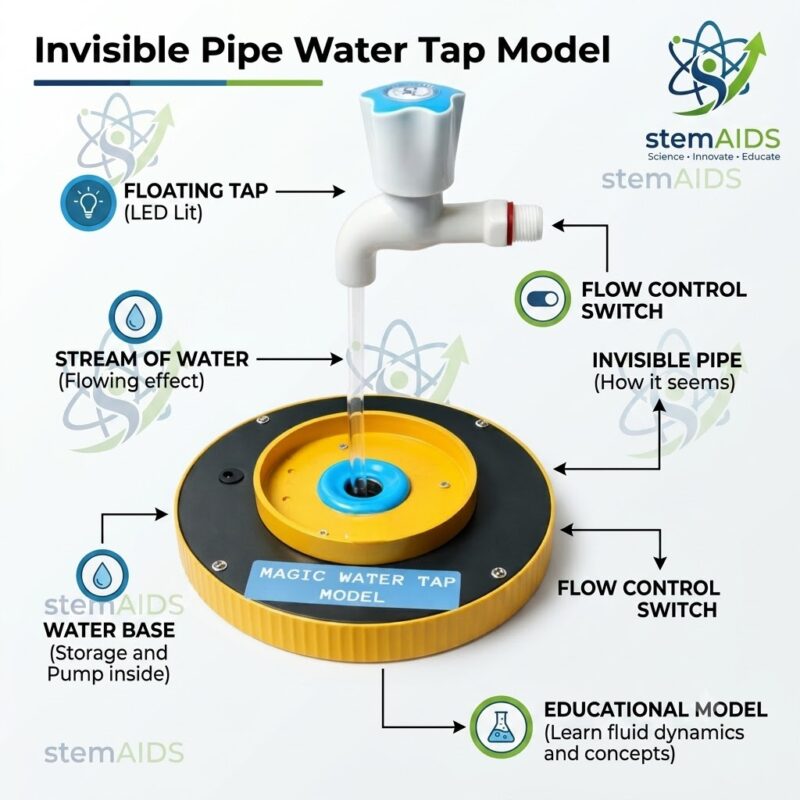
The listing image shows this invisible pipe water tap model as a tap held above a round water base, with the base housing the reservoir and pump and a switch for the flow. Water is pumped up a clear tube to the tap, spills out of the tap mouth and runs down around the outside of the same tube. Because the tube is transparent and wrapped in moving water, the eye sees only a stream.
Students enjoy being fooled for a moment, and then the real lesson begins. Why is the tube so hard to see? The rippling surface of the water film bends and scatters light, so the edges of the clear tube behind it are almost impossible to pick out. Why does the water keep coming? It is pushed up steadily by the pump, the same way a fountain or a building’s water supply relies on a pump to lift water against gravity.
The model also shows a closed water loop. The same water circulates from the reservoir to the tap and back, which links to lessons on pumps, on energy transfer from electrical to kinetic and gravitational energy, and on water reuse in fountains and cooling systems. The switch on the base lets a teacher start and stop the effect during an explanation.
Applications
- Science exhibitions and school open days as an attention-grabbing display
- Lessons on pumps and on lifting water against gravity
- Discussing refraction and why transparent objects can seem to vanish
- Critical-thinking starters where students explain an illusion before it is revealed
Specifications
| Item | Floating-tap illusion model |
| Hidden feed | Transparent tube inside the falling water stream |
| Circulation | Pump and reservoir in the base, as shown in the listing image |
| Control | Flow on/off switch |
| Water used | Clean tap water, recirculated |
| Power requirement and size | Confirm at enquiry |
Care & Handling
- Keep the power connection and adaptor dry and away from splashes, and switch off before refilling.
- Never let the pump run dry; top up the reservoir before switching on.
- Change the water regularly and clean the reservoir so algae or scale cannot block the tube.
- Drain the model completely before storage or transport.
Why Choose LabEquip
Schools, science centres and exhibition organisers usually buy this model for display tables, where it keeps visitors asking how it works. LabEquip lists it in the STEM kits range, and teachers building a lesson on moving water often add the Hand Pump Model, which lifts water by hand instead of by motor. Ask about quantities on the contact page.
Frequently Asked Questions
How does the tap stay in the air?
The tap sits on top of a clear tube that rises from the base. Because water runs down all around that tube, the tube is hidden, and the tap looks as if it is floating.
Where does the water come from?
A pump in the base draws water from the reservoir and pushes it up the inside of the clear tube. The water leaves through the tap, falls back into the reservoir and is pumped round again.
Why is the tube so hard to see?
The tube is transparent, and it is covered by a moving film of water whose rippling surface bends and scatters light. With no sharp edges for the eye to catch, the tube blends into the stream.
Can the model be left running all day at an exhibition?
Small fountain pumps are generally made for continuous running, but it is sensible to check the water level every few hours, keep the reservoir topped up and switch off when the display is unattended.
Can coloured water be used?
Yes, a few drops of food colouring make the stream easier to see in photographs. Use a colouring that washes out easily and rinse the reservoir afterwards so stains do not build up.
What science topics does the model support?
It supports lessons on pumps and pressure, on energy changes from electrical to kinetic and potential energy, on refraction of light, and on observing carefully before drawing conclusions.
Last Updated: September 2026
You must be logged in to post a review.
Bestsellers



Sale

Sale
Sale


Reviews
There are no reviews yet.