


Sale
In Stock
Infinite Reflection Mirror Model
Original price was: $35.53.$17.65Current price is: $17.65.
Quick Answer: The Infinite Reflection Mirror Model is a framed optical display that places a light source between a fully reflecting back mirror and a partly transparent front mirror. Light bounces between the two surfaces many times, so viewers see a tunnel of images that seems to go on without end, making multiple reflection easy to teach.
How the Tunnel of Reflections Forms
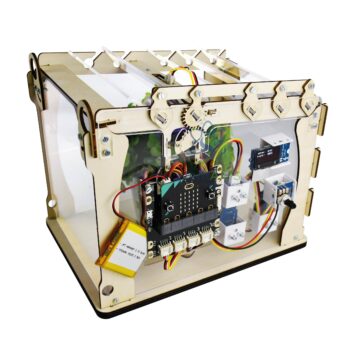
An infinity mirror uses two parallel reflecting surfaces. The rear surface is an ordinary mirror, while the front is a semi-transparent, or two-way, mirror that reflects part of the light and lets the rest through. The listing image of this infinite reflection mirror model shows a row of LEDs around the space between them, set in a wooden frame.
Light from each LED strikes the front glass. Some of it escapes to the viewer’s eye, and the rest is reflected back to the rear mirror, which returns it to the front again. Each round trip creates another image of the LED ring that appears one extra gap deeper, so the rings seem to stretch into a long tunnel. Because a little light is lost at every reflection and transmission, the distant rings grow fainter until they disappear, which shows students that the tunnel is not truly infinite.
The model also connects with the two-mirror rule taught in school optics. As the angle between two plane mirrors closes towards zero, the number of images given by 360°/θ − 1 grows without limit, and parallel mirrors are the limiting case. The power supply and switch arrangement should be confirmed at ordering.
Specifications
| Item | Infinity mirror display model |
| Optical elements | Rear mirror and partly transparent front mirror, parallel to each other |
| Light source | LED array between the mirrors, as shown in the listing image |
| Housing | Framed box, pictured with a wooden frame |
| Effect | Receding tunnel of repeated images that fade with depth |
| Power supply details | Confirm at enquiry |
Applications
- Demonstrating multiple reflection between parallel mirrors in optics lessons
- Explaining partial reflection and transmission at a two-way mirror
- Discussing energy loss: why each successive image is dimmer
- An eye-catching exhibit for science fairs, open days and science corners
Care & Handling
- Clean the front glass with a soft microfibre cloth and a little glass cleaner sprayed onto the cloth, never directly onto the display.
- Avoid pressing on the front mirror; thin two-way glass or film scratches and marks easily.
- Switch the LEDs off when the model is not being viewed, and disconnect batteries or adaptors in storage.
- Keep the unit away from damp and direct sunlight, which can fog or discolour the mirror coating.
Why Choose LabEquip
Physics departments and science-centre staff usually buy this infinity mirror as a talking point that draws students into an optics topic. LabEquip carries it in the STEM kits range together with the Infinite Depth Well Model, which uses the same effect looking downward, and the Angle Between Two Mirrors Apparatus for counting images at measured angles. Ask about quantities on the contact page.
Frequently Asked Questions
Why do the reflections in an infinity mirror get dimmer?
Every time light meets the front mirror, part of it passes out and part is reflected back, and the mirrors also absorb a little. After many round trips only a small fraction of the original light remains, so the deeper images fade until the eye can no longer see them.
What is a two-way mirror?
It is glass or film with a very thin reflective coating that reflects part of the light and transmits the rest. Light from the brighter side shows through to the darker side, which is why the lit gap between the mirrors is visible from the room.
How is this model different from the Infinite Depth Well Model?
Both use two parallel mirrors with lights between them. This model is a framed panel viewed from the front, giving a horizontal tunnel, while the well version is a vessel viewed from above, so its reflections appear as a shaft going down into the floor.
Is the tunnel really infinite?
No. The images are virtual and each is fainter than the last, so only a limited number can be seen. The name describes the impression, which makes the model a good way to discuss the difference between appearance and physical reality.
Can students measure anything with the model?
They can count the visible images, compare the apparent spacing of the rings with the real gap between the mirrors, and note how the effect changes with the room lights on and off. These observations support written explanations of reflection rather than precise measurement.
How should the model be positioned for a class?
Place it at eye level in a dim corner so the LEDs stand out against their surroundings. Viewers standing slightly to one side see the tunnel curve away, which helps explain that each image is formed behind the previous one.
Last Updated: September 2026
You must be logged in to post a review.
Bestsellers




Sale
Sale

Sale


Reviews
There are no reviews yet.