






Sale
In Stock
Infinite Depth Well Model
Original price was: $12.97.$6.37Current price is: $6.37.
Quick Answer: The Infinite Depth Well Model is an optical illusion display shaped like a well: LEDs are set between a mirror below and a partly transparent glass top, and light reflecting back and forth makes the well appear to drop away without end. It is used to teach repeated reflection, virtual images and why the effect fades.
Why the Well Looks Bottomless
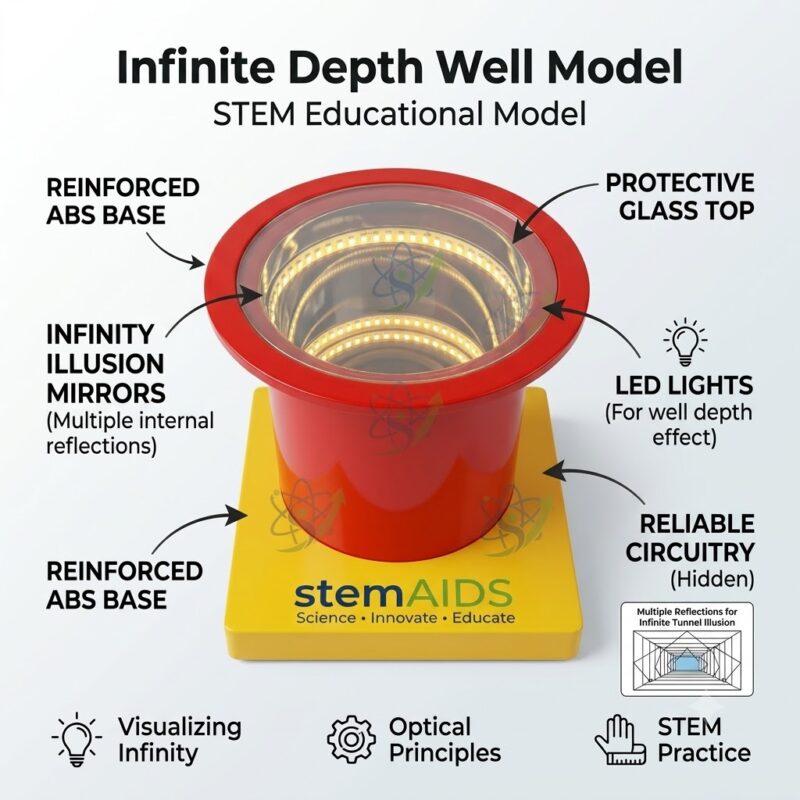
The listing image shows the infinite depth well model as a round, well-shaped vessel on a base, with LED lights around its inner wall, mirror surfaces inside and a protective glass top. The top glass is the key part: it reflects some light back down while letting the rest reach the viewer, so the well behaves as a pair of facing mirrors with the lights trapped between them.
Looking down, a viewer sees the ring of LEDs, then a second ring reflected from below, then a third after another round trip, and so on. Each ring appears one well-depth further down and therefore smaller, which is ordinary perspective, so the rings seem to form a narrowing shaft. Some light escapes or is absorbed at every reflection, so the lower rings dim and eventually vanish.
Compared with a wall-mounted infinity mirror, the well format invites people to lean over and look down, which is why it is popular at exhibitions and in science corners. Students can test the explanation themselves by shading the top glass, viewing from different angles, or switching off the room lights and noting how the apparent depth changes.
Applications
- Science exhibitions and open days where visitors look into the well
- Optics lessons on repeated reflection and virtual images
- Discussing perspective: why equally spaced rings look smaller with depth
- Critical-thinking starters in which students explain an illusion using physics
Care & Handling
- Do not stand on or lean heavily on the glass top; it is a viewing cover, not a step.
- Clean the top with a soft cloth and mild glass cleaner applied to the cloth.
- Switch off and disconnect the power before moving the model.
- Keep it indoors and away from spills, since water on the electrics is a hazard.
Specifications
| Item | Infinity well optical illusion display |
| Principle | Multiple reflection between a mirror and a partly transparent top glass |
| Lighting | LEDs around the inside wall, as shown in the listing image |
| Top | Protective glass cover |
| Viewing | From above, looking down into the well |
| Power supply and dimensions | Confirm at enquiry |
Why Choose LabEquip
Exhibition organisers, science-centre staff and schools setting up a physics corner usually buy this well for its immediate visual effect. LabEquip lists it in the STEM kits range next to the Infinite Reflection Mirror Model, a front-facing version of the same principle. Send your enquiry through the contact page.
Frequently Asked Questions
How does the infinite depth well create the illusion of depth?
Light from the LEDs bounces between a mirror below and a partly transparent glass above. Each bounce forms another image of the LED ring a little further down, so the rings stack into what looks like a deep shaft.
Why do the lower rings look smaller?
Each reflected ring appears further from the eye than the one above it. Objects further away look smaller, so the rings shrink with apparent depth, just as a straight road seems to narrow towards the horizon.
Is there any real depth inside the well?
Only the physical depth of the vessel. Everything below that is a virtual image formed by reflection, and measuring the outside of the model shows how shallow it really is.
Is this a model of a quantum potential well?
No. Despite the similar name, this is an optical mirror illusion. The infinite potential well of quantum physics is a mathematical model of a particle in a box, taught with equations and graphs rather than with a display like this.
Where should the well be placed for display?
On a low, stable table or on the floor in a dim area, so visitors can look straight down. Bright overhead lights reflecting off the top glass weaken the effect, so keep it away from windows and spotlights.
What do students learn from the well?
They practise explaining a striking illusion with the laws of reflection, partial transmission and perspective. It also shows that each reflection loses some energy, which is why the shaft fades instead of continuing forever.
Last Updated: September 2026
You must be logged in to post a review.
Bestsellers

Sale
Sale

Sale
Sale


Reviews
There are no reviews yet.