






In Stock
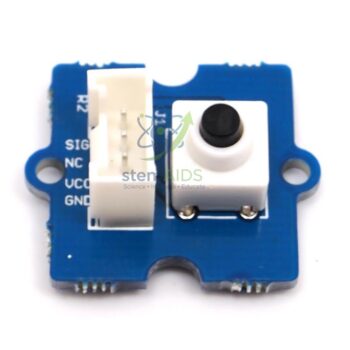
Grove Ultrasonic Ranger
₹230.00
Quick Answer: The Grove Ultrasonic Ranger is a distance sensor on a Grove-connector board that sends out a burst of ultrasound and times how long the echo takes to return from an object. From that time and the speed of sound, a microcontroller calculates the distance, which is why the Grove ultrasonic ranger is so widely used in robotics and physics projects.
Measuring Distance with an Echo
The principle is the same as a bat’s echolocation or a ship’s sonar. The ranger emits a short pulse of sound too high-pitched to hear, the pulse reflects from the nearest object in front of it, and the receiver detects the echo. Sound travels at about 343 metres per second in air at 20 degrees Celsius, and the pulse makes a round trip, so distance equals the speed of sound times the echo time, divided by two.
On the Grove version the trigger and echo usually share a single signal line, so the module needs just one digital port, unlike four-pin boards that use separate trigger and echo pins. A library returns the distance directly, leaving students free to concentrate on what to do with it: stop a robot, sound an alarm or plot a graph.
Results are only as good as the target. Soft materials such as cloth absorb the pulse, angled surfaces reflect it away from the sensor, and very close objects fall inside the minimum range. Investigating these limits is a worthwhile practical in its own right.
Specifications
| Sensor | Ultrasonic distance ranger on a Grove board |
| Principle | Time of flight of a reflected ultrasonic pulse |
| Connection | One Grove digital port (trigger and echo shared on the usual Grove design) |
| Output | Echo timing, converted to distance in code or by a library |
| Measuring range and supply voltage | Confirm at enquiry |
Applications
- Obstacle-avoiding and wall-following robots
- Parking-sensor models that beep faster as an object approaches, using the Module Buzzer Grove
- Distance-time and speed graphs of a moving trolley or a walking student in physics motion lessons
- Water-level or bin-fill monitors that measure the gap to a surface
- Estimating the speed of sound from a known distance and the measured echo time
Care & Handling
- Keep the two transducers of the Grove Ultrasonic Ranger clean and unobstructed; do not push objects into their mesh.
- Mount the sensor facing squarely at the target, since a tilted sensor picks up false echoes from the floor or side walls.
- Keep it dry: a water-level project should hold the sensor above the surface, never in the spray.
- Avoid running two rangers facing each other at the same moment, because one can pick up the other’s pulse.
Why Choose LabEquip
Robotics clubs and physics departments both buy ultrasonic rangers, the first for navigation and the second for motion experiments. LabEquip lists the ranger in its Stem Kits category; send the number of groups you teach through the contact page.
Frequently Asked Questions
How does the ranger calculate distance?
It measures the time between sending an ultrasonic pulse and receiving its echo. Multiplying that time by the speed of sound, about 343 metres per second in room-temperature air, and halving the result gives the distance to the object.
Why are some readings wrong or jumpy?
Soft or angled surfaces reflect little sound back, small targets may be missed, and nearby walls or the floor can return a stronger echo. Averaging several readings and aiming the sensor squarely at a flat target improves consistency.
Does temperature affect the measurement?
Yes. Sound travels faster in warmer air, by roughly 0.6 metres per second for each degree Celsius. For careful physics work, students can correct the speed of sound using a thermometer reading.
How is it different from a four-pin ultrasonic module?
Many four-pin modules use separate trigger and echo pins. The Grove ranger normally combines them on one signal line and uses the Grove plug, so wiring is quicker and less error-prone in class.
Can it detect people?
It detects any object that reflects sound back, including people, but clothing absorbs some of the pulse, so the reliable range to a person is shorter than to a wall. For detecting presence rather than distance, a PIR motion sensor is simpler.
Can students use it to measure the speed of sound?
Yes. Place a flat board at a measured distance, record the echo time in microseconds and calculate the speed as twice the distance divided by the time. Repeating at several distances and plotting a graph improves the result.
Last Updated: September 2026
You must be logged in to post a review.
Bestsellers

Sale

Sale
Sale


Reviews
There are no reviews yet.