


In Stock
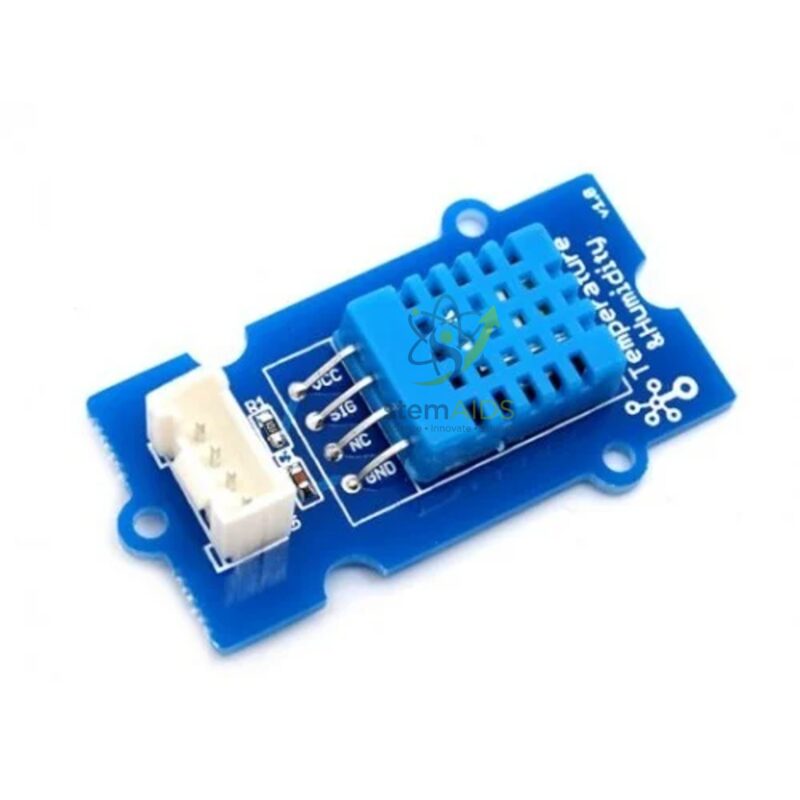
Grove Temperature and Humidity Sensor
₹230.00
This Grove-compatible sensor is commonly based on the DHT11 temperature and humidity sensor, which is widely used for general-purpose environmental monitoring. It is useful for learning how sensors collect real-world climate data and how microcontrollers process that data for display, automation, alerts, and IoT applications.
The StemAids Grove Temperature and Humidity Sensor is suitable for school STEM labs, Arduino learning kits, Raspberry Pi demonstrations, IoT classrooms, smart agriculture projects, greenhouse models, mini weather stations, and environmental science activities.
Key Features
- Grove-compatible temperature and humidity sensor for STEM learning
- Measures ambient temperature and relative humidity
- Commonly based on DHT11 digital sensor technology
- Provides digital signal output for microcontroller-based projects
- Useful for Arduino, Raspberry Pi, IoT, smart home, and weather station models
- Simple Grove 4-pin interface for clean and beginner-friendly wiring
- Suitable for school labs, electronics labs, robotics labs, and training centers
Product Specifications
| Brand | StemAids |
|---|---|
| Product Name | Grove Temperature and Humidity Sensor |
| Product Type | Grove-compatible environmental sensor module |
| Sensor Function | Temperature and relative humidity measurement |
| Common Sensor IC | DHT11-based module |
| Output Type | Digital signal output |
| Operating Voltage | 3.3V–5V |
| Temperature Measuring Range | 0°C to 50°C |
| Humidity Measuring Range | 20% RH to 90% RH |
| Temperature Accuracy | ±2°C |
| Humidity Accuracy | ±5% RH |
| Temperature Sensitivity | 1°C |
| Humidity Sensitivity | ±1% RH |
| Signal Collecting Period | Approx. 2 seconds |
| Interface Type | Grove 4-pin interface |
| Compatible Platforms | Arduino, Raspberry Pi with Grove interface, and Grove-compatible boards |
| Applications | Weather station, IoT monitoring, greenhouse model, smart home, and STEM projects |
How to Use the Grove Temperature and Humidity Sensor
- Connect the StemAids Grove Temperature and Humidity Sensor to a Grove Base Shield, Grove Base Hat, or compatible digital interface.
- Use a Grove cable to connect the sensor securely to the selected Grove port.
- Open Arduino IDE, Python environment, or another compatible programming platform.
- Install the required DHT or Grove temperature and humidity sensor library.
- Select the correct input pin in your program.
- Read the temperature and humidity values from the sensor.
- Display the values on an LCD, serial monitor, OLED display, or IoT dashboard.
- Use the sensor readings to trigger an LED, buzzer, fan, relay, alarm, or automation response.
- Calibrate project threshold values according to classroom or laboratory conditions.
Educational Benefits
The StemAids Grove Temperature and Humidity Sensor helps students understand environmental sensing, digital signal reading, climate monitoring, threshold programming, IoT data collection, and smart automation. It connects science concepts such as temperature, humidity, weather, plant growth, and indoor climate with practical electronics and coding.
Applications
- Mini weather station projects
- Arduino temperature and humidity monitoring
- Raspberry Pi environmental sensing projects
- IoT room climate monitoring systems
- Greenhouse monitoring models
- Smart agriculture learning kits
- Fan control and ventilation demonstrations
- LCD-based temperature and humidity display
- Smart home automation models
- STEM environmental science experiments
Why Choose StemAids?
StemAids provides practical STEM, robotics, electronics, IoT, and automation learning modules for schools, colleges, training centers, and technical laboratories. The StemAids Grove Temperature and Humidity Sensor is designed to make environmental sensing simple, visual, and project-friendly. It is a useful module for institutions building Arduino labs, IoT labs, robotics labs, agriculture technology labs, and environmental science project kits.
FAQ
Q1. What is the StemAids Grove Temperature and Humidity Sensor used for?
It is used to measure ambient temperature and relative humidity in STEM, Arduino, Raspberry Pi, IoT, weather station, smart home, and environmental monitoring projects.
Q2. Is this sensor compatible with Arduino?
Yes, it can be used with Arduino through a Grove Base Shield or compatible digital input connection.
Q3. Can this sensor be used with Raspberry Pi?
Yes, it can be used with Raspberry Pi when connected through compatible Grove interface hardware and suitable user-written code.
Q4. What type of output does the sensor provide?
The sensor provides digital output data for temperature and relative humidity.
Q5. What is the temperature range of this sensor?
The commonly documented DHT11-based Grove version measures temperature from 0°C to 50°C.
Q6. What is the humidity range of this sensor?
The commonly documented DHT11-based Grove version measures relative humidity from 20% RH to 90% RH.
Q7. Can students use this sensor for a weather station project?
Yes, it is suitable for classroom weather station models, IoT climate monitoring, greenhouse monitoring, smart agriculture models, and smart room automation projects.
Q8. Does the sensor require soldering?
No, when used with Grove-compatible boards, the 4-pin Grove connector allows simple plug-and-play wiring.
SEO Keywords
Grove Temperature and Humidity Sensor, StemAids temperature sensor, StemAids humidity sensor, Grove DHT11 sensor, Arduino temperature humidity sensor, Raspberry Pi humidity sensor, IoT environmental sensor, STEM weather station sensor, smart agriculture sensor, greenhouse monitoring sensor, electronics lab sensor, Grove climate sensor module.
You must be logged in to post a review.
Bestsellers

Sale
Sale

Sale


Reviews
There are no reviews yet.