





Sale
In Stock
Electrical Circuit Demonstration Board
Original price was: ₹1,150.00.₹565.00Current price is: ₹565.00.
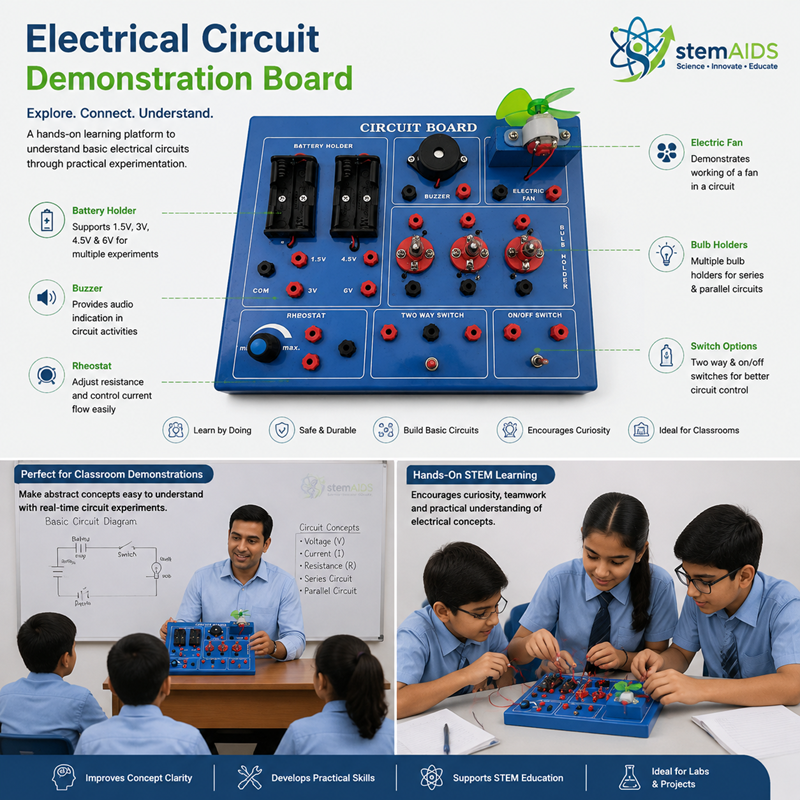
Quick Answer: The Electrical Circuit Demonstration Board is a panel for building basic circuits in front of a class. The listing image shows battery holders, three bulb holders, a buzzer, a rheostat, a two-way switch, an on-off switch and a small electric fan, each wired to sockets on one board so that series and parallel arrangements can be connected with leads.
Components on One Panel
Loose components on a bench are hard for a whole class to follow. The electrical circuit demonstration board mounts each part in a fixed position with its own sockets, so the teacher can build a circuit with connecting leads and pupils can trace the path of the current from the cells, through the switch and load, and back again. Among electricity experiment kits for schools, a board like this suits whole-class teaching and covers most of the circuits met in early secondary science.
Bulbs in series share the voltage and glow dimly; in parallel each gets the full voltage and glows brightly, and removing one does not switch off the others. The rheostat varies the current, dimming a bulb or slowing the fan, which introduces resistance before any formulas. The buzzer and fan show that electrical energy can become sound and motion as well as light.
The two-way switch allows the classic staircase circuit, in which a lamp can be turned on or off from either of two switches. The cell sizes, bulb ratings and leads supplied with the board should be confirmed when ordering.
Applications
- Building series and parallel lamp circuits in front of the class
- Showing how a rheostat changes brightness and motor speed
- Wiring a two-way staircase switching circuit
- Discussing energy transfers to light, sound and motion
Specifications
| Apparatus type | Basic circuits demonstration panel |
| Power | Cells in on-board battery holders |
| Loads | Bulbs in holders, buzzer and small electric fan, as pictured |
| Control | Rheostat, two-way switch and on-off switch |
| Connections | Sockets for connecting leads |
| Cell type, bulb ratings and leads | Confirm at enquiry |
Care & Handling
- Remove the cells after each lesson so they cannot leak into the holders.
- Never connect a lead directly across a cell without a load; that short circuit heats the lead and drains the cell.
- Replace blown bulbs with the same rating so comparisons between circuits stay fair.
- Keep the board dry and store leads coiled beside it rather than across the sockets.
Why Choose LabEquip
Primary and lower-secondary teachers buy this board for the electricity unit because a single panel replaces a tray of loose parts during class demonstrations. LabEquip supplies it through the STEM kits range; for small-group practicals, the Series and Parallel Circuit Kit gives students their own components. Ask questions through our contact page.
Frequently Asked Questions
Why do bulbs glow dimmer when connected in series?
In series the bulbs share the voltage from the cells, so each receives only part of it and a smaller current flows through the chain. Each bulb therefore converts less energy per second and glows more dimly than it would alone.
What happens if one bulb is removed in a parallel circuit?
The other bulbs stay lit. Each parallel branch connects directly across the supply, so breaking one branch does not interrupt the others. This is why household lights are wired in parallel.
What does the rheostat do?
A rheostat is a variable resistor. Turning its knob changes the resistance in the circuit, which changes the current. Increasing the resistance dims a bulb or slows the fan; decreasing it does the opposite.
How does a two-way switch let a lamp be controlled from two places?
Two changeover switches are linked by two wires. The lamp lights when both switches connect to the same wire and goes off when they connect to different ones, so flipping either switch changes the state. This is how stair lights are wired.
Can the board be connected to mains electricity?
No. It is designed for low-voltage cells in its battery holders. Mains voltage would be dangerous to touch and would destroy the components, so only the cell types specified for the board should be used.
Why does the fan spin faster with more cells?
Adding cells in series increases the voltage across the motor, which drives a larger current through it. The motor turns faster and converts more electrical energy into kinetic energy each second.
Last Updated: September 2026
You must be logged in to post a review.
Bestsellers

Sale

Sale
Sale


Reviews
There are no reviews yet.