


Sale
In Stock
DIY Hydraulic Jack Model
Original price was: $32.71.$16.24Current price is: $16.24.
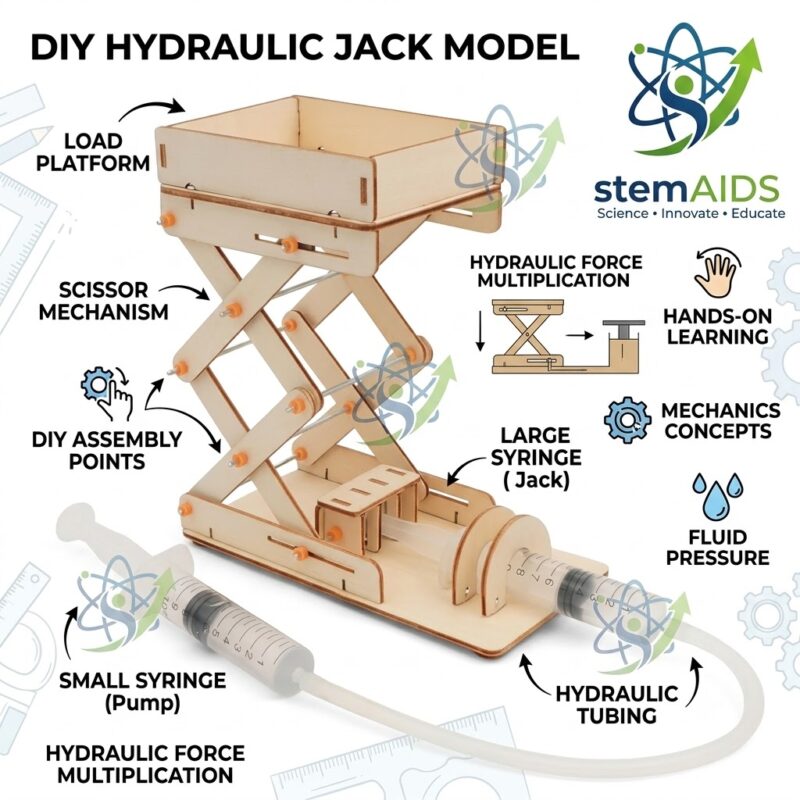
Quick Answer: The DIY Hydraulic Jack Model is a build-it-yourself STEM kit in which liquid in a closed system transfers pressure from a small piston to a larger one, lifting a platform the way a car jack does. It is used to teach Pascal’s law, force multiplication and hydraulic machines.
How a Small Push Lifts a Bigger Load
Pascal’s law states that pressure applied to an enclosed liquid is transmitted equally throughout it. In a hydraulic jack a small piston presses on the liquid, and the same pressure acts on a larger piston. Because force equals pressure multiplied by area, the larger piston produces a larger force: a piston with four times the area gives four times the force, although it moves only a quarter as far.
DIY hydraulic models usually use plastic syringes as pistons and cylinders, linked by tubing and filled with water. Building the jack makes students face the practical problems engineers meet: air bubbles that make the system spongy, leaks at joints and the need for a rigid frame so the platform rises straight. Swapping syringes of different sizes lets them test the trade-off between force and distance directly. Confirm the syringe sizes and frame material supplied.
The model connects to machines students see around them: car jacks and garage lifts, excavator arms, adjustable chairs, and car brakes, where a light push on the pedal presses the brake pads with a much larger force. With extra syringes the same principle can be extended into a hydraulic arm or lift as a follow-on design project.
Specifications
| Item | Hydraulic jack construction model kit |
| Principle | Pascal’s law: pressure transmitted through an enclosed liquid |
| Working fluid | Water in a closed system, usual for syringe models |
| Concepts | Force multiplication, pressure, area and work |
| Activity | Assembly, testing and modification |
| Syringe sizes and frame material | Confirm at enquiry |
Investigations
- Comparing input and output forces with syringes of different sizes
- Measuring how far each piston moves and linking it to work done
- Showing why air bubbles make a hydraulic system spongy
- Designing a lift, brake or arm from the same parts
Care & Handling
- Fill syringes and tubing slowly to avoid trapping air.
- Work over a tray and keep the model away from electrical equipment.
- Empty and dry the system after lessons to stop mould growing in the tubing.
- Do not overload the platform, as plastic parts crack if forced.
Why Choose LabEquip
Teachers buy the hydraulic jack model because it turns Pascal’s law from a formula into something students feel in their fingers. LabEquip lists it in the STEM kits range with the Air Propulsion Car Kit, another build-and-test mechanics project. Ask for class sets on the contact page.
Frequently Asked Questions
What is Pascal’s law?
Pressure applied to an enclosed liquid is transmitted equally in all directions throughout the liquid. Hydraulic machines use this to pass force from one piston to another.
Why does the larger piston push with more force?
Force equals pressure times area. The pressure is the same at both pistons, so the piston with the larger area produces the larger force.
If the force is multiplied, why is it not free energy?
The larger piston moves a shorter distance. Force multiplied by distance, the work done, is the same at both ends apart from losses to friction.
Why does the hydraulic jack model feel spongy?
Air bubbles in the system compress, unlike water. Refill slowly with the tube ends under water and tap out any bubbles before closing the system.
Can oil be used instead of water?
Real jacks use hydraulic oil, but water is cleaner and safer for classroom models. Oil is messy and can soften some plastics and tubing.
Where are hydraulic systems used in real life?
In car jacks, garage lifts, excavators, car brakes, some building lifts and adjustable chairs. All of them use a liquid to pass on and multiply force.
Last Updated: September 2026
You must be logged in to post a review.
Bestsellers
Sale
Sale
Sale


Reviews
There are no reviews yet.