


Sale
In Stock
Distance and Oscillation Pendulum Apparatus
Original price was: ₹1,500.00.₹740.00Current price is: ₹740.00.
Quick Answer: The Distance and Oscillation Pendulum Apparatus is a physics stand from which pendulums of different lengths hang side by side. Set swinging together, they show at once that a longer pendulum swings more slowly, and timed oscillations let students find the relationship between length and period and calculate g.
Three Lengths on One Stand
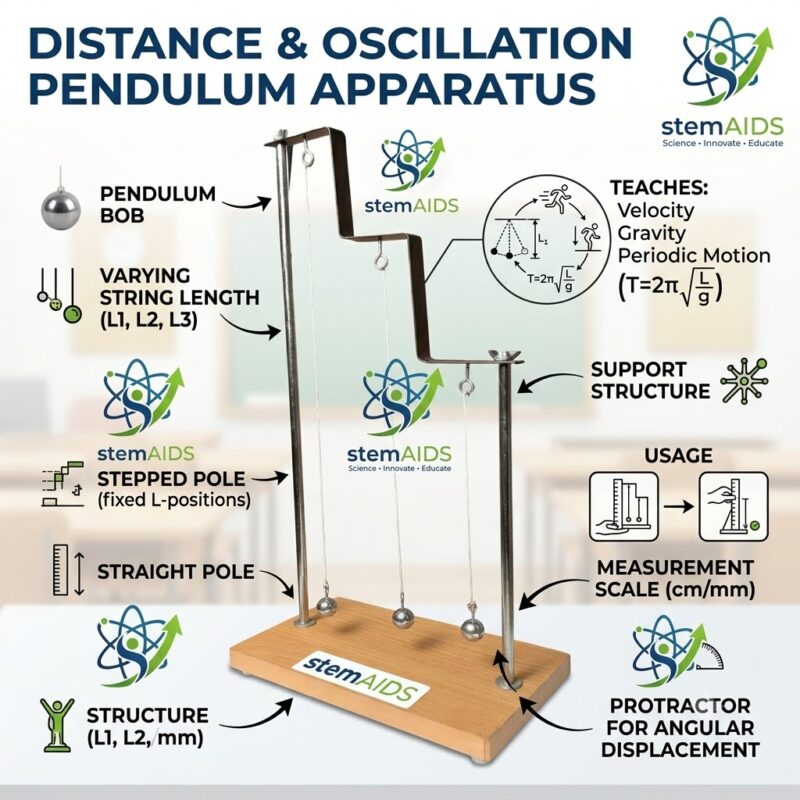
In the listing image the distance and oscillation pendulum apparatus has a stepped metal support on a wooden base, holding three metal bobs on threads of different lengths, with a scale and a protractor marked for measuring length and angle. Because the pendulums hang side by side, students can pull all three aside and release them together: the shortest completes its swings quickly, the longest lags behind, and the pattern is visible immediately.
For small swings, the period of a simple pendulum depends only on its length and the gravitational field strength: T = 2π√(L/g). Mass and, within small angles, amplitude make no difference. Here L is the distance from the suspension point to the middle of the bob. Quadrupling the length doubles the period, which students can check directly if the lengths on the stand are in a suitable ratio.
For accurate results, students time 20 oscillations and divide, keep the swing below about 10 degrees, and start timing as the bob passes through the centre, where it moves fastest. Plotting T² against L gives a straight line through the origin with a gradient of 4π²/g, from which g can be calculated. As physics lab equipment for mechanics practicals, the stand saves setting up three separate clamp stands. The exact pendulum lengths should be confirmed at enquiry.
Practicals
- Comparing periods of different-length pendulums swinging together
- Measuring the period for each length and plotting T² against L
- Calculating the gravitational field strength g from the gradient
- Showing that bob mass and small changes of amplitude do not affect the period
Specifications
| Item | Multi-length simple pendulum stand |
| Pendulums | Three metal bobs on threads of different lengths (listing image) |
| Support | Stepped metal frame on a wooden base |
| Measuring aids | Length scale and angle protractor, as shown in the listing image |
| Key relationship | T = 2π√(L/g) for small swings |
| Pendulum lengths | Confirm at enquiry |
Care & Handling
- Untangle and straighten the threads before each lesson; a kinked thread changes the effective length.
- Keep swings small and in one plane, and stop the bobs by hand before storing.
- Check that each thread is firmly clamped at its suspension point.
- Stand the pendulum apparatus on a steady bench away from draughts and fans.
Why Choose LabEquip
Physics teachers want a pendulum practical that is quick to set up and gives consistent readings across several groups. LabEquip lists this stand in its STEM kits range, and more mechanics apparatus is in the physics lab products section. Send your group numbers through the contact page.
Frequently Asked Questions
Does the mass of the bob change the period?
No. For a simple pendulum the period depends on length and gravitational field strength only. A heavier bob needs more force to accelerate, but gravity pulls on it with proportionally more force, so the two effects cancel.
Which length goes into the pendulum formula?
The effective length runs from the point of suspension down to the middle of the bob, where its mass is effectively concentrated. Using the thread length alone, or measuring to the bottom of the bob, adds a constant error that makes the graph of period squared against length miss the origin.
Why time 20 oscillations instead of one?
Reaction time adds an error of perhaps a fifth of a second to each start and stop. Timing 20 swings spreads that error over the whole run, so the period calculated by dividing by 20 is far more precise.
Why must the swing be kept small?
The formula for the period assumes small angles. At larger amplitudes the period becomes slightly longer, so keeping the swing under about 10 degrees keeps results consistent with the equation.
How is g found from the results?
Plot the period squared against length. The graph should be a straight line through the origin with gradient four pi squared divided by g. Rearranging gives g as four pi squared divided by the gradient.
Why start timing at the centre of the swing?
The bob moves fastest through the centre, so the moment it passes a reference mark is sharp and easy to judge. At the ends of the swing it slows and stops, making the exact turning point hard to see.
Last Updated: September 2026
You must be logged in to post a review.
Bestsellers



Sale

Sale

Sale


Reviews
There are no reviews yet.