








Sale
In Stock
Brachistochrone Experiment Model
Original price was: $14.66.$7.22Current price is: $7.22.
Quick Answer: The Brachistochrone Experiment Model is a wooden apparatus with two tracks between the same start and finish points, one straight and one curved towards the cycloid shape of fastest descent. Balls released together show that the curved, longer path is quicker, a classic result linking physics and mathematics.
Why the Longer Path Wins
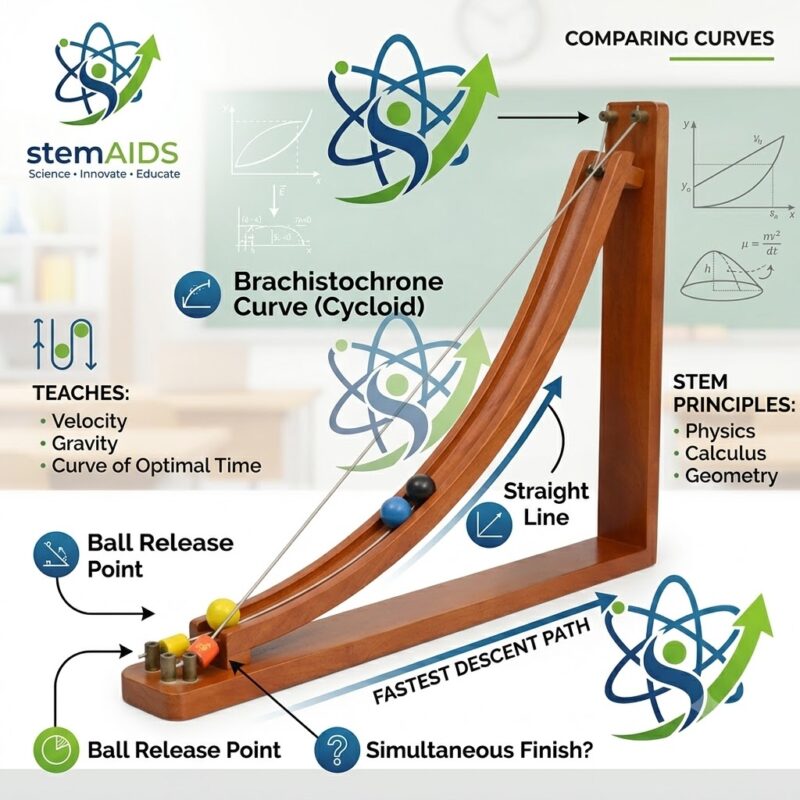
In the listing image, the brachistochrone experiment model is a wooden right-angled frame with two tracks running from a high release point down to the same finish at the base: one straight ramp and one curved channel. Two balls are released at the same moment. Most students predict that the straight track, the shortest route, will win. In fact the ball on the curved track arrives first.
The reason is that the curve drops steeply at the start. The ball gains speed quickly and then carries that speed along the rest of the path, whereas the ball on the straight ramp accelerates only gradually. The curve that gives the least possible time is a cycloid, the path traced by a point on the rim of a rolling wheel. Johann Bernoulli posed the problem in 1696, and the solutions it prompted helped found the branch of mathematics now called the calculus of variations.
A cycloid track has a second surprising property: balls released from different heights on it reach the lowest point at the same time, which is why it is also called a tautochrone. Whether this model’s curve is a true cycloid, and whether it includes a third track for comparison, should be confirmed at enquiry.
Care & Handling
- Release balls from rest by lifting a card or finger at the same instant, rather than pushing them.
- Keep the tracks clean and dry; dust and grit slow the balls and spoil comparisons.
- Stand the brachistochrone experiment model on a firm, level surface and catch balls at the bottom.
- Store it where the tracks cannot be knocked or warped.
Where It Is Used
- Prediction-and-test lessons that challenge the idea that the shortest path is quickest
- Discussing energy conversion from potential to kinetic energy on different slopes
- Introducing the cycloid in mathematics and its construction with a rolling wheel
- Exploring the tautochrone property by releasing balls from different heights
Specifications
| Item | Brachistochrone (fastest descent) demonstration |
| Tracks | Straight ramp and curved track between common start and finish (listing image) |
| Construction | Wooden frame |
| Released objects | Balls or marbles |
| Concepts | Energy conversion, acceleration, cycloid, calculus of variations |
| Curve profile and number of tracks | Confirm at enquiry |
Why Choose LabEquip
Physics and mathematics teachers both use the brachistochrone because it overturns a confident prediction in a couple of seconds. LabEquip lists it in the STEM kits range, and the Giant Yo-Yo model offers another way to watch potential energy change into motion. Send your enquiry through the contact page.
Frequently Asked Questions
Why is the straight track not the fastest?
A straight track is the shortest route, but its slope is gentle all the way, so the ball gains speed slowly. The curved track drops steeply at first, so its ball reaches high speed early and covers the longer distance in less time.
What is a cycloid?
It is the curve traced by a point on the rim of a wheel rolling along a flat surface. Turned upside down, it forms the track that gives the fastest descent between two points under gravity, ignoring friction.
Who first solved the brachistochrone problem?
Johann Bernoulli set it as a challenge in 1696. Solutions came from Johann himself, his brother Jakob, Newton, Leibniz and others, and the methods developed grew into the calculus of variations.
Do both balls reach the bottom with the same speed?
Ignoring friction, yes. Both fall through the same height, so they convert the same gravitational potential energy into kinetic energy. The difference is how quickly they reach high speed, not their final speed.
What is the tautochrone property?
On a cycloid-shaped track, a ball released from any height reaches the lowest point in the same time. A ball starting higher gains speed faster, exactly making up for its longer path. Christiaan Huygens used this property in designing pendulum clocks.
How can students make the race fair?
Use identical balls, release them at the same instant from rest, and repeat each run several times. Filming with a phone in slow motion shows clearly which ball arrives first when the result is close.
Last Updated: September 2026
You must be logged in to post a review.
Bestsellers




Sale

Sale

Sale

Sale


Reviews
There are no reviews yet.