




Sale
In Stock
Bicycle Dynamo Power Generation Model
Original price was: $15.23.$7.50Current price is: $7.50.
Quick Answer: The Bicycle Dynamo Power Generation Model is a hand-turned wheel that drives a bicycle bottle dynamo by friction, lighting an LED as it spins. It shows how motion is converted into electrical energy by electromagnetic induction, the same way many bicycles power their lamps.
How the Dynamo Makes Electricity
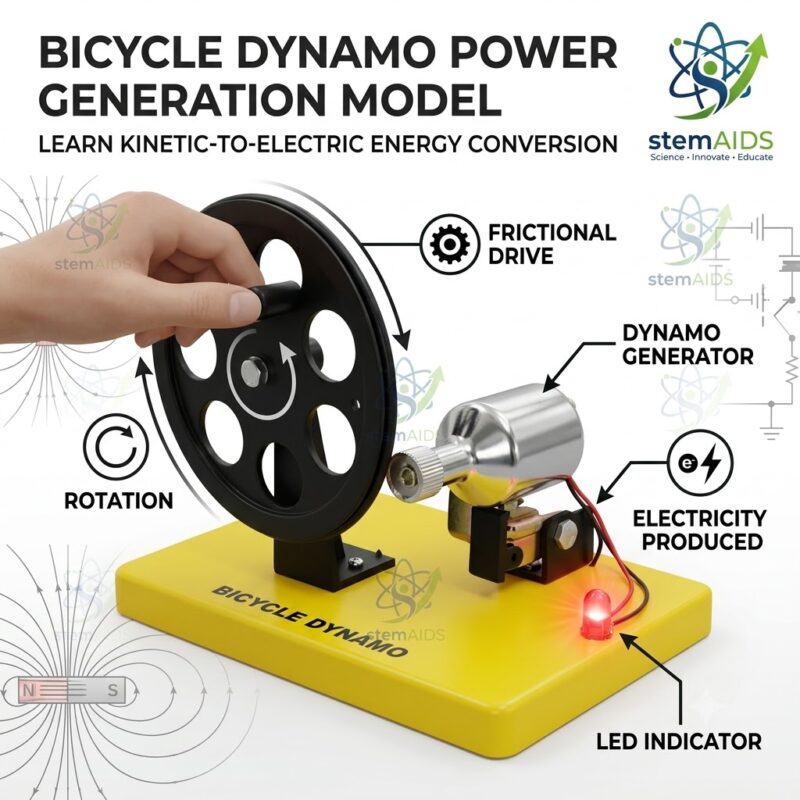
In the listing image the bicycle dynamo power generation model has a black spoked wheel with a handle, mounted upright on a yellow base, with a silver bottle dynamo pressed against its rim and wired to a small LED. Turning the handle spins the wheel, the wheel’s rim turns the dynamo’s small roller by friction, and the LED lights. Stop turning and the light goes out, which makes the link between motion and electricity immediate.
Inside a bottle dynamo, a permanent magnet spins within a coil of wire. As the magnet turns, the magnetic flux through the coil keeps changing, and by Faraday’s law an alternating voltage is induced. The faster the magnet spins, the faster the flux changes and the higher the voltage and frequency. Because the output is alternating, an LED on its own lights only during half of each cycle, which students may notice as flicker when the wheel turns slowly.
The friction drive is also a lesson in gearing. The wheel rim is much larger than the dynamo roller, so each turn of the wheel spins the roller many times, raising the magnet’s speed. Students can count turns, compare slow and fast cranking, and feel the wheel become harder to turn when the dynamo is lit.
Care & Handling
- Keep the dynamo roller pressed evenly against the rim; too much pressure wears the rim and roller.
- Turn the handle steadily rather than spinning it as fast as possible.
- Keep the rim and roller free of oil, which makes the friction drive slip.
- Check the LED leads and connections if the light becomes intermittent.
Specifications
| Item | Hand-driven bicycle dynamo demonstration |
| Drive | Spoked wheel with handle, friction drive to the dynamo roller (listing image) |
| Generator | Bottle-type bicycle dynamo |
| Output indicator | LED |
| Concepts | Electromagnetic induction, alternating current, energy transfer, gear ratio |
| Dynamo rating and wheel size | Confirm at enquiry |
Lessons and Investigations
- Demonstrating the conversion of kinetic energy into electrical energy
- Relating cranking speed to LED brightness and flicker
- Explaining alternating current and why an LED lights only one way
- Connecting an oscilloscope or voltmeter to observe the output
Why Choose LabEquip
Physics teachers use the bicycle dynamo because students already know the device from real bicycles, which makes induction feel familiar rather than abstract. LabEquip lists this model in its STEM kits range alongside the Energy Conversion Kit, which sets the generator next to solar and battery sources. Order through the contact page.
Frequently Asked Questions
How does a bicycle dynamo produce electricity?
A magnet inside the dynamo spins inside a coil of wire. The changing magnetic field through the coil induces a voltage, which drives a current through the lamp or LED. This is electromagnetic induction, discovered by Michael Faraday.
Why does the LED get brighter when the wheel turns faster?
Faster rotation changes the magnetic flux through the coil more rapidly, and the induced voltage is proportional to the rate of change. A larger voltage drives a larger current through the LED, so it glows more brightly.
Is the output AC or DC?
A bottle dynamo produces alternating current, because the magnet’s north and south poles pass the coil in turn. An LED conducts in one direction only, so it lights for half of each cycle; at low speed this shows as flicker.
Why does the wheel feel harder to turn when the LED is on?
When current flows, the coil’s own magnetic field opposes the spinning magnet, as described by Lenz’s law. The student must do extra work to keep the wheel turning, and that work becomes the electrical energy delivered to the LED.
Why is the dynamo driven by the rim rather than the hub?
The rim moves much faster than the hub. Driving the small roller from the rim spins the dynamo many times for each turn of the wheel, giving enough speed for a useful voltage, the same principle as a gear ratio.
Can the model charge a battery?
Not directly. The output is alternating and varies with speed, so charging would need a rectifier and a regulator. Discussing what would be needed is a useful extension for older students.
Last Updated: September 2026
You must be logged in to post a review.
Bestsellers

Sale

Sale
Sale


Reviews
There are no reviews yet.